The End of Ages Graph, 1: The 2005 Game as a Graph
Nearly three thousand fixed points under a world that can be walked
Part 1 of 2 in The End of Ages Graph


After Myst, Riven, Exile and Revelation, the fifth game seemed the least likely to make a graph. [Version of the game: Myst V: End of Ages, release 2.0.0.9 for Windows. The point labels are those of this release.] Myst V was made by Cyan Worlds on Plasma, the engine of Uru, and it draws its eight Ages in three dimensions, in real time. Its player can walk anywhere a floor allows. Yet the game also offers a mode in which a click moves the player from one place to the next, and those places are stored.
Drawn from them, Myst V is a graph:
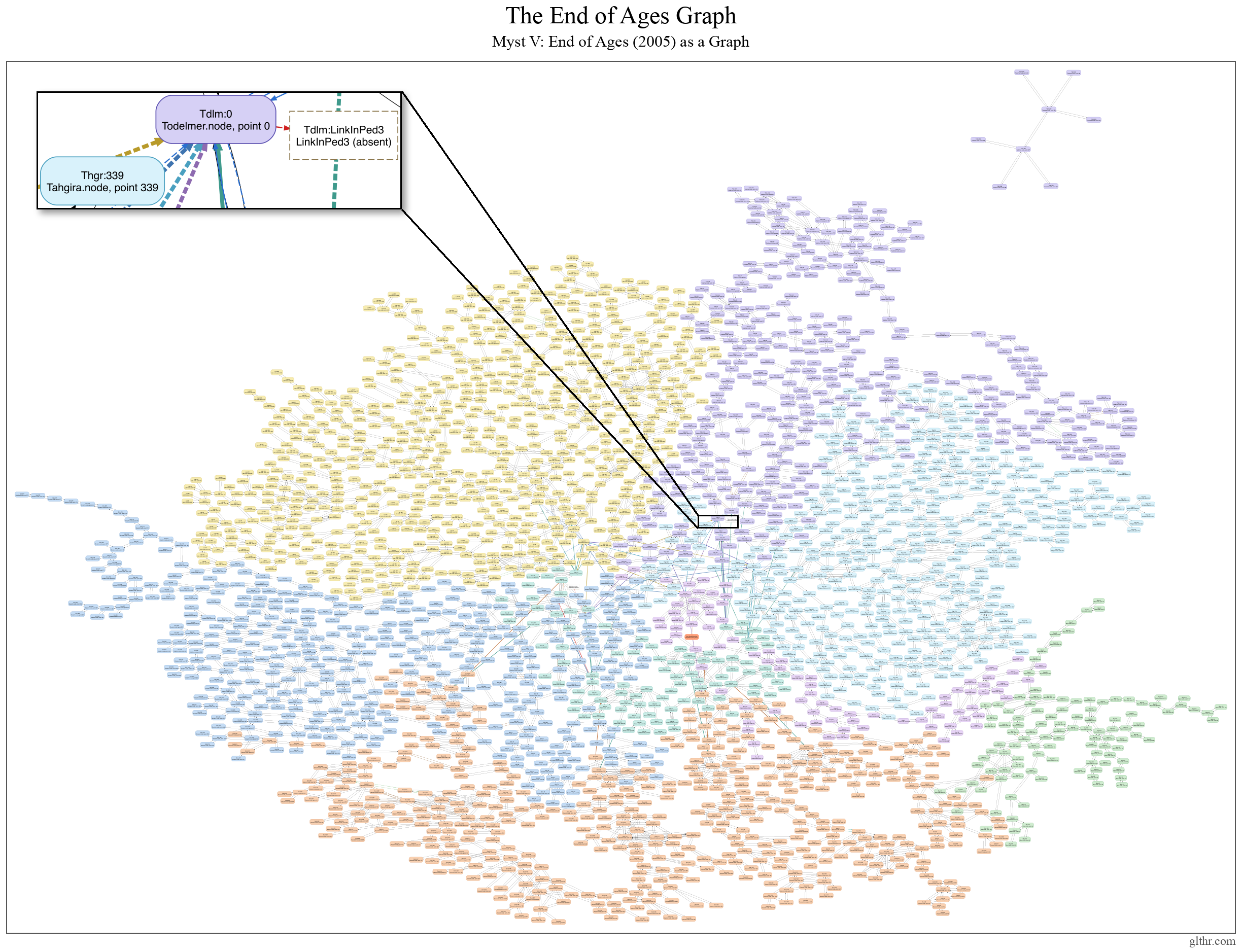
The 2,732 nodes and the moves between them, placed by Graphviz from the moves alone (the 12 moves that lead from a point to itself are not drawn): the points of an Age gather by themselves, and a thick line in the color of an Age is a link that leaves it. Magnified: one of the four links that can never open, to a spawn point that Todelmer names and does not have.
The End of Ages Graph can be explored in the browser, where any point can be found by its label, the points can be seen where the game stores them, on a map in three dimensions, and the shortest path between two points can be drawn.
Disclaimer
This is an unofficial, non-commercial study of Myst V: End of Ages (2005), independent of Cyan Worlds and its publisher. The game and its artwork remain the work of their creators. The analysis contains spoilers. It reads the released data without playing every state of the game: conditions are recorded as text, never evaluated, and the moves that are inferred rather than stored are marked as such.
Introduction
Roadmap
(1) In this article, I introduce the End of Ages Graph: what the game stores, what the graph draws, and how to read it. Free Roam, Compared then measures what walking reaches beyond the stored points, and How the Graph Was Created describes how the files were read.
(2) The second article looks at what the graph shows: an Age with no way back, eight points that nothing reaches, links that can never open, and how much of the game the state of the game holds back.
Three Ways to Move
Myst V offers three ways to move, which its options call Classic Mouse-Click, Classic Plus and Free-Move (Advanced); this article calls them Classic, Classic Plus and Free Roam. Inside the program, they are named Novice, NovicePlus and Expert.
- Classic: a click moves the player to the next fixed point.
- Classic Plus: the same fixed points, with the mouse free to look around.
- Free Roam: the keyboard walks the player anywhere on the floor.

The three modes, as the game’s options name them.
The graph is built from Classic mode only. Free Roam was not used to make it: its nodes are the fixed points that Classic mode stores, and its arrows are the moves that the data names. Walking is compared with the graph below, as far as the data allows.
One File of Points per Age
Each playable Age has a file named after it, such as Kveer.node. I found no published description of these files, and libHSPlasma, the open-source library for Cyan’s engine, does not read them. Deciphered (see below), each is a plain list: a version number, then each point with its position, then its links. A link names another point of the same file, a type from 0 to 4, and a vector.
| Age | File | Points | Stored links |
|---|---|---|---|
| K’veer | Kveer.node | 89 | 226 |
| Descent | Descent.node | 480 | 1,392 |
| Direbo | Direbo.node | 100 | 264 |
| Laki’ahn | Laki.node | 711 | 1,684 |
| Noloben (internal name: Siralehn) | Siralehn.node | 430 | 1,110 |
| Tahgira | Tahgira.node | 442 | 1,094 |
| Todelmer | Todelmer.node | 363 | 846 |
| Myst | Myst.node | 114 | 262 |
| Total | 2,729 | 6,878 |
Every link has its way back: apart from six links of Laki’ahn that point to their own point, the stored links form 3,436 pairs. The program loads each file into a component it calls the node manager, and, in Classic mode, its scripts “send player to closest node” after a ride, a scene or an elevator.


The 89 points of Kveer.node, each at its stored position, and the moves between them. The ringed point, Kver:4, is where a new game begins.
The points are not abstract. In all eight Ages, their median height above the floor that Free Roam walks on is 3.0 units, and 2,379 of the 2,537 points over a static floor lie within 0.2 units of that median height. Classic mode moves the player over the same floor, only from one stored position to the next.


Height above the walkable floor for 2,537 Classic points. Dots mark the median, 3.00 units in every Age. Bars show the middle 80% of points. The axis is zoomed to 2.90–3.20 units so these small differences remain visible.
What Is in This Graph?
2,732 nodes. The 2,729 Classic points, and three nodes that the data names without a point: two spawn points that a pedestal links to and the Age does not have (drawn as dashed white boxes), and Releeshahn, the place of the final scene (WarpReleeshan in the data), which has no Classic point (a sink: no move leaves it).
7,024 edges, in seven kinds:


The seven kinds of move, each with a real pair of points, drawn as the graph draws it. The Classic moves are the stored links; the others were read in the pages and scripts of each Age.
The 6,878 stored links give 6,876 Classic moves: two of the links of Laki’ahn that point to their own point are exact repeats, kept once. Of the other kinds, 88 moves depend on the state of the game: a book found, a pedestal activated, a ladder unrolled, a platform at a level, a scene not yet seen. Four of them can never open.
Basic Properties of the End of Ages Graph
Point labels such as Kver:4 have a thick underline, in the color of their Age, and open that point in the graph browser.
Nodes and Edges
The eight Ages are of very different sizes: Laki’ahn has 711 points, K’veer 89. Each point has between one and fifteen neighbors; the busiest, Srln:191 in Noloben, has fifteen.
Between the Ages, 52 moves: 47 links and 5 links made by scripts. Direbo is the hub: four links come from Descent and four go back, and from Direbo, links lead to each of the four Ages of the slates.
Paths
A new game starts at Kver:4, in K’veer. Taking every condition as met, but for the four links that can never open, a path reaches 2,722 of the 2,732 nodes. The farthest points, three of Todelmer such as Tdlm:333, are 59 moves away, and the longest of all shortest paths takes 88 moves. Using only unconditional moves and the introduction’s scripted link to Descent, a path reaches only 1,516 nodes. The second article follows these paths.
Pieces
Inside an Age, the Classic links do not always join every point. K’veer, Direbo and Myst are each one piece; Descent, Laki’ahn and Noloben have five, Tahgira four, and Todelmer nine. Ladders, elevators, rides on moving platforms and links inside an Age join the pieces.
Legend: How to Read the Graph
Labels. A point is named by the four-letter prefix that the game itself gives its Age in its names (Kver for K’veer, Dsnt for Descent, Drbo for Direbo, Laki for Laki’ahn, Srln for Noloben, whose files are named Siralehn, Thgr for Tahgira, Tdlm for Todelmer, and Myst), then its index in the Age’s file, counted from 0: Kver:4 is the fifth point of Kveer.node. Each box shows the full name below the label, such as “Kveer.node, point 4”; the browser also gives the spawn points that stand within 6 units.
Boxes. Each node is a rounded box in the color of its Age, with its label and, below it, its full name. Releeshahn, which no move leaves, is a sink and has the salmon of the sinks of the other graphs; the two spawn points that the Ages do not have are dashed white boxes.
Arrows. A Classic move is a thin black arrow. The other kinds have their own colors (see the table above): a link, blue; a scripted link, thick dashed purple; a recorded scene, orange; a warp, teal; a ladder, brown; a ride, green. A move between two Ages is a thick line in the color of the Age it leaves. A dashed line is conditional; a red one can never open.
Positions. In the graph, Graphviz places the boxes from the moves alone, as in the other graphs: the points of an Age gather by themselves, and where a box stands says nothing of the place in the game. As in Revelation, the first game in the series to store node positions, the coordinates that Myst V stores are drawn by the maps of these articles, each Age from above, in its own axes and at its own scale (a ringed point is the start of a new game), and by the Map in 3D of the browser, which also sets the eight Ages in one scene. The game keeps each Age apart and does not say where one Age lies from another: that scene is a choice of the browser.
Free Roam, Compared
A graph built from Classic mode owes Free Roam an account of what walking adds. The collision objects of the eight Ages are stored with them: 1,598 objects, all read. From the fixed meshes among them, the floor is every surface that faces up enough to stand on, and the floor that Free Roam reaches is what a walker reaches from the floors under the Classic points, a step of 1.6 units at a time, stopped by walls and by the invisible walls that block the player. Only the points that stand at the usual height above the floor found under them, within a step, take part: 2,481 of the 2,537 that have a floor under them. The 56 others stand higher or lower, on something that the floor model leaves out, such as a platform, or over a surface that is not their floor.
A part of that floor is “Free Roam only” when it lies more than 15 units, seen from above, from every Classic point at a similar height:


The floor that Free Roam reaches, and the part of it far from every Classic point, per Age.
| Age | Floor reached (square units) | Free Roam only | Share |
|---|---|---|---|
| K’veer | 20,322 | 2,029 | 10% |
| Descent | 125,712 | 28,517 | 23% |
| Direbo | 18,172 | 419 | 2% |
| Laki’ahn | 634,312 | 452,011 | 71% |
| Noloben | 533,023 | 408,604 | 77% |
| Tahgira | 199,249 | 75,443 | 38% |
| Todelmer | 74,274 | 13,718 | 18% |
| Myst | 16,581 | 2,489 | 15% |
The compact Ages are almost covered by Classic mode: Direbo, K’veer and Myst. The open Ages are not: the beaches of Laki’ahn and Noloben and the ice fields of Tahgira are wide floors that Classic mode crosses along a few paths.
Free Roam can also shorten a path. Between two points of the same Age, the walk that Classic mode imposes is, at the median, between 1.3 times the straight line (Direbo, Tahgira) and 3.1 times (Noloben). Some pairs stand close and are far apart by Classic mode, with a straight walk between them on the floor: 94 such pairs are candidates for a shortcut.


Thgr:222 and Thgr:223 stand 7.0 units apart, at the same height. Classic mode joins them in 2 moves, 107 units long, through the hub Thgr:191; in the game, on foot, half a second on the Up arrow carries the player from one to the other.
Classic mode takes the scenic route.
These remain candidates: the floor model leaves out doors, gates and moving platforms, which are not static, and the collision objects shaped as boxes or spheres; it ignores jumps and falls. A candidate may cross a closed door. In the game, I tested six pairs at the same height on foot: five were walked straight across, and the sixth had an unobstructed path as far as I tested it.
How the Graph Was Created
Encrypted Files and a Published Key
Myst V encrypts many of its files, among them the descriptions of its Ages and their settings, its scripts, its subtitles and the .node files. Each begins with the same four bytes, the size of the plain data, then the data in AES-128. The key is published by libHSPlasma, the open-source library of the community that keeps Cyan’s engine alive, which reads Myst V among other games. The pages that hold the objects of each Age are not encrypted.
Links, Ladders, Rides and Scenes
The Classic moves are the stored links. The others were found in the objects of each Age and in its scripts:
- Links are messages that send the player to a spawn point of an Age: fifty such messages, in the responders of the Ages, give 55 links, and the script that handles the Bahro and the slates makes the other 30, read in its compiled code. A link starts at the point nearest to what the player clicks and ends at the point nearest to its spawn point.
- Links made by a script: the one that takes a new player from K’veer to Descent after Yeesha’s introduction, and the four that bring the player back to K’veer once the four slates rest on their Keeps.
- Ladders: 15, read in their objects, up and down.
- Warps: Descent’s two elevators, and in Tahgira, the crack in the ice and the fall through it.
- Scenes: eight recorded scenes move the player; twenty others leave the player where they start and are attached to their point.
- Rides on moving platforms (14): Descent’s rising floor, Laki’ahn’s arena pedestal, maze pillar and three-level cage, and Todelmer’s tram. These are inferred, not stored: they join the points that stand on the platform’s axis.
What Is Inferred
Three things are not read but deduced, and the data says which: the fourteen rides, the point where a link starts or ends (the nearest one, as the game’s own scripts do after a move), and the meaning of the conditions, which are kept as the text that names them.
Was Everything Read?
Two kinds of object that only Myst V has are only partly read. The first holds no list of points: it is a box, and a script of its Age turns the Classic points inside it on and off with the state of the game (the scripts call them novice nodes). There are 21 such boxes, in six Ages: K’veer with or without Yeesha, Descent’s shaft, Laki’ahn’s cage, Noloben’s tunnels, Tahgira’s water field, and Todelmer’s third dock and two of its pillars. Three of the seven scripts kept a shortcut with which the developers did it by hand: “Faking like the tram is docked at Pillar 3. Enabling Novice Nodes there.” (Behind the Ages shows how to call one.) The second kind moves the elevators; it was not decoded. The meaning of the five types of Classic link is not proven either: type 4 joins short pairs of points, always in both directions, which may be the steps to the left and to the right that the program names. Eight points of Todelmer are reached by nothing that was decoded: the second article returns to them.
Conclusion
Myst V can be walked, and it was not built to be drawn as a graph. Its Classic mode nevertheless rests on 2,729 points that the game keeps, most of them at the same height above the floor, with every move between them. The End of Ages Graph draws that skeleton, and measures what walking adds to it: little in the interiors, most of the floor on the open islands.