The Exile Graph, 2: The Places Nothing Leads To
An ending behind a book, panoramas that nothing selects, and rooms left in the program
Part 2 of 2 in The Exile Graph


Introduction
The Exile Graph, introduced in the previous article, draws the 820 places of Myst III: Exile and the references between them. [Version of the game: Myst III: Exile 1.0, the original English four-CD release, May 2001. The node numbers are those of this release.] As with Myst and Riven, I now look at what the graph shows that playing does not. To my knowledge, the findings presented here are new, except where I credit earlier work. Any node named below can be found in the explorable graph, where each link of this article opens the node it names.
Visual Indicators
I keep the two indicators of the Myst findings. A crossed-out eye on a view means that the game never displays it: the node that holds it cannot be reached, or the picture is one that no script selects. An open eye means that the view is displayed in the game. [Node labels such as LEIS:1 have a thick underline, in the color of their Age, and open that node in the graph browser.]
As in Riven, a node and its picture are different things: a node can select among several panoramas, and a panorama can be stored without any node to show it. A crossed-out eye applies to the view where it is drawn. The caption says which of the two cases applies.
A panorama is shown unrolled, twice as wide as it is high, with the heading 0 at its center. Edges under discussion are drawn in red, as in the Myst and Riven figures.
Disclaimer
The disclaimer of the first article applies. This article contains spoilers for the game, including its endings.
General
Shortest Theoretical Path
From the first view of the game (TOHO:101) to the arrival in Narayan (NACH:11), the theoretical minimum distance is 23 edges:
TOHO:101 → TOHO:1 → TOHO:2 → TOHO:4 → TOHO:5 → TOHO:6 → TOHO:506 → TOHO:606 → LEIS:3 → LEIS:4 → LEIS:5 → LEIS:6 → LEIS:7 → LEIS:74 → LEIS:75 → LEIS:175 → LEOS:1 → LEOS:2 → LEOS:3 → LEOS:4 → LEOS:5 → LEOS:105 → LEOS:205 → NACH:11.
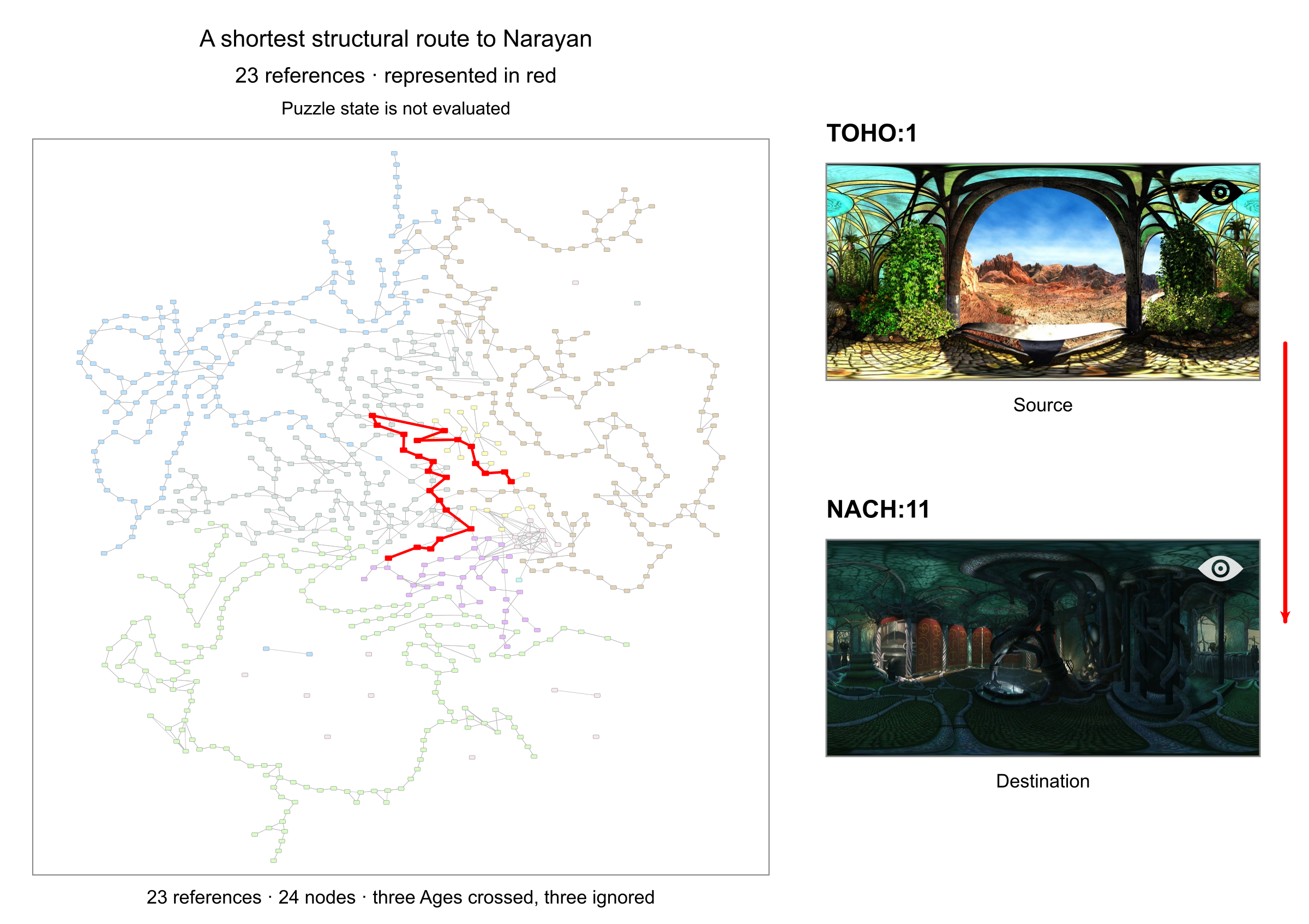
The route crosses three Ages and ignores three others. It goes from Atrus’s study to J’nanin, walks up to the observatory, and takes the last book. In the graph, Voltaic, Amateria and Edanna are detours. What makes them necessary is everything that the graph leaves out: the door of the observatory, and the three symbols that must be brought back to open the way to Narayan. In Myst, the same distance was 24 edges; in Riven, 3. As explained in the first article, a path in the graph is a distance between places, never a way to finish the game.
The Way Home Is in the Inventory
Arriving in Narayan is not finishing the game. The good ending takes place in Tomahna, and here the graph has a surprise: no path leads from the first view to the last one.
The return is a linking book, and the player carries it. The Tomahna book lies on a stand of vines in Narayan (NACH:20), where a click puts it in the inventory:

NACH:20 in version 1.27 of the game, before and after one click.
Using the book opens NACH:220, the closed book, from wherever the player stands. This is done by the engine, as for the journals. The script of the game takes over from there: NACH:220 → NACH:320, the open book → NACH:420, the link → TOHB:1, back in Tomahna.
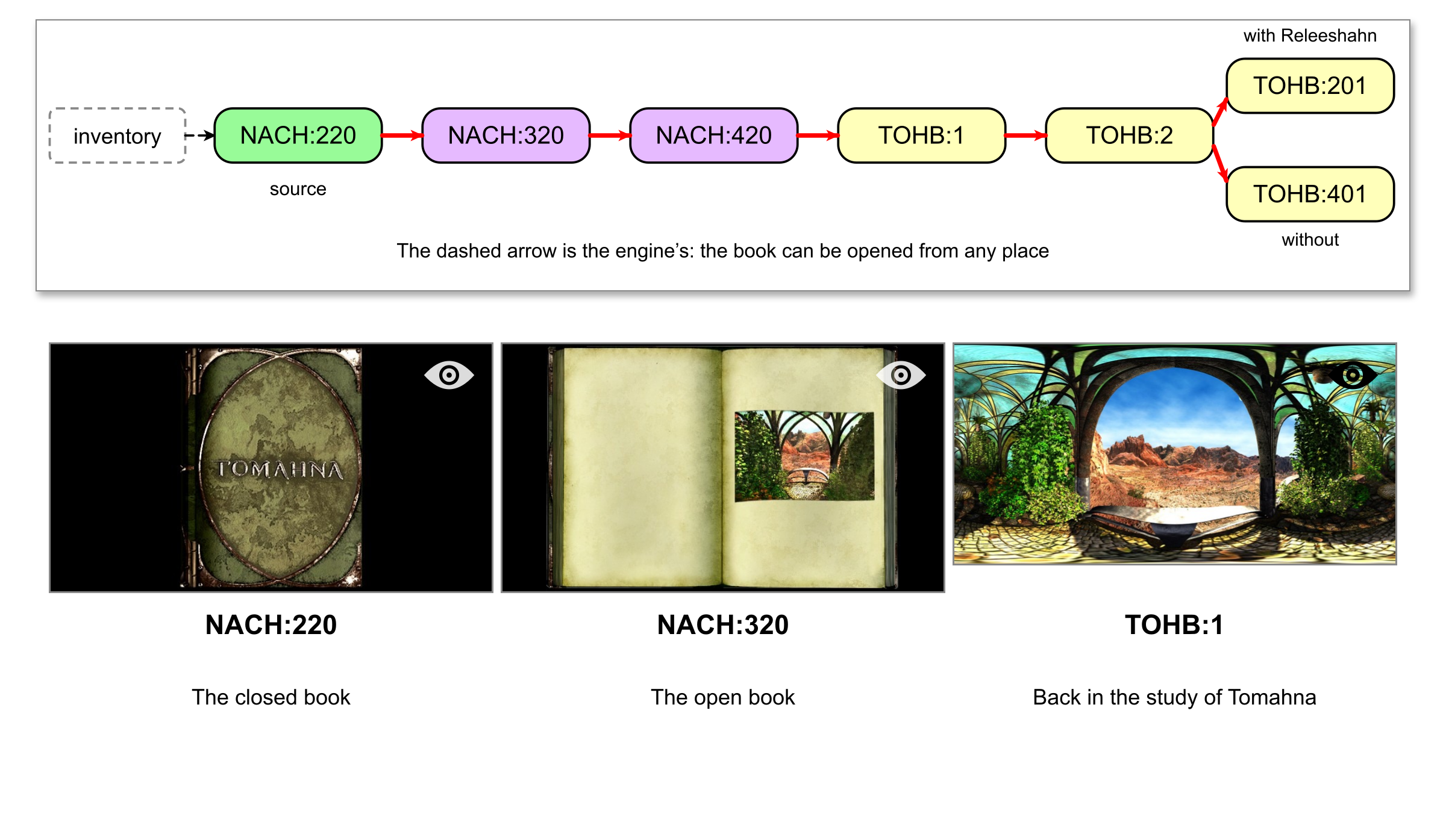
The last steps of the game start at a source node. The dashed arrow is the engine’s, and the graph does not draw it.
NACH:220 is therefore a source node, and the whole return to Tomahna hangs from it: seven nodes that the first view does not reach, among them the ending that the game is played for.
TOHB:2 is where these endings part. Its script, which runs by itself, plays one of three movies, according to the variable that records what became of Saavedro and to whether the book of Releeshahn is in the inventory. Two of the movies lead to TOHB:401, and from there to a dialog. The third, which needs the book, leads to TOHB:201, then TOHB:301, then the credits. A single node holds the three outcomes, as Temple:137 held four in Riven.
The endings that fail in Narayan itself go to NACH:998, then to the same dialog. Its three answers are in the script: start again from the observatory of J’nanin (LEOS:4), with the variables of Narayan set back; load a saved game; or go back to the main menu. In the game, it says “You failed to save Releeshahn.”

The dialog of the endings that fail, in version 1.27. “TRY AGAIN” leads to LEOS:4.
Longest Shortest Theoretical Path
The most distant nodes are separated by 189 edges (125 in Riven, 130 in Myst). Three pairs are that far apart: they go from the electromagnet of Voltaic (ENEM:19, ENEM:118 and ENEM:120) to the last node of Edanna (LINE:103), in the nest from which the player links back to J’nanin.
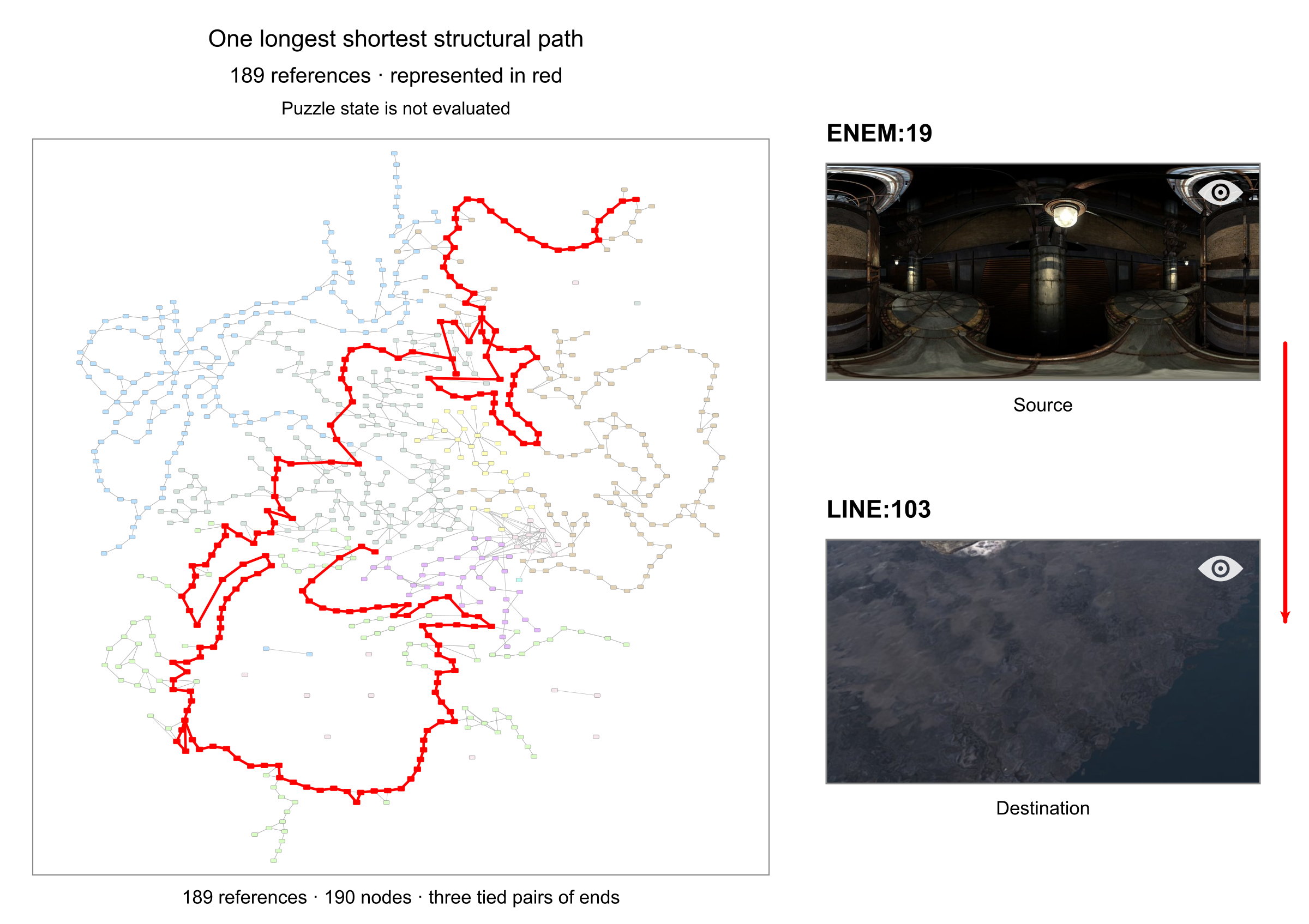
Starting from the first view of the game, the farthest node is the same one, 130 edges away. By coincidence, 130 is also the longest distance of the Myst Graph.
The length says something about how the Ages are built. Edanna is a descent: the player goes down a hollow tree, from the top to the swamp and back up to a nest, and almost every step has only one continuation. A walk of that kind is long in a graph, whatever its length in minutes.
The Places That No Route Avoids
A graph can also say which places are unavoidable. A node dominates another when every route from the start to the second passes through the first.
The beginning of Exile is a corridor. Of the 796 other nodes that can be reached from the first view, 773 are dominated by one chain: TOHO:1, TOHO:2, TOHO:4, TOHO:5, TOHO:6, TOHO:506, TOHO:606 and LEIS:3. They are the study, the desk on which the book of J’nanin lies, and the arrival on the island. Before them lie the rooms of Tomahna. Beyond them lies the rest of the game.
The Ages are corridors too. The route to the farthest node, LINE:103, is 130 edges long, and 111 of its nodes are unavoidable. In Riven, the route to the farthest card was 116 edges long, and 36 of its cards were unavoidable. Riven’s islands are joined in a ring. Exile’s Ages are entered at one end and left at the other.
What Zip Mode Buys
Exile keeps the Zip mode of Myst and Riven: once a place has been visited, a click on it in the distance goes there at once. The graph draws these shortcuts in a separate layer. There are 183 of them, from 116 nodes to 111 places.
| Without Zip | With every shortcut | |
|---|---|---|
| Longest shortest path | 189 | 115 |
| Average distance between two nodes | 58.0 | 35.1 |
| Farthest node from the start | 130 | 97 |
A shortcut replaces 4.25 edges on average and 14 at most (from ENCH:78 to ENCH:61, in Voltaic). Taken together, they shorten Exile by about 40%, as they did in Riven.
Few Hubs
Leaving the main menu and its links aside, no place of Exile has more than seven neighbors. The most connected are LEOF:8, in J’nanin, and TOHO:7, in Tomahna, with seven incoming and seven outgoing edges each. The stone circle of Riven had thirteen and ten.
A panorama needs fewer connections than a card. One place leads to the few places that can be seen from it, and the looking around is done without the graph.
Between the Ages
A Hub and Three Returns
Thirty-three pairs of nodes join two different Ages. Leaving aside the menus and the endings, twelve remain, and they draw the whole plan of the game.
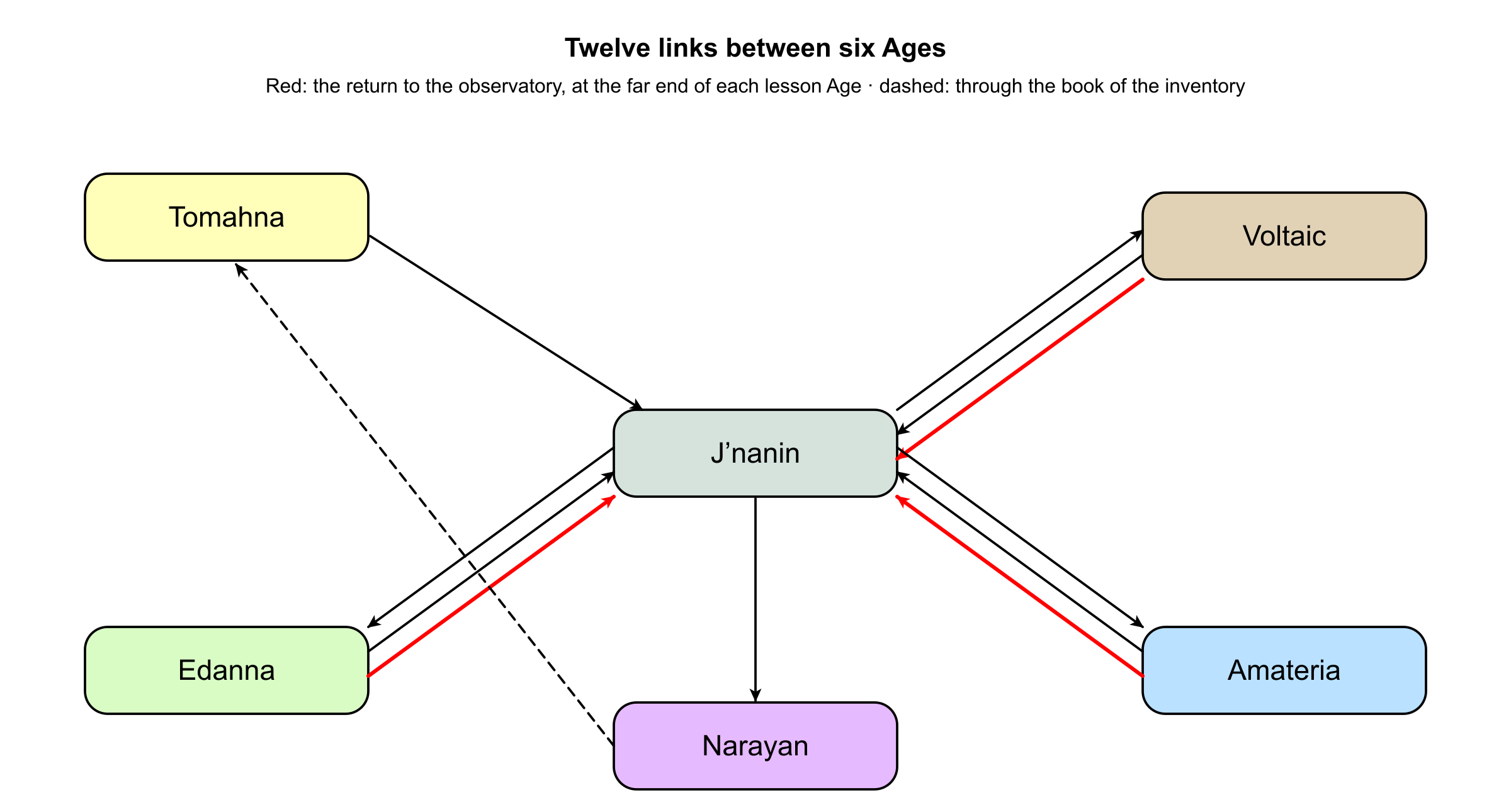
Twelve links between six Ages. Each of the three lesson Ages has two ways back: one to its tusk, one to the observatory.
TOHO:606 → LEIS:3 leaves Tomahna for J’nanin. Each of the three tusks of J’nanin holds a book: LEET:602 → ENSI:1 for Voltaic, LEMT:912 → MAIS:5 for Amateria, and LELT:602 → LIDR:2 for Edanna.
Each of these Ages then has two ways back. One returns to the tusk: ENSI:107 → LEET:101, MAIS:102 → LEMT:11 and LIDR:130 → LELT:101. The other, at the far end of the Age, returns to the observatory: ENLI:127, MATO:112 and LINE:103 all lead to LEOS:2.
The observatory then leads to Narayan (LEOS:205 → NACH:11), and Narayan to Tomahna, by the book of the inventory.
Journals Outside the Graph
JRNL:100, JRNL:200 and JRNL:300 are isolated nodes: the journal of Atrus, the journal of Saavedro and the book of Releeshahn. The player reads them throughout the game.
Like the Tomahna book, they are opened from the inventory by the engine, and closing them goes back to the place where they were opened, whichever it was. Drawing these returns as edges would join every place of the game to every other through a book, so the graph leaves them out and notes them beside the node, just as with the journals of Riven. An isolated node is not necessarily an unreachable one.
Places That Nothing Leads To
Five places of the released Ages have no incoming edge at all, of any kind, and no engine routine that enters them.
A Corner of Edanna in Gray
LISW:40 is a panorama of the swamp of Edanna. It leads to LISW:39 and to LIFO:1, the first node of the forest. Nothing leads to it: from LISW:39, the player goes straight to the forest.
Its picture explains why. Most of it is gray. The walls of the cave are flat, untextured surfaces, and only a few objects carry their final materials.
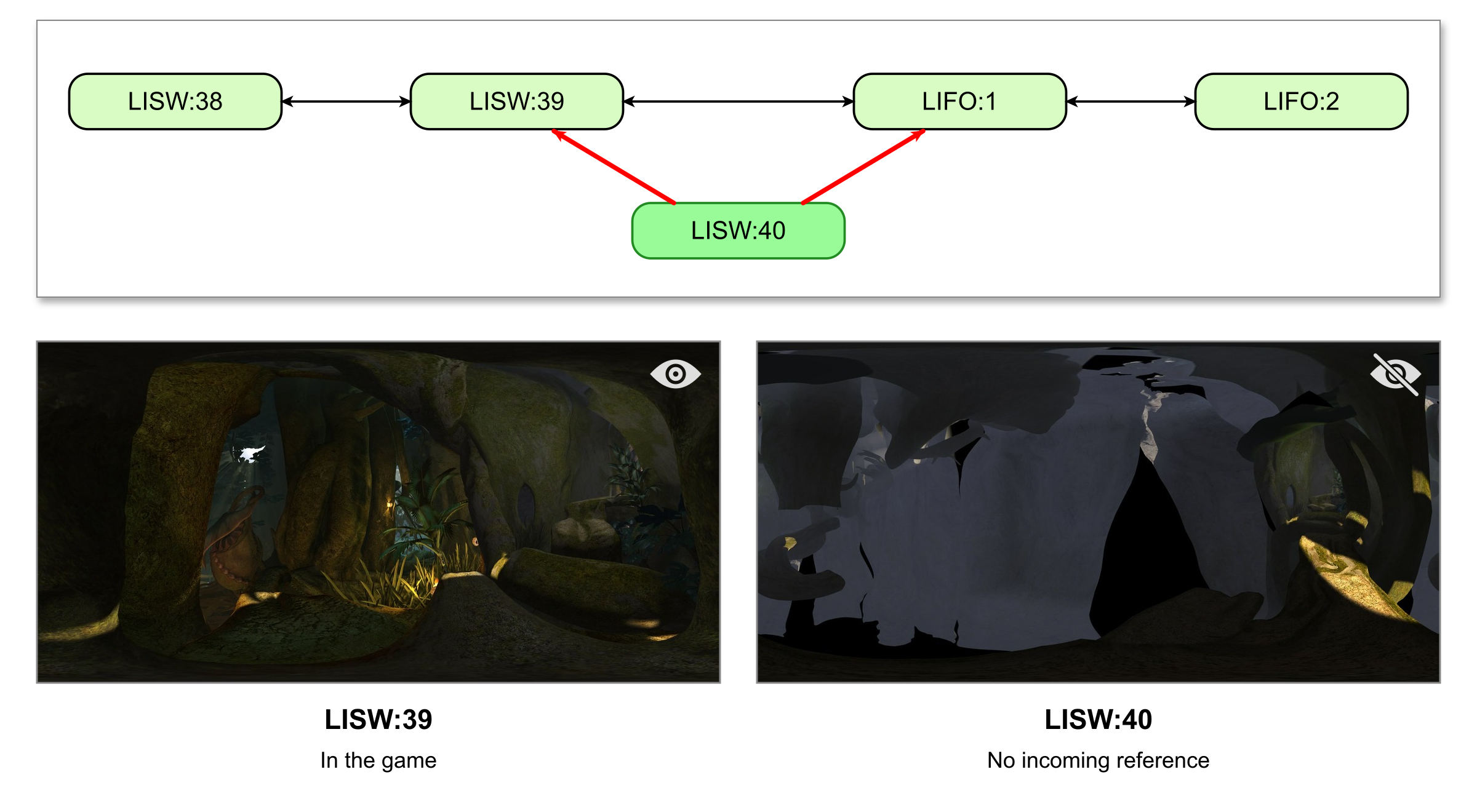
LISW:40 has two exits and no entrance. Its panorama looks like a render made before the place was finished.
The node was scripted like its neighbors, with two zones and its sounds, and then left out of the route. Its picture was not finished, or not replaced. It is on the fourth disc of every copy of the game.
A Node Replaced by a Variable
MATO:203 stands in the tower of Amateria, at the same spot as MATO:3. Both lead to MATO:2 and MATO:4. Nothing leads to MATO:203.
Its panorama is not hidden, though, and this is where a node and its picture part ways. MATO:3 holds four panoramas, for two things that change around the player: a flight of steps, lowered by a movie when the player arrives, and a wooden panel that a click opens on the night outside. Its script picks one of the four from two variables. The one with the steps lowered and the panel open is panorama 203: the panorama of MATO:203.
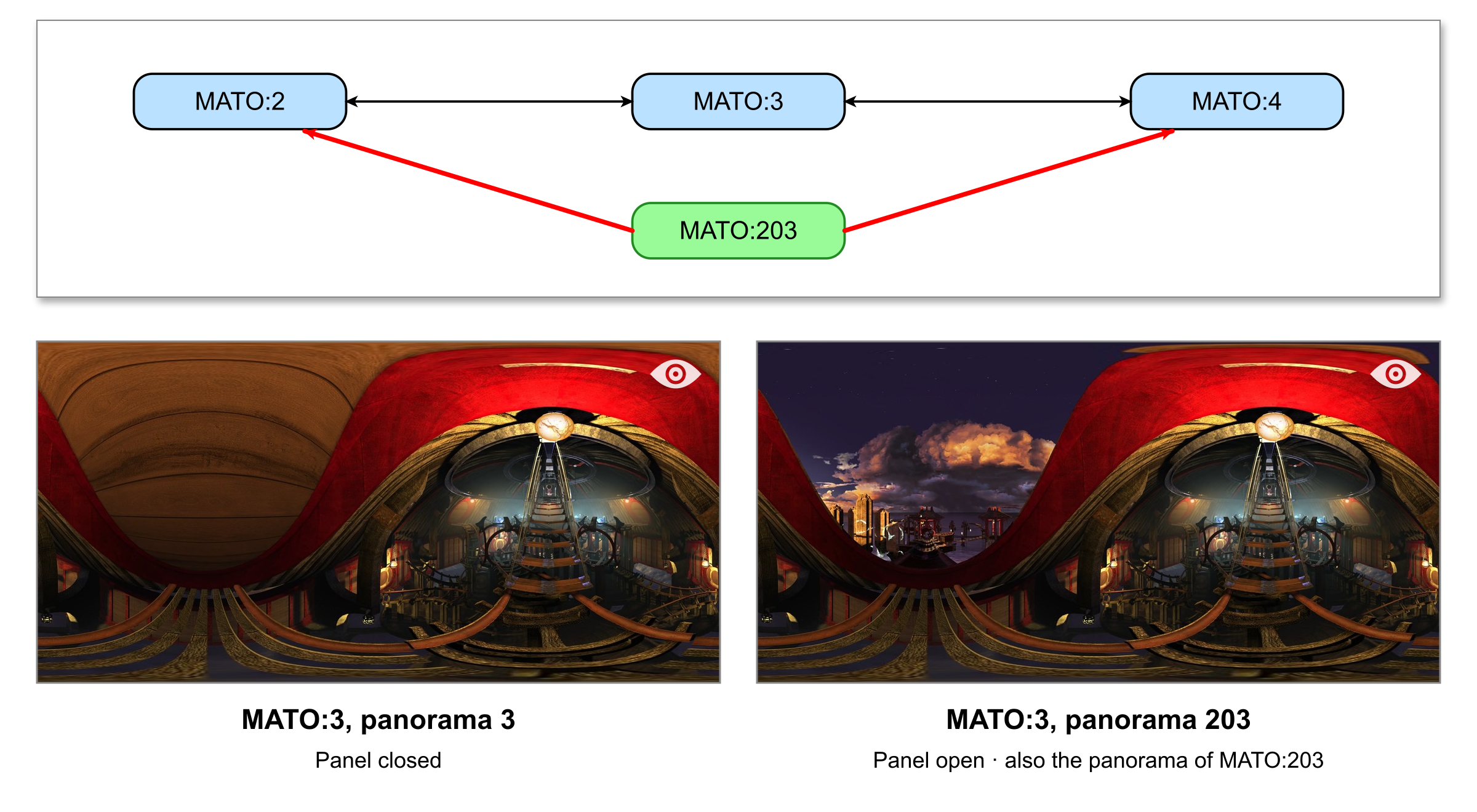
MATO:3 shows the open panel itself. MATO:203 holds the same panorama and is never entered.
The scripts show how the place works in the game. On MATO:3, a first click on the panel sets a variable and plays a movie: the panel opens, and the node is drawn again with panorama 203. A second click on the same zone walks out to MATO:2. The player never leaves the node while the panel moves. In version 1.27, once the panel is open, the box of the developers’ mode still names MATO:3:

The panel of MATO:3 open, after one click. The box gives the place where the player stands.
MATO:203 is the same state written as a node: panorama 203, the way out to MATO:2 where the panel was, and the way on to MATO:4. It looks like the first way of doing it, in which opening the panel led to another node, before the variable took over. The node stayed in the program, and still does in version 1.27. As with two cards of Riven’s Jungle Island, an unreachable node does not make an unseen picture.
A Close-Up That No Hotspot Opens
ENPP:110 is a frame of the power plant of Voltaic: a round opening in a wooden wall. Its only zone covers the whole picture and goes back to ENPP:10. By its number, it is the close-up of that node, and ENPP:10 has no zone that leads to it.
The frame even has two pictures, selected by a variable, and two movies. All of this was prepared, and the hotspot that would open it is not in the node.
A View of the Waterfall Without Any Zone
LEIS:86 is isolated: nothing leads to it, and it leads nowhere. Its script draws a panorama of J’nanin, beside a waterfall, and stops there. It has no zone.
Its neighbor by number, LEIS:85, shows almost the same view and belongs to the game. LEIS:86 looks like one standpoint too many on that path.
A Node That Is Not There
MAIS:20 is the fifth of these places, and the strangest. Its script draws panorama 20 of the room, and the archive holds no panorama 20. Its only zone leads to MAIS:21, and the room has no node 21.
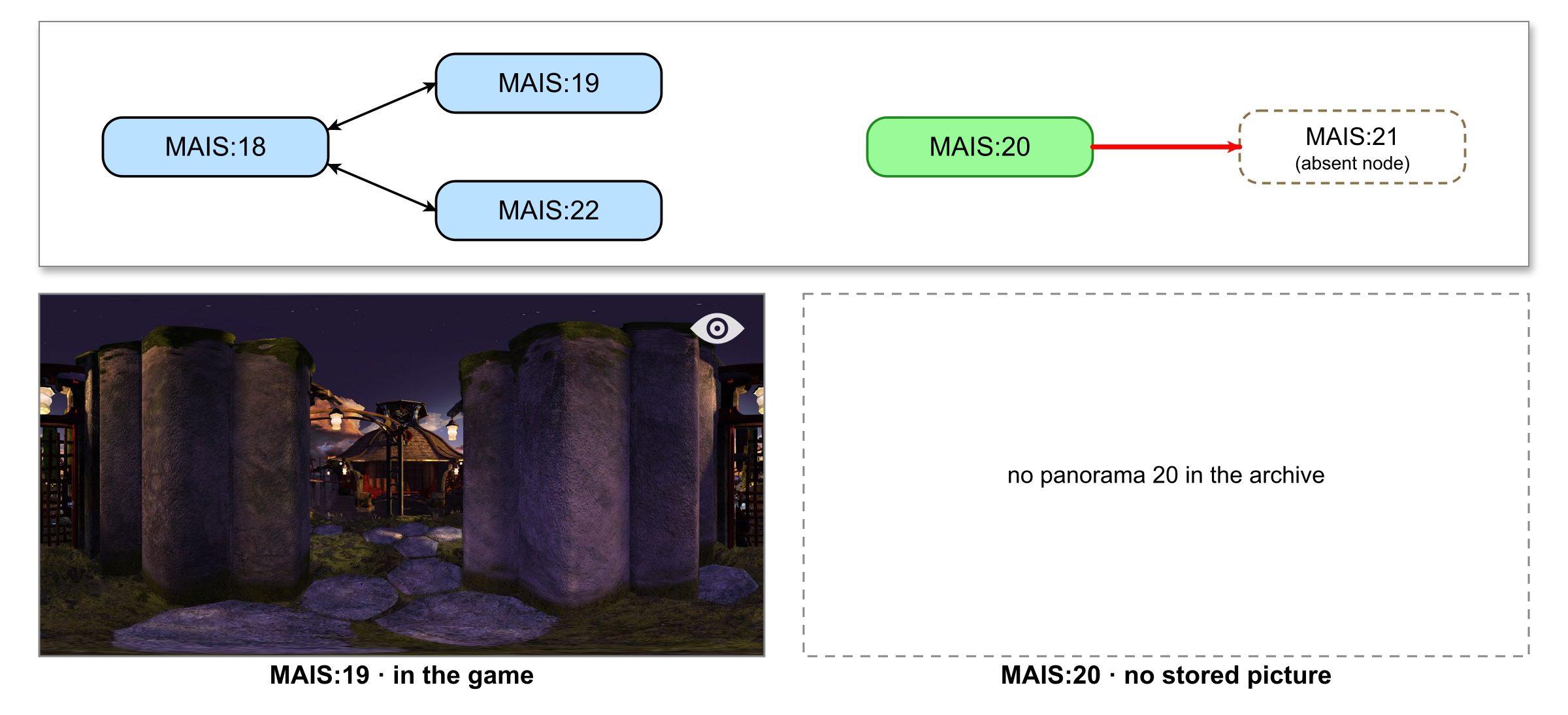
A node without a picture leads to a node without a script.
The numbers around them exist: MAIS:19 and MAIS:22 are ordinary places of Amateria. Two standpoints were removed from the path between them. One left its script, the other left only its number.
A player cannot reach MAIS:20, which is fortunate. Asked for it through the developers’ mode, the original program displays “Unable to locate JPEG face ID # 20,0” and quits.
Panoramas That Nothing Selects
The archives of the four discs hold 904 panoramas. The scripts can select 894 of them (leaving aside the seven panoramas named in the program without files on the discs). Ten are stored and never asked for.
The Lava Chamber Without Its Lava
In Voltaic, ENLC:9 and ENLC:10 are two places of a chamber lit by lava. Each selects one of two panoramas, numbered 109 and 209, or 110 and 210, according to a variable. Neither ever selects the panoramas numbered 9 and 10, which the archive also holds.
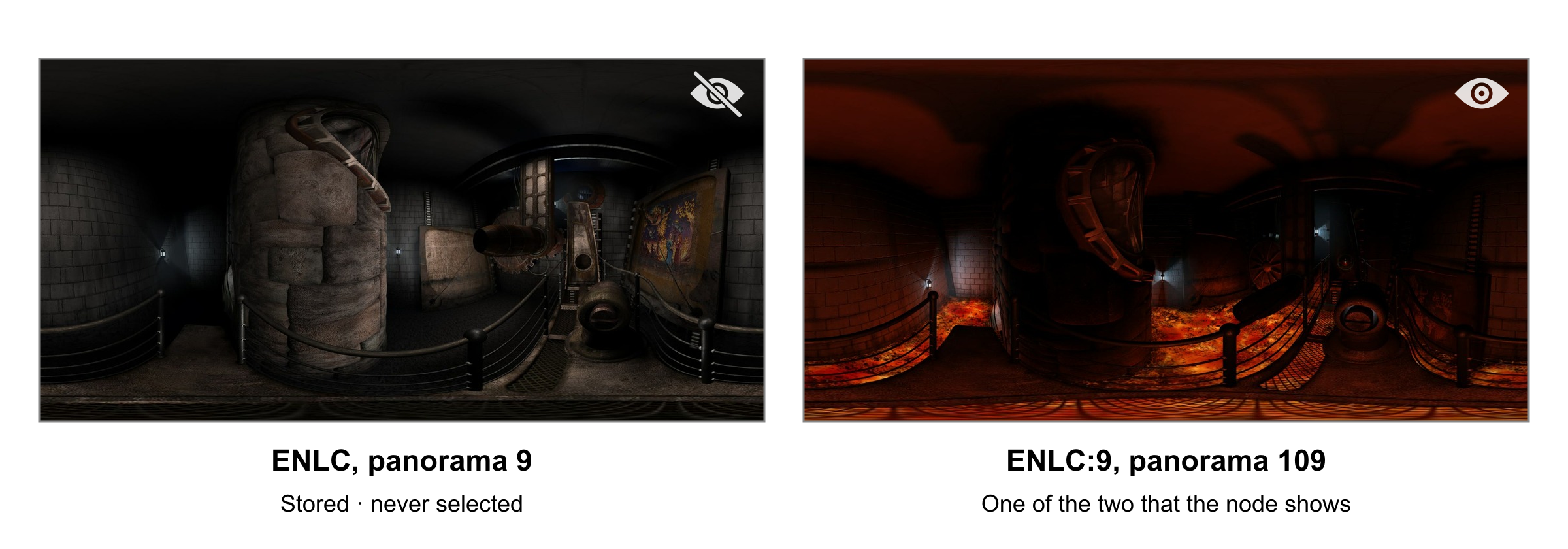
Panorama 9 of the room ENLC, which nothing selects, and panorama 109, one of the two that ENLC:9 shows.
The unselected pictures show the chamber without lava, in a neutral light. In the game, the player never sees it that way from these two places: both states of the variable show the red glow. A lava chamber, rendered without its lava, and then left without a branch of script to ever show it dry.
Four Places Rendered Twice
In the forest of Edanna, LIFO:47, LIFO:48, LIFO:49 and LIFO:52 select the panoramas 147, 148, 149 and 152. The panoramas 47, 48, 49 and 52 are stored too, and never selected.
Each unselected panorama differs from the selected one in one face out of six, and only in a small part of it. The five other faces are the same files, byte for byte.
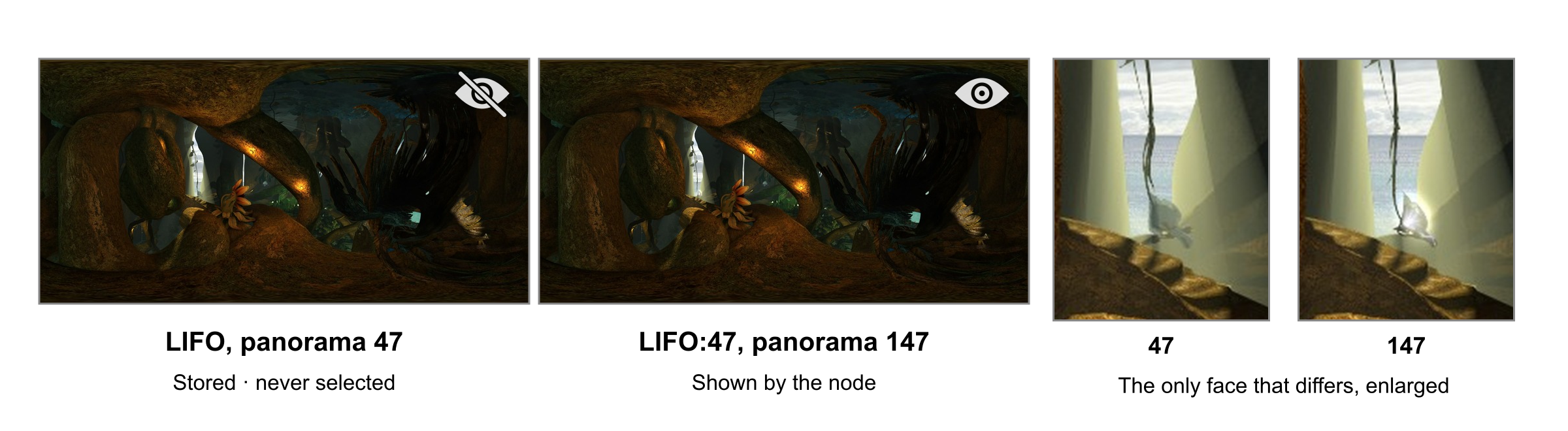
Panorama 47 and its replacement, and the one spot where they differ.
One direction of view was rendered again for each of the four places, and the new pictures were stored under new numbers rather than over the old ones. It is the same story as the bridge of Temple:236 in Riven: the first picture stayed in the files.
Four Panoramas Without a Node
The last four have no node at all. No script of the room carries their number.
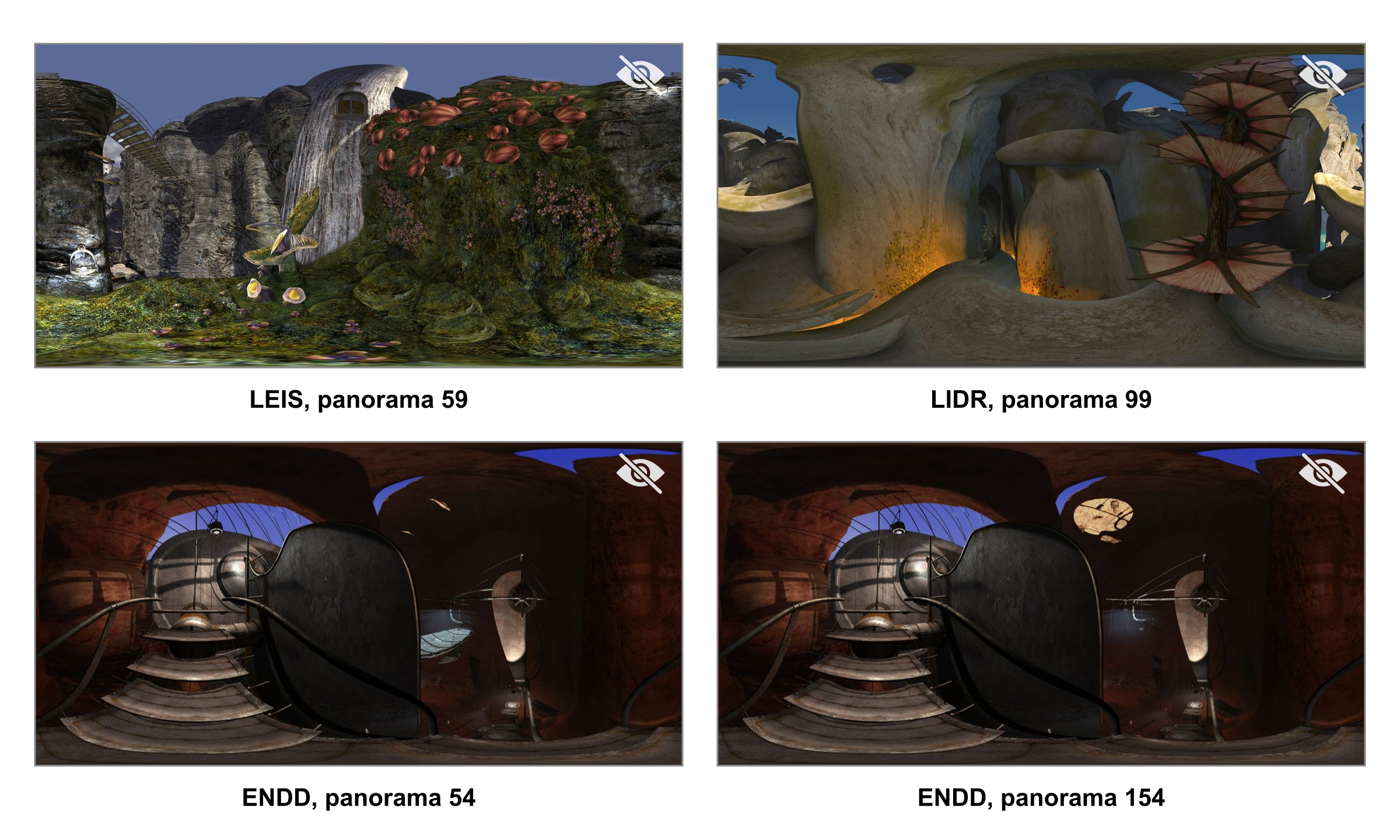
Stored on the discs, numbered like nodes, and absent from the program.
Panorama 59 of LEIS is a bank of J’nanin, near the waterfall of LEIS:86. Panorama 99 of LIDR is a hollow of Edanna. Panoramas 54 and 154 of ENDD show the airship of Voltaic in its dry dock, and differ from each other in a few faces, like two states of one place.
These are standpoints that were rendered and then dropped from the scripts. Together with LEIS:86 and MAIS:20, they show the same editing at different stages: here the script went and the picture stayed, there the picture went and the script stayed.
The list is short. Of 904 panoramas, 894 are selected by a script, and 892 can be shown: the two others belong to LISW:40 and LEIS:86, which nothing leads to. As in Riven, almost every picture that was kept is a picture that the game can display.
What the Program Still Carries
Two Rooms Without Pictures
The table of rooms of the program lists 33 rooms. The discs hold the archives of 27 of them, and four more need none: the menu and the journals take their pictures from shared files, and two rooms only hold scripts. Two rooms remain: DEMO and ATIX.
DEMO has four panoramic nodes, DEMO:1 to DEMO:4, with their movies and their sounds. Nothing joins them to one another or to the rest of the game: they are four isolated nodes. ATIX has two, ATIX:1 and ATIX:2. The first limits how far the camera can turn and watches where the player looks; one of its zones leads to the second.
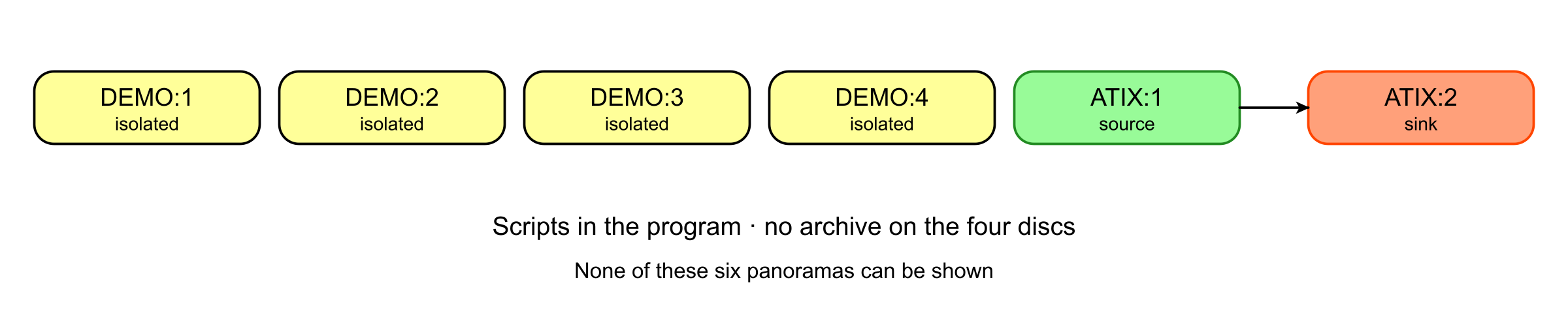
Neither room has an archive on the four discs, so none of their six panoramas can be shown. By their names, they were made for demonstrations of the game, and their scripts stayed in the program that shipped. This is a guess: the files give the names and nothing else.
A Script That Lost Two Bytes
One script of the game is damaged, and has been since the first release.
In the tower of Amateria, the room script of MATO (node 32765, which runs before every node of its room) should begin with a condition, on two bytes, followed by its instructions. The two bytes of the condition are missing. Read as stored, the first instruction’s opcode word is mistaken for the condition (“variable 565 is not zero”), throwing off the arguments of the instructions that follow:
when v565 != 0
    ifVarInRange()
    inventoryAddBack()
    varSetValue(vSunspotColor, 4090)
    varSetValue(vSunspotRadius, 40)
Read with the two bytes restored, it sets the light of the room, as the equivalent scripts of the other rooms do:
when always
    varSetValue(vSunspotIntensity, 45)
    varSetValue(vSunspotColor, 4090)
    varSetValue(vSunspotRadius, 40)
This is known: ScummVM repairs the script when it loads it. The original program reads it as stored. No script of the game refers to variable 565, so the damaged script most likely never runs, and the tower keeps the light of the room before it. The extractor applies the same repair and marks the script.
Self-References and Redraws
Nineteen places refer to themselves (22 connections in all): a script asks for the node where the player already stands, to draw it again after a change. Myst had nine such nodes and Riven none.
Exile has another way to do it, and uses it far more: more than a hundred instructions draw the same node again without naming it, most of them after a movie. These leave no trace in a graph whose nodes are places. They are where most of the game’s mechanisms live: the levers, the valves and the doors that change a panorama without changing the place.
Conclusion
The graph of Exile is smaller than those of Myst and Riven, and tidier. Its Ages are corridors, its links can almost all be walked back, and its files hold very little that the game does not show.
What is left over is all the more readable: a standpoint in gray, a node replaced by a variable, a chamber without its lava, four places rendered twice, a node that asks for a node that is not there. Each is a step of the production that the final cut skipped.
The end of the game is the one thing that the graph does not hold. It is in a book, in the inventory, where a graph of places cannot follow.