Kryptos K4: Why the ‘W’ Matters
K1 Avoids It, K2 Draws It, K3 Moves It, K4 Hinges on It
Readers of this blog know that I have a soft spot for the W’s of K4.
In my two earlier articles, I looked at the five W’s of K4. Here, I step back and look at the W in the whole sculpture.
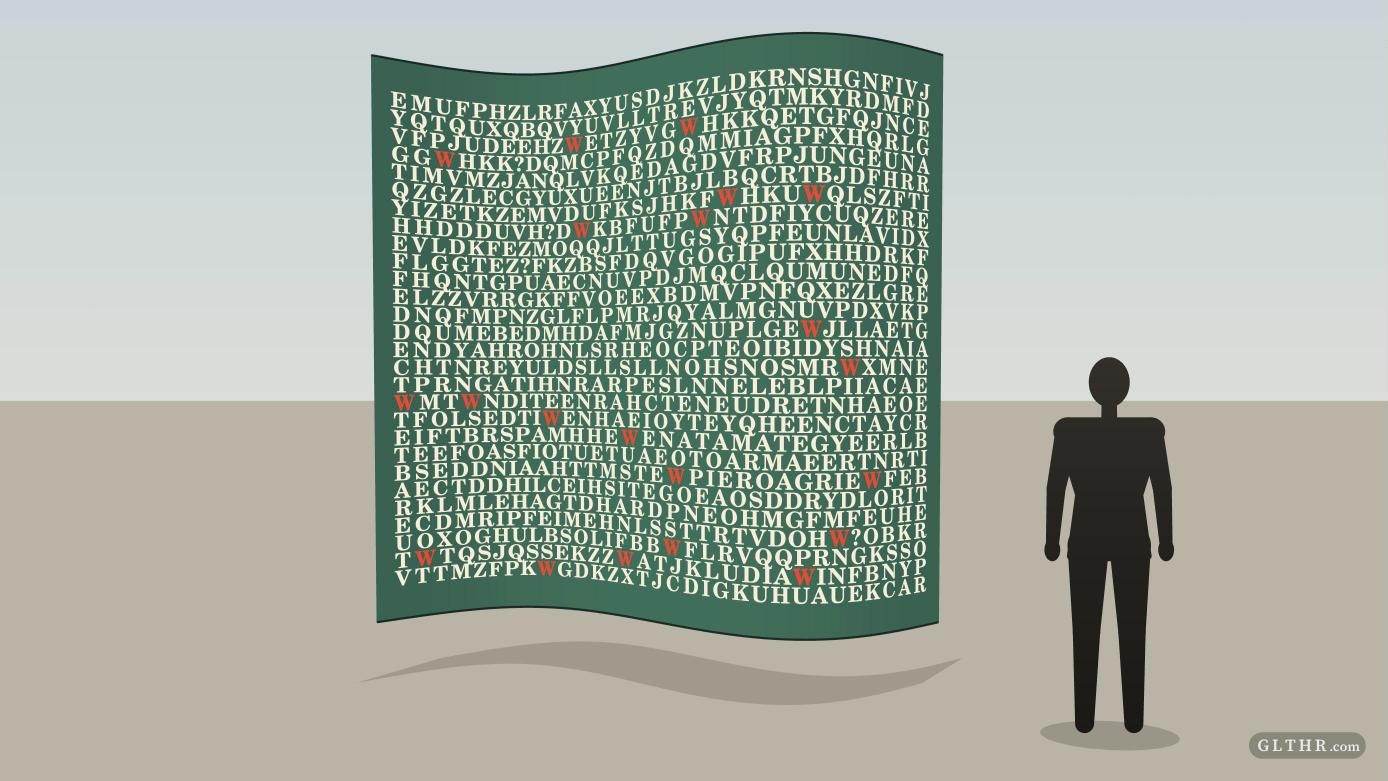
In each one, the W is treated differently from every other letter. I have made other discoveries about Kryptos since then, which I will publish on this blog at a later date. This article focuses purely on the W.
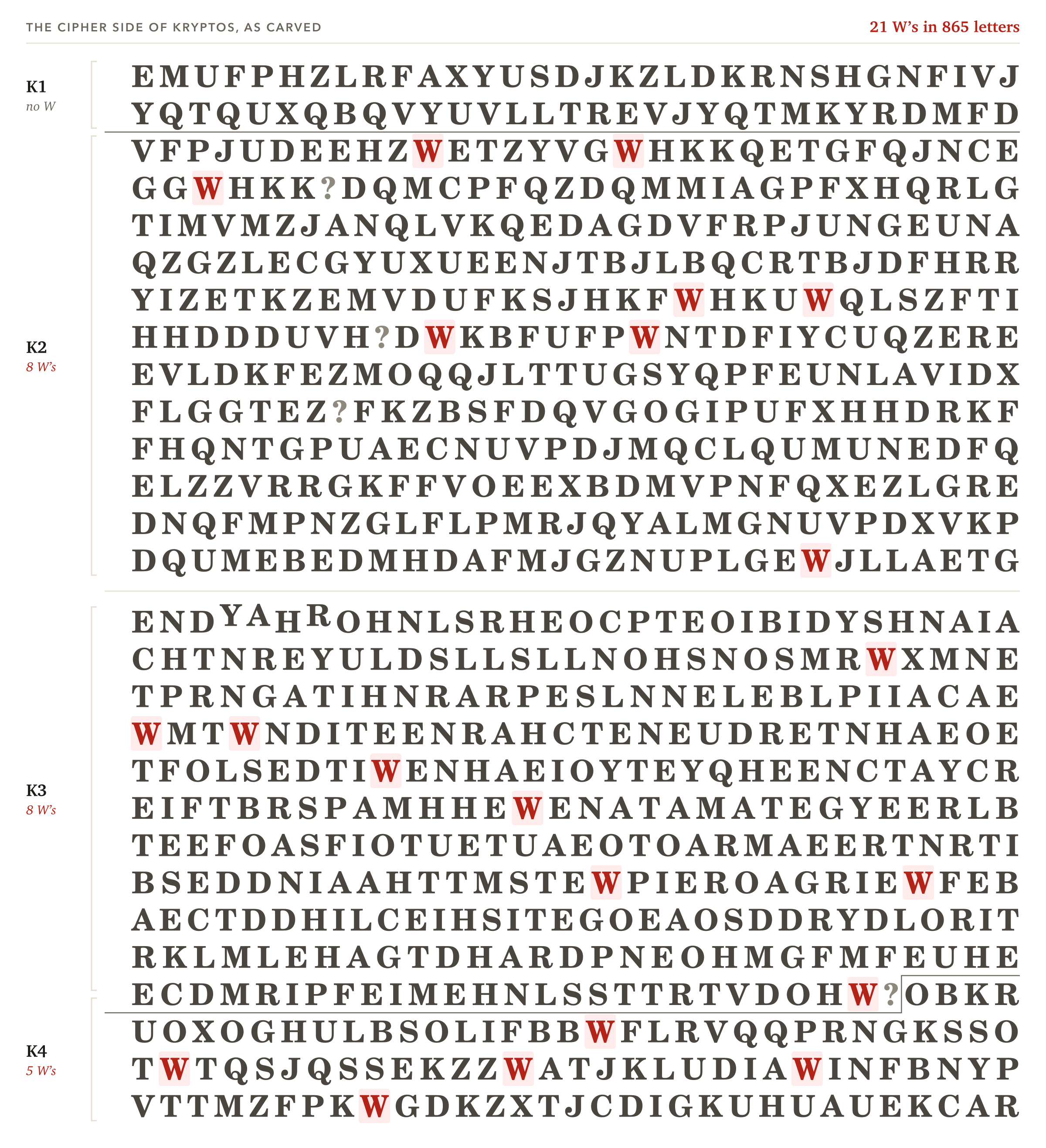
K1 Avoids It
The first message of Kryptos contains no W. Leaving a letter out on purpose has a long history: Georges Perec wrote a whole novel, La Disparition (1969), without a single E.
K1 is famous for a spelling mistake: its solution ends with THE NUANCE OF IQLUSION, not ILLUSION.
Sanborn’s own coding chart shows how the Q appeared. He wrote the sentence correctly, ILLUSION, but misspelled the repeating key as PALIMPCEST instead of PALIMPSEST. Where the C stood in for the S, the cipher letter changed. On the first line of the chart, he caught three of these slips and overwrote them in bold. On the second line, he left one C uncorrected: it sits directly under the first L of ILLUSION.
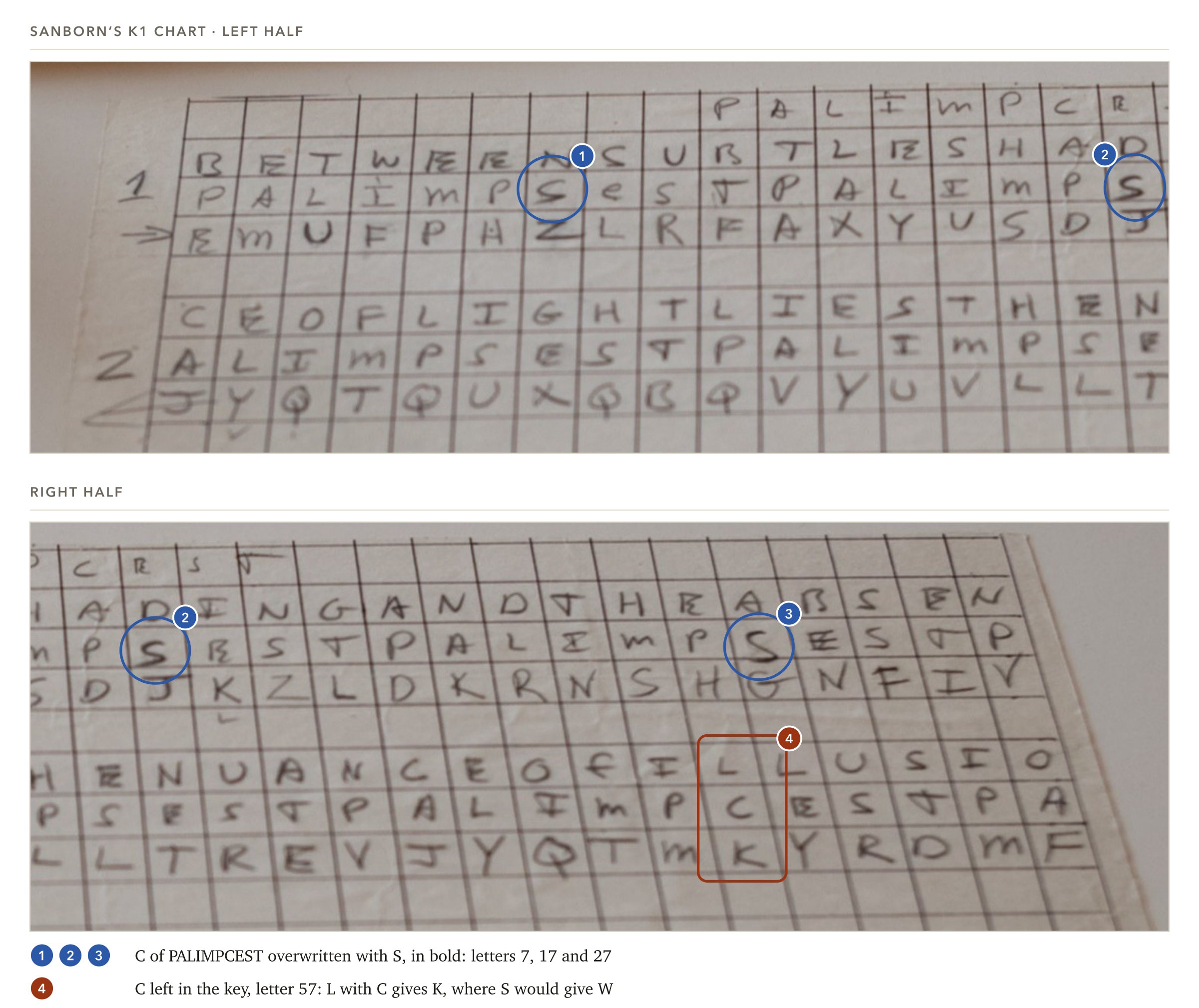
Sanborn’s K1 chart. He overwrote three C’s of his key with S (1 to 3); the fourth C stayed (4), and with it the K on the copper.
That C is the only slip that reached the copper, and it falls on the only cell of K1 where the correct key would have produced a W. Enciphered as Sanborn intended, K1 would show one W. As carved, it shows a K instead, and decoders read the K back as a Q. [To my knowledge, new: of the four slips, the forgotten one is precisely the one that removes the only W that K1 would have shown.]
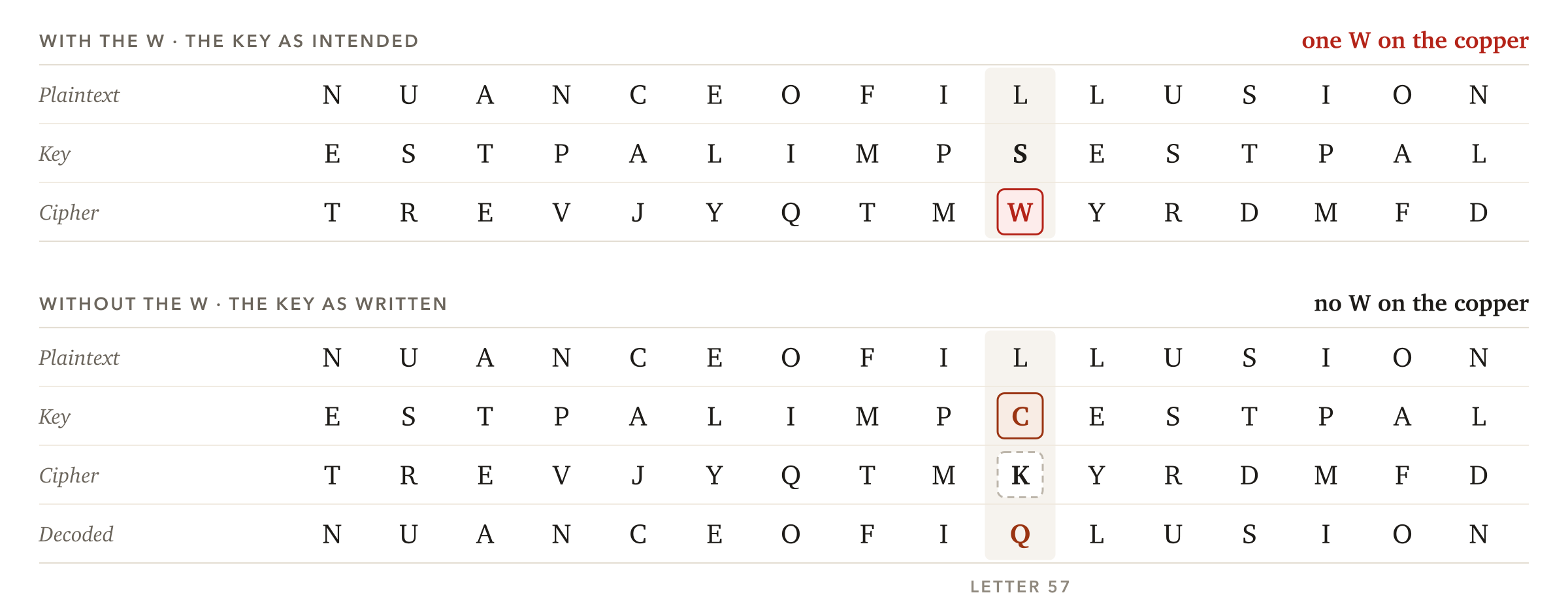
The end of K1, enciphered twice. With S in the key, the first L of ILLUSION becomes a W; with the C that Sanborn left, it becomes a K, which the correct key reads back as Q.
In 2019, Intel Today noted that Sanborn corrected three of these C’s and forgot the fourth, reading it as a plain slip of the pen.1 It may well be, but I do not believe so, as I try to show below.
K2 Draws It
K2 is enciphered in place: each letter of its hidden message stays in its cell, so the hidden text can be laid back onto the copper, line by line.
On lines 9 and 10, five W’s of the hidden message (in SOMEWHERE, WHO, KNOWS, the first W of “ONLY WW”, and WAS) stand at the five points of a letter W: three on the upper line and two on the lower line, stepping three columns to the right each time. The two letters WW are usually read as the initials of William Webster, then director of the CIA.2
Sanborn’s draft of K2 shows that WW was not there from the start. Under the blue-ink WW, the pencil reads JS, Sanborn’s own initials.3 [To my knowledge, new: neither the figure nor the pencil JS under the WW had been published before.4]
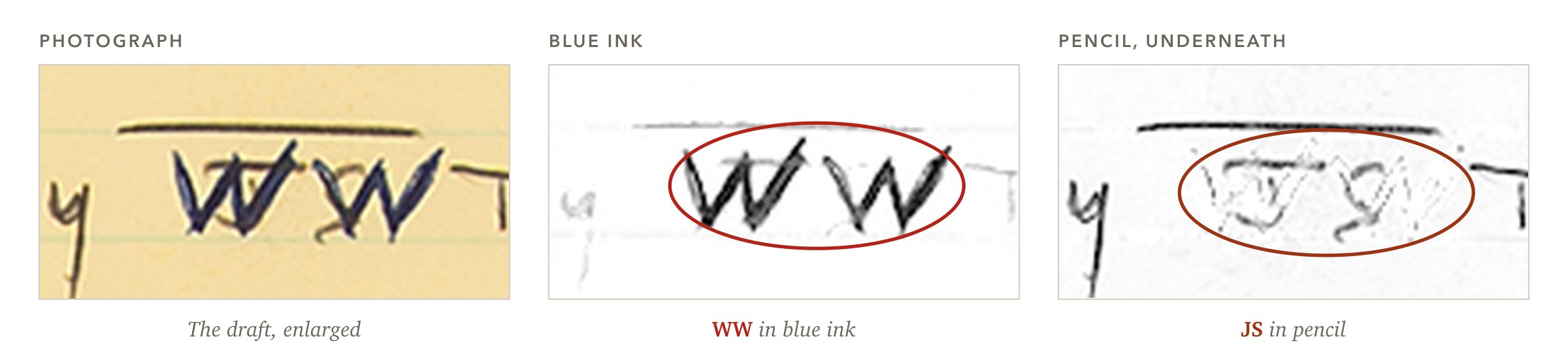
The detail “only WW” of Sanborn’s K2 draft, enlarged, then separated by color: WW in blue ink, JS in pencil underneath.
With JS, four of the five points of the figure are already W’s. The fifth point is the J. Changing the initials completed the drawing. Few artists sign a work by taking their name off it.
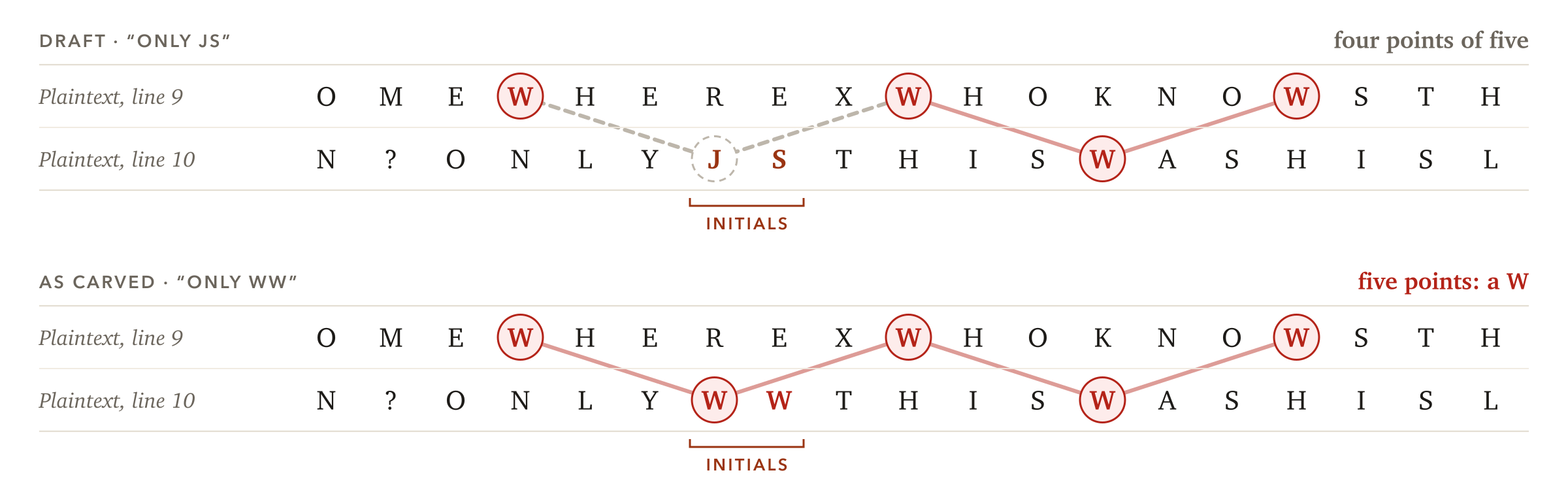
Lines 9 and 10 of K2’s message, in their cells. In the draft, four W’s and a J; as carved, five W’s that draw a W.
This cuts both ways. The figure was finished by a change of names, not laid out from the start, and a writer who never thought about W’s could have made the same change. Still, the J is the only letter of K2 whose change to a W would complete such a figure, and it is the one Sanborn changed.
K3 Moves It
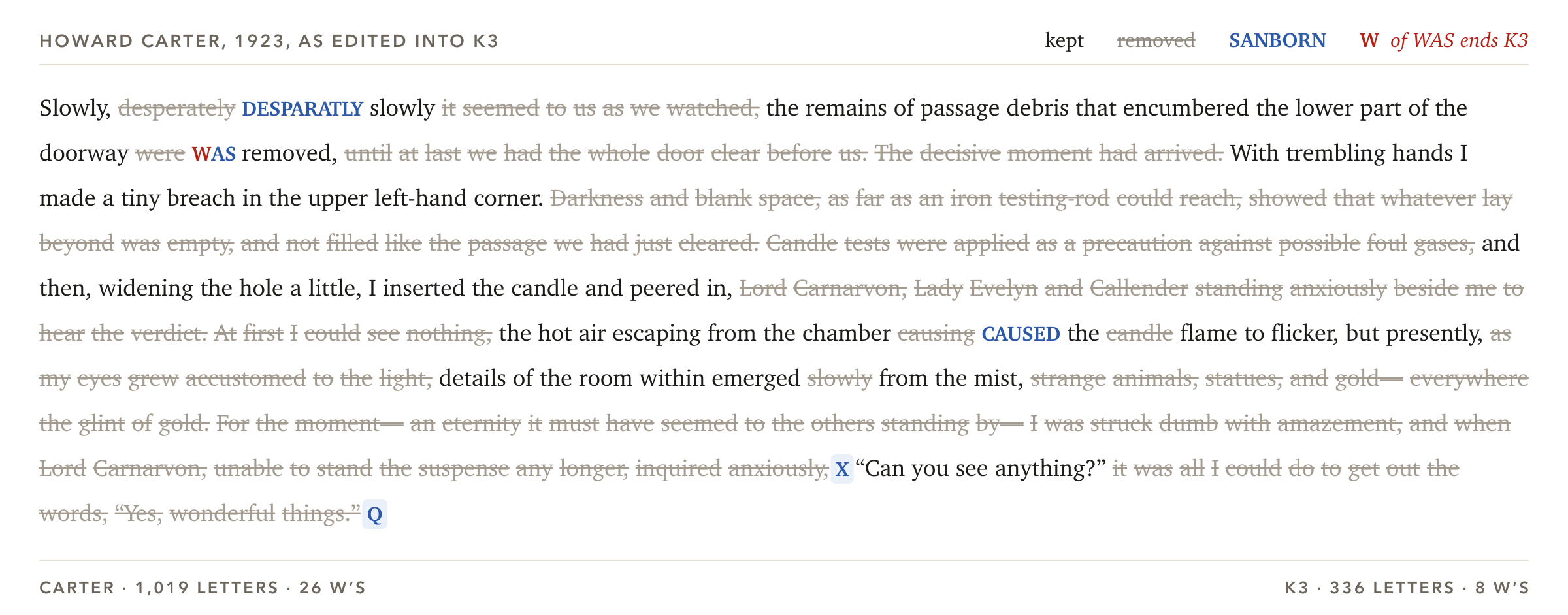
K3 adapts Howard Carter’s account of first peering into Tutankhamun’s tomb, in 1922. Sanborn did not copy Carter’s text verbatim: he trimmed it down. Carter’s passage has about a thousand letters and 26 W’s.5 K3 has 336 letters and 8 W’s.
The changes are small but deliberate. Sanborn dropped Carter’s aside “it seemed to us as we watched”, changed “were removed” to “was removed”, cut most of the middle, and spelled desperately as DESPARATLY. That spelling matters for the count: with Carter’s spelling, the text would have 337 letters, a prime number that no rectangle can hold. With 336 letters, it fills a grid exactly,6 and Sanborn turned that grid twice to scramble it.7
110the W of were, then WAS: its letter
1,019letters in the text
Carter’s account as edited into K3: struck words were cut, blue words are Sanborn’s, and the W of WAS, in red, becomes the last letter of K3.
These edits, already noticed in the past, decide what the sculpture shows. In Carter’s text, the W of were is the 110th letter. Cutting the aside and the E of desperately brings it to the 86th, and in a text of 336 letters, 86 is the one position that the double turn sends to the very last place of K3. On the copper, K3 therefore ends on that W, followed by a question mark, and then by K4. Change the length before it, or the total length, and that W would land elsewhere.
Sanborn said so himself. In a talk in 2013, showing his charts, he said that the final letter of the coding system “might be the W up there. And so that would be the last word before the part that hasn’t been cracked yet.”8
Based on the above, I postulate that the two misspellings, IQLUSION in K1 and DESPARATLY in K3, are deliberate and directly linked to the W.
K4 Hinges on It
The five W’s of K4 are the subject of my two earlier articles:
- In “Kryptos K4: The ‘W’ as a Separator”, the five W’s split K4 into six pieces that fall, in turn, into two groups with the same letter-count profile.
- In “Kryptos K4: The W-Rectangle”, K4 written in rows of 19 puts four W’s on the corners of a rectangle and the fifth next to the center, at the exact middle of the text. You can explore it on the interactive grid.
I have made further observations directly related to the W’s of K4, but I need to explore them more before publishing them.
What It Adds Up To
Each of these could be an accident on its own. A short text missing one letter is not rare. A drawing completed by a change of initials could be luck. Many English passages, trimmed to a length, would place some letter at the end.
What convinces me is that the W gets special treatment in every message, and a different treatment each time: removed from K1, drawn in K2 by taking Sanborn’s place, fitted into K3 by trimming Carter’s account, and spaced out in K4. I know of no other letter treated this way in all four. And when Sanborn, showing his charts in 2013, singled out one letter, it was a W: the one that leads into K4.
I do not think the W tells us how K4 was enciphered. I think it tells us where to look.
Technical Details
K1: the cell where the W would have been
K1 is a Vigenère cipher on the alphabet KRYPTOSABCDEFGHIJLMNQUVWXZ (the keyword KRYPTOS, then the other letters). A cipher letter is found by adding the positions of the plaintext letter and the key letter in that alphabet, modulo 26. With the key PALIMPSEST, the plaintext BETWEENSUBTLESHADINGANDTHEABSENCEOFLIGHTLIESTHENUANCEOFIQLUSION gives the engraved ciphertext exactly.
| Position 57 | Plaintext | Key | Cipher letter |
|---|---|---|---|
| As intended | L (index 17) | S (index 6) | W (index 23) |
| As carved | L (index 17) | C (index 9) | K (index 0) |
| As decoded with the right key | Q | S | K |
With ILLUSION and the correct key, the ciphertext would differ in that one cell, …TMWYRDMFD instead of …TMKYRDMFD, and would hold exactly one W. The engraved K1 lacks three letters of the alphabet: C, O and W. A random text of 63 letters lacks a given letter about 8% of the time, so the absence alone proves little; the point is which slip survived.
K2: the five W’s on lines 9 and 10
K2 is enciphered with the same alphabet and the key ABSCISSA. A question mark takes a cell of its own and does not advance the key, so each plaintext letter stays in its cell. Lines 9 and 10 of the copper, with the plaintext written in place (columns counted from 1, question marks counted):
line  9   THERESOMEWHEREXWHOKNOWSTHEEXACTL
                   ^     ^     ^
                   10    16    22
line 10   OCATION?ONLYWWTHISWASHISLASTMES
                      ^     ^
                      13    19
The W’s at (9, 10), (9, 16), (9, 22), (10, 13) and (10, 19) form a zigzag with a step of three columns. In the draft wording “only JS”, the cell (10, 13) holds the J, and the four other points are already W’s. The two W’s of WW sit at (10, 13) and (10, 14); only the first is a point of the figure.
Under the draft wording, the J is the only letter of K2 whose change to a W completes a zigzag of this kind (two neighboring lines, a step of one to seven columns). The figure is exact in letter positions. On the copper, where letters have different widths, it holds to about half a letter. In my tests, a complete figure of this kind never appeared when ordinary English text was laid into the same cells; four points out of five, without the fifth, appeared in about 1 window in 400. That is why the change from JS to WW, not the figure itself, carries the argument.
K3: from Carter’s 1,019 letters to 336
Carter’s passage (The Tomb of Tut.ankh.Amen, vol. I, 1923, pp. 95–96) has 1,019 letters with 26 W’s. K3’s plaintext has 336 letters with 8 W’s. The main edits:
| Carter (1923) | K3 | Letters | W’s |
|---|---|---|---|
| desperately | DESPARATLY | −1 | 0 |
| it seemed to us as we watched | (cut) | −23 | −2 |
| were removed | WAS REMOVED | −1 | 0 |
| causing the candle flame | CAUSED THE FLAME | −7 | 0 |
| emerged slowly from the mist | EMERGED FROM THE MIST | −6 | −1 |
| strange animals … inquired anxiously | X | −207 | −4 |
| Can you see anything? | CANYOUSEEANYTHINGQ | +1 | 0 |
| five other cuts (narrative and the reply) | (cut) | −439 | −11 |
K3 is enciphered by transposition: the 336 letters are written in rows of 14, the grid is turned a quarter turn clockwise, rewritten in rows of 42, and turned again. In positions counted from 1, plaintext letter P goes to ciphertext position 192 × P mod 337. Letter 86, the W of WAS, goes to 192 × 86 mod 337 = 336, the last cell. The engraved K3 ends …TVDOHW, then ?, then K4.
The first four W’s of K3’s plaintext (positions 4, 20, 67, 83) also form a mirror-symmetric frame, with 15, 46 and 15 letters between them; with Carter’s spelling of desperately the first gap would be 16. A frame of this kind opens about one English passage in 120, so I treat it as a curiosity beside the main point.
K4: the five W’s
K4’s W’s are at positions 21, 37, 49, 59 and 75 of its 97 letters. Position 49 is the exact middle. The two earlier articles give the segments, the frequency profiles and the grid in detail.
Conclusion
K1, K2 and K3 have been solved for decades, and their W’s look like leftovers of the solving. Read side by side, now they look more like a habit of the maker. If K4 was made the same way, its five W’s are not noise to be filtered out before an attack: they are part of the design. That is the lead I am still following.
Intel Today, “Kryptos: Analysis of Jim Sanborn’s K1 Worksheet”, 25 November 2019, which notes that three of the C’s were overwritten with S and the last one forgotten, “yielding the infamous K instead of the correct W”, and concludes that it is “a silly mistake”. Neither Intel Today nor the Kryptos Wikipedia article notes that this slip removed the only W that K1’s ciphertext would have had, leaving none on the copper. Sanborn’s K1 and K2 charts were first published by the New York Times on 20 November 2010. The photograph of the K1 chart was published by Paradigm. ↩︎
Sanborn gave the solution of Kryptos to William Webster, Director of Central Intelligence when the sculpture was dedicated. The photograph of the draft is from RR Auction, lot 2001; detail enlarged, ink and pencil separated by their colors; the circles are mine. ↩︎
Sanborn signed the sculpture itself “J.S. 1988”, stamped into the edge of the copper: see the photograph in Paradigm’s history of Kryptos. ↩︎
Neither my notes, nor published Kryptos analyses, nor web and Reddit archive searches on 27 November 2026 turned up an earlier public account of either observation. ↩︎
Howard Carter and A. C. Mace, The Tomb of Tut.ankh.Amen, vol. I, Cassell, 1923, pp. 95–96. ↩︎
Others made this point before me: Schridde, in the third part of his Kryptos series on numberworld.blog (July 2018), noted that the E is already missing from Sanborn’s plaintext so that K3 makes a perfect rectangle, and Richard Bean, in his 2019 lecture slides, that 337 is a prime number. ↩︎
The two turns were worked out by the NSA team that solved K1 to K3 in 1992 and 1993, and again by Jim Gillogly in 1999. Richard Bean describes the same scrambling as taking every 192nd letter, modulo 337. ↩︎
Jim Sanborn, talk at the Big Techday conference, Munich, 2013, at 13:23; transcript kept by Richard Bean. ↩︎