The Myst Graph, 2: Unreachable Views and Disabled Links
What the graph shows that the game hides


Card labels such as Myst:70105 have a thick underline, in the color of their Age, and open that card in the graph browser.
Introduction
Previous analyses of Myst’s source code have indicated that some assets are not seen in the game, such as Catherine’s crumpled note and the opened music box in the Mechanical Age. [Version of the game: Myst, original Macintosh CD-ROM release (1993). The card IDs are those of its six HyperCard stacks, all dated July 1993.] Also, the analysis of commented-out scripts indicates a reference to an intriguing “Rattle Ratchet Routine” (Myst:70105), as revealed during the “Reverse Engineering Myst” presentation at Mysterium Con 2024:
-- Rattle Ratchet Routine…
-- It’s no longer with us, but it may be back!!!
These findings offer a fascinating glimpse into the artistic, gameplay, and last-minute decisions made by the Myst creators. By creating the “Myst Graph” (shared in the previous article), I aim to reveal new insights into the game’s creation by focusing on the relationships between cards instead of just the cards themselves. The scripts quoted below can also be read as plain text in mystextract, Andrew Plotkin’s extraction of Myst’s HyperTalk scripts, and any card named below by its number can be found in the explorable graph.
Visual Indicators
Before diving into the findings, let’s clarify one point related to visual indicators used in this article.
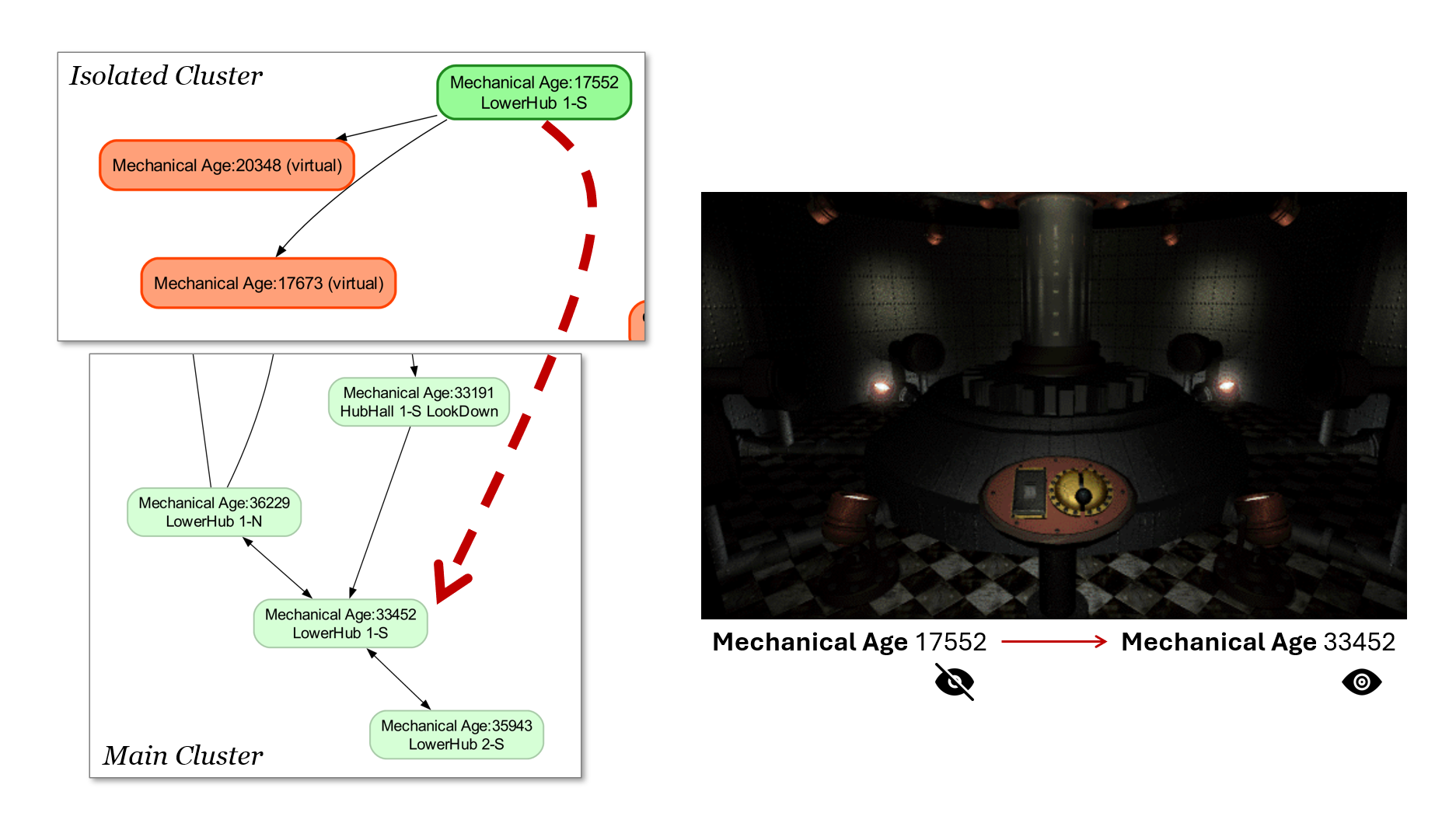
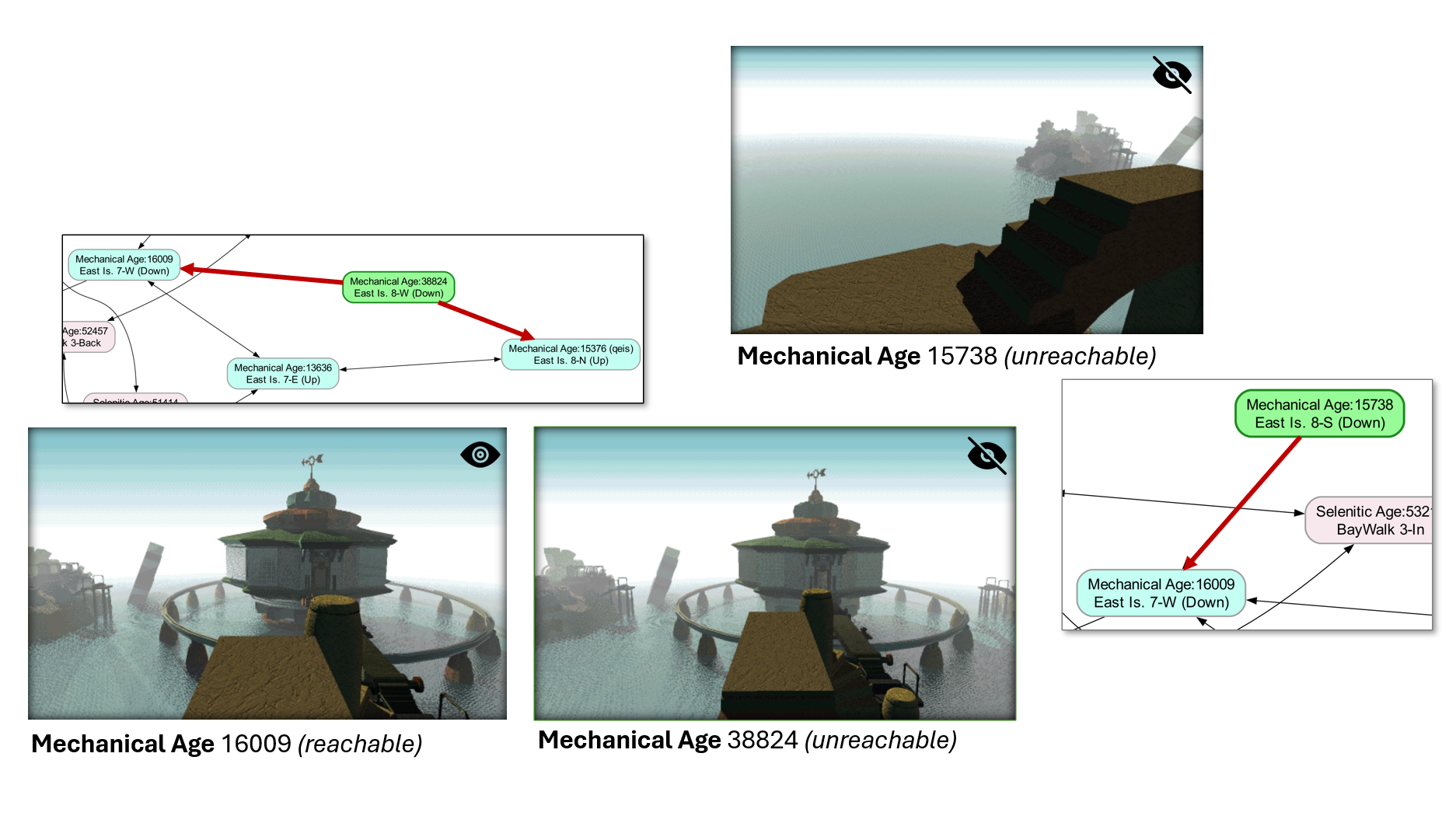
A crossed-out eye superimposed on a game screenshot signifies that the asset is not accessible within the game environment. This typically occurs when the asset is featured in a source node with no incoming edges, effectively making it invisible and unreachable. On the other hand, an open-eye icon indicates that the corresponding asset is visible and can be accessed while playing the game (I typically used reachable nodes to show a contrast in viewing perspective). By default, if no indicator is shown, the image is viewable in the game.


Also, for demonstration purposes (especially when the edge density is high), edges may be highlighted with thick red lines.
Disclaimer
The disclaimer of the first article applies. This article contains spoilers for the game.
Revisions
I update this article with new findings and corrections, which are tracked on this page.
General
Shortest Theoretical Path
From the dock (Myst:8336), where the player starts the game, to Dunny Age:11088, where the player can return to Myst Island, the theoretical minimum distance is 24 edges. [(Update November 2026) In a playthrough of the original Macintosh release, the player gave Atrus the white page at Dunny Age:4840. After Atrus returned, the player opened his book at Dunny Age:10805. The 24th edge ends at the open book. Clicking its linking panel takes the player one edge further, to the library ceiling on Myst:44018.]
One of the possible paths (there are alternative sub-paths in the library, after Myst:46094) is: Myst:8336 → Myst:2737 → Myst:5026 → Myst:6798 → Myst:7516 → Myst:7902 → Myst:8079 → Myst:3604 → Myst:9960 → Myst:11521 → Myst:46094 → Myst:49958 → Myst:47338 → Myst:49781 → Myst:56926 → Myst:63906 → Myst:71909 → Myst:23753 → Myst:28552 → Dunny Age:6532 → Dunny Age:2943 → Dunny Age:9757 → Dunny Age:4840 → Dunny Age:10805 → Dunny Age:11088.


As explained in the first article, this calculation assumes no gameplay constraints and provides a baseline for understanding the graph’s topology. One instance of the shortest theoretical path can be downloaded here.
Longest Shortest Theoretical Path
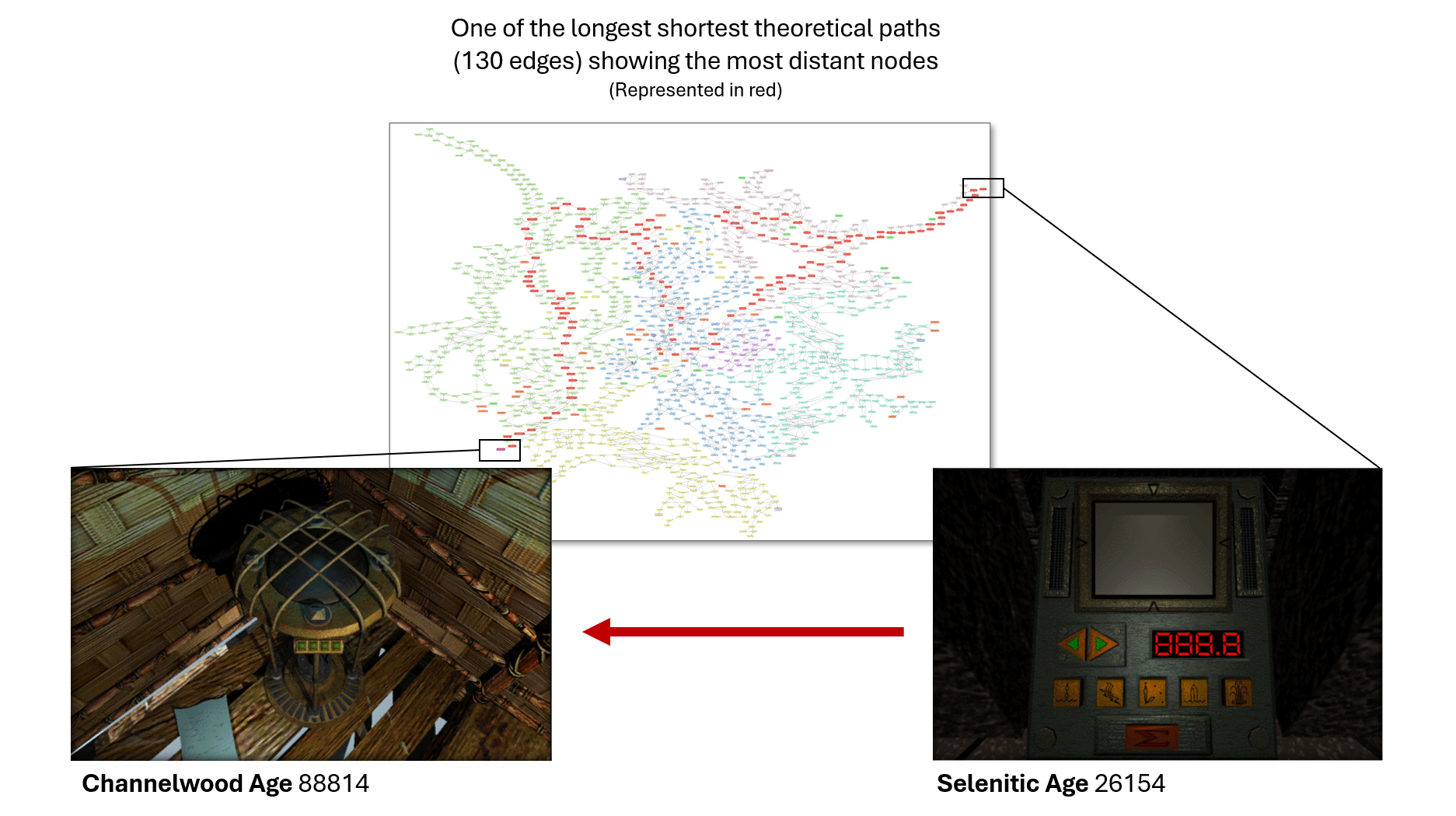
The most distant nodes are Selenitic Age:26154 (the tower controls) and Channelwood Age:88814 (the Achenar monitor), which are separated by 130 edges. Incidentally, these nodes feature screen-based interfaces with button controls. The graph representing this path can be downloaded here.
Self-References
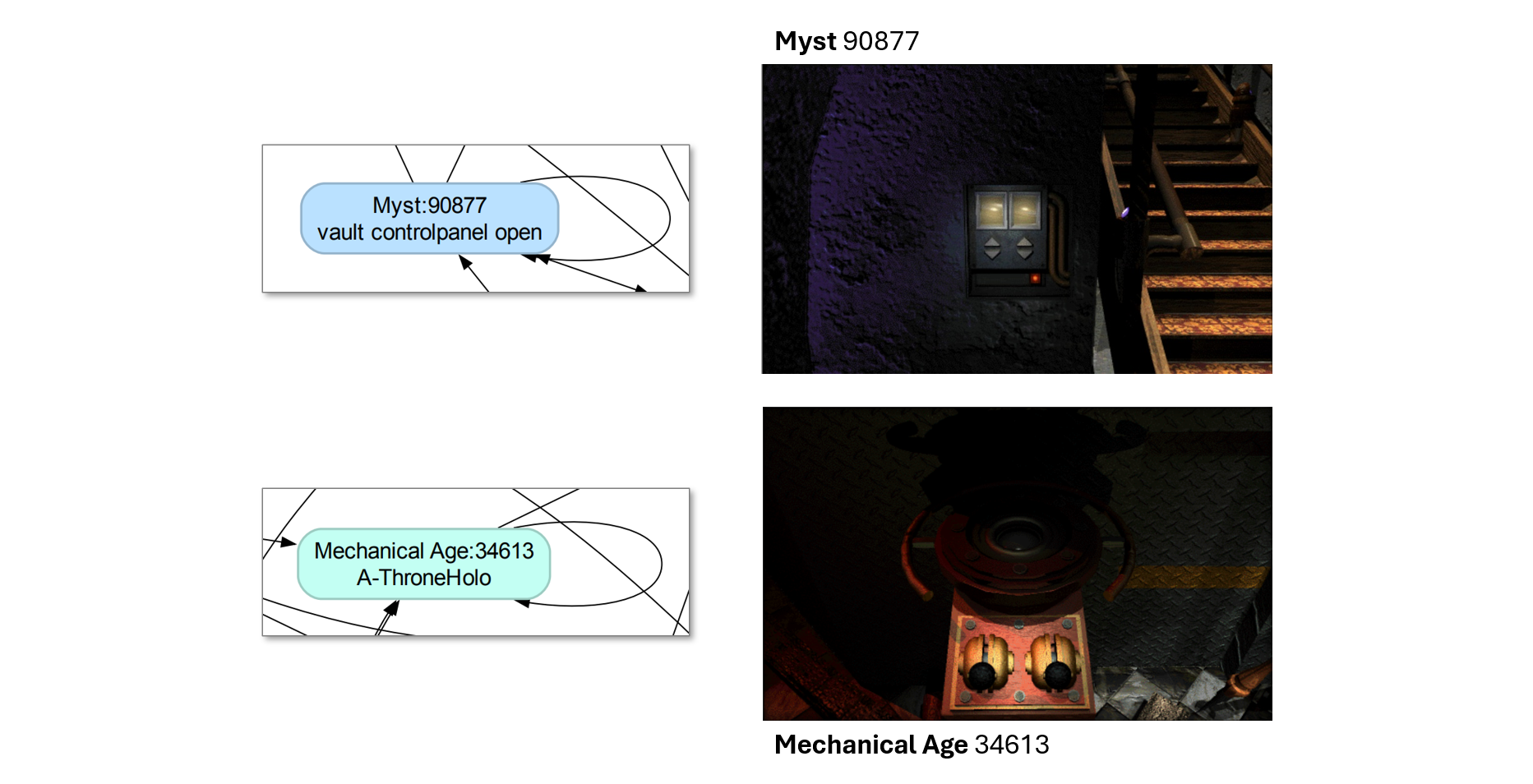
Nine nodes refer to themselves (fifteen more self-references are disabled). These self-loops are used as a mechanism to represent interactive effects rather than as a means of navigation.
On Myst Island, a self-referencing node represents the view of the control panel of the underground room next to the sunken ship (90877). In the Mechanical Age, 34613, representing the hologram in Achenar’s room, also self-loops. The goal of these actions seems to be to reset the state of the card, which contains variables.
In the Mechanical Age, the cage card (14628) redirects to itself too, but for a more practical effect: cycling quickly between cards to simulate, along with sound effects, the rendering of electricity arcs: cage, cage electrified bright, cage electrified, then cage again. Interestingly, it also connects to two nodes that are used for this effect, not for navigation: the handler’s next request from each of them is recorded as an automatic next step.
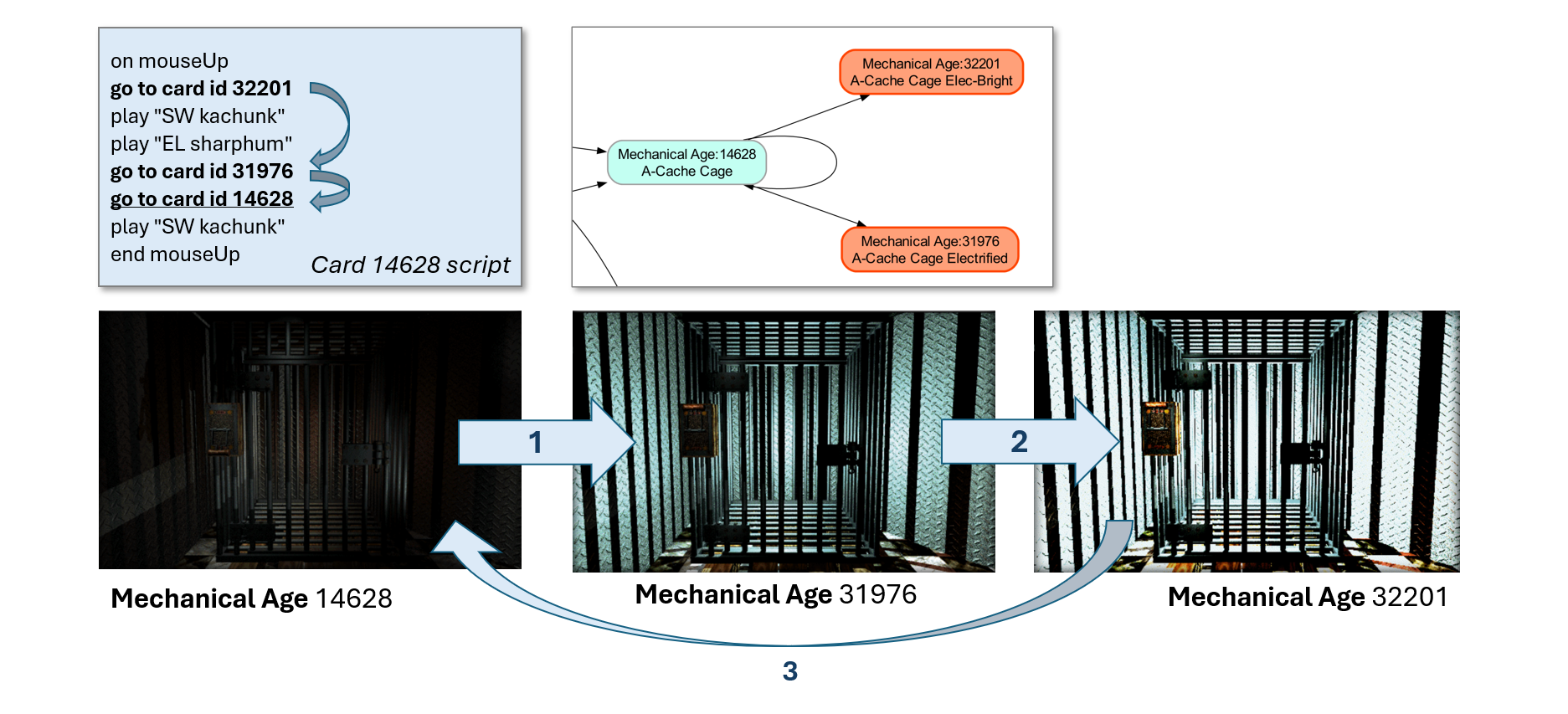
In this earlier graph, the two intermediate views were sinks. The current graph records their automatic next steps.
Isolated Cluster
As indicated in the previous article, there is an isolated cluster of three nodes unreachable from the game. The puzzle they represent has not been removed from the game; it may just have been duplicated and replaced by Mechanical Age:33452, which is part of the game. The key difference is that the duplicate card plays a video named “MU Lower Layer” before going to the card Mechanical Age:35943.
Cross-Ages
Mysterious Missing Direct Link From Myst Island to Selenitic Age
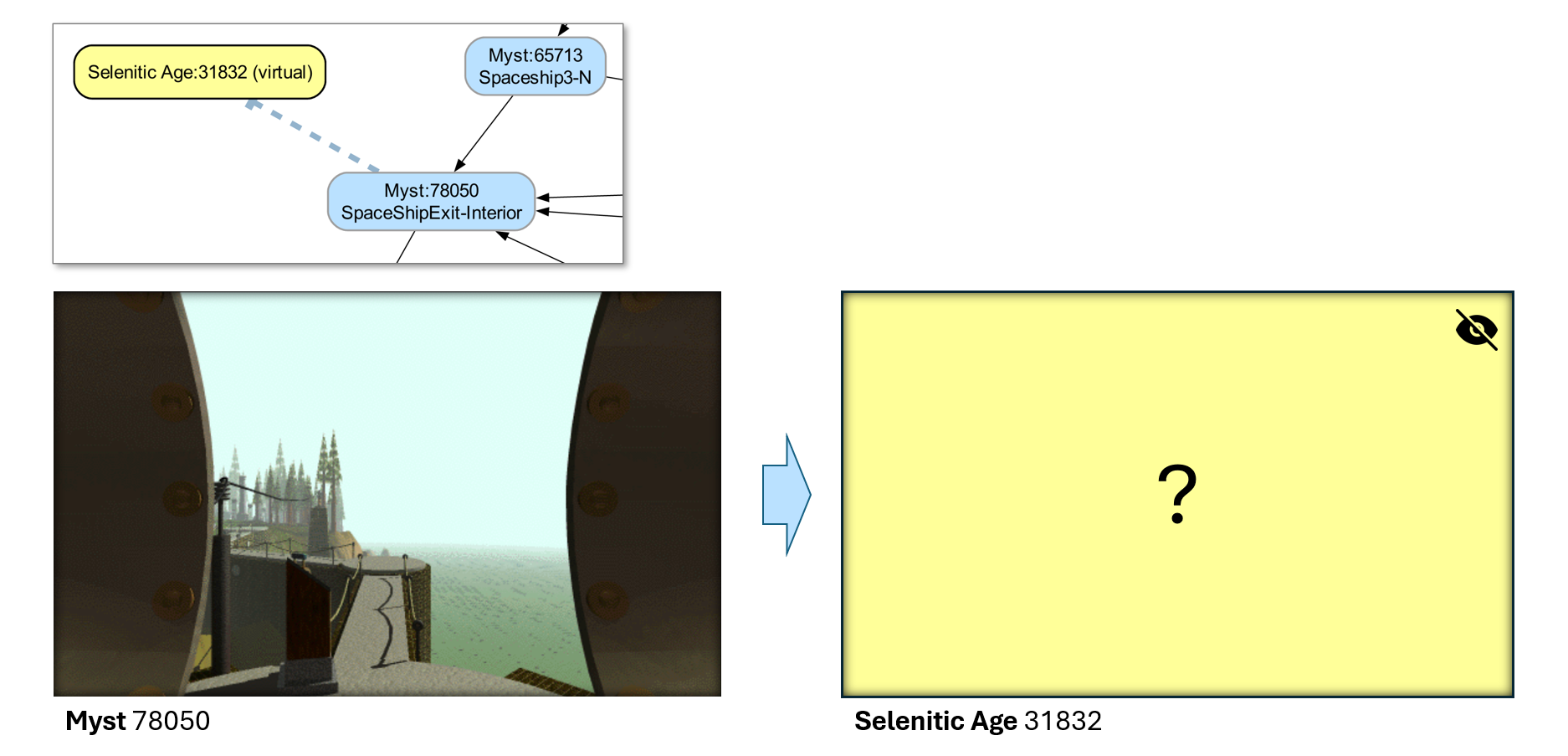
The Spaceship on Myst Island (78050) is somehow directly linked to the Selenitic Age (31832, virtual). This link is commented out (but still visible in the code), and the destination card is absent: the released files do not establish when that target existed, whether it was playable, or why it is absent. As of the game’s release, only the exterior path (Myst:14069) is reachable when leaving the ship.
Myst Island
Centrality of the Bookshelf
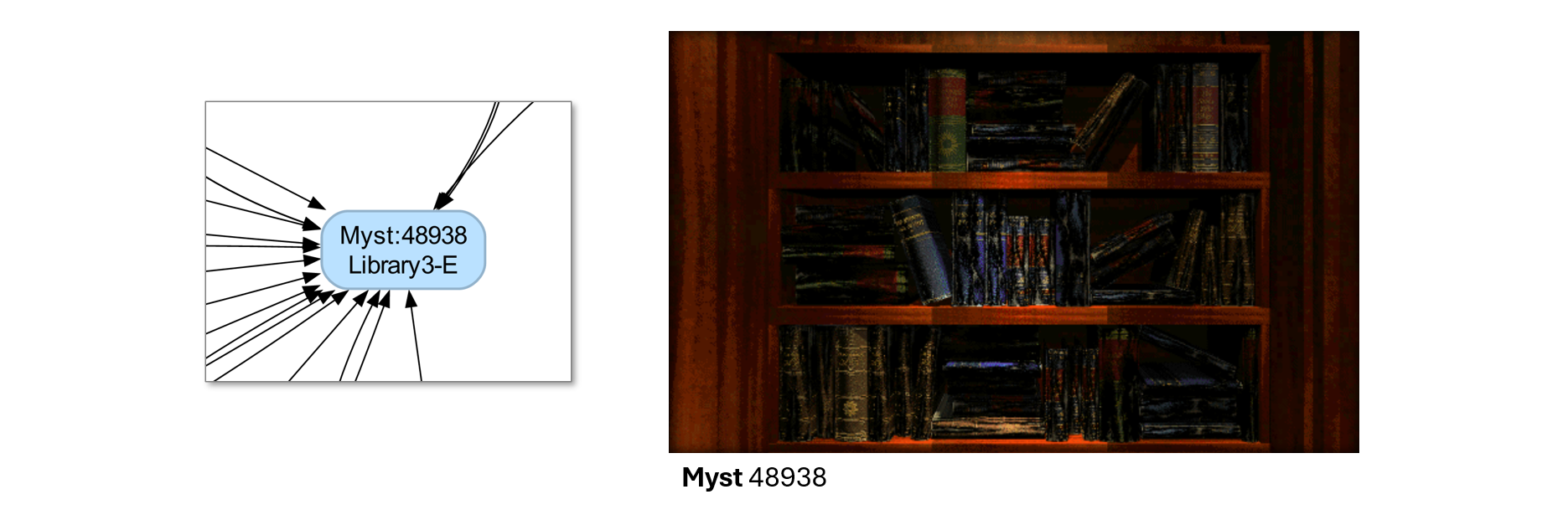
With 19 incoming and 10 outgoing edges, the bookshelf (Myst:48938) is a central hub connecting various nodes throughout the graph. This position can be attributed to its role as a gateway for accessing openable books, which are treated as individual nodes that share connections with the bookshelf. This impression is reinforced by the fact that returning from an Age places the player facing the bookshelf from two views back, in Myst:46439 (see the “transitivity” section of the previous article). This is unsurprising in a universe where books are the gateway to other worlds.
Additional Note on the Crumpled Note
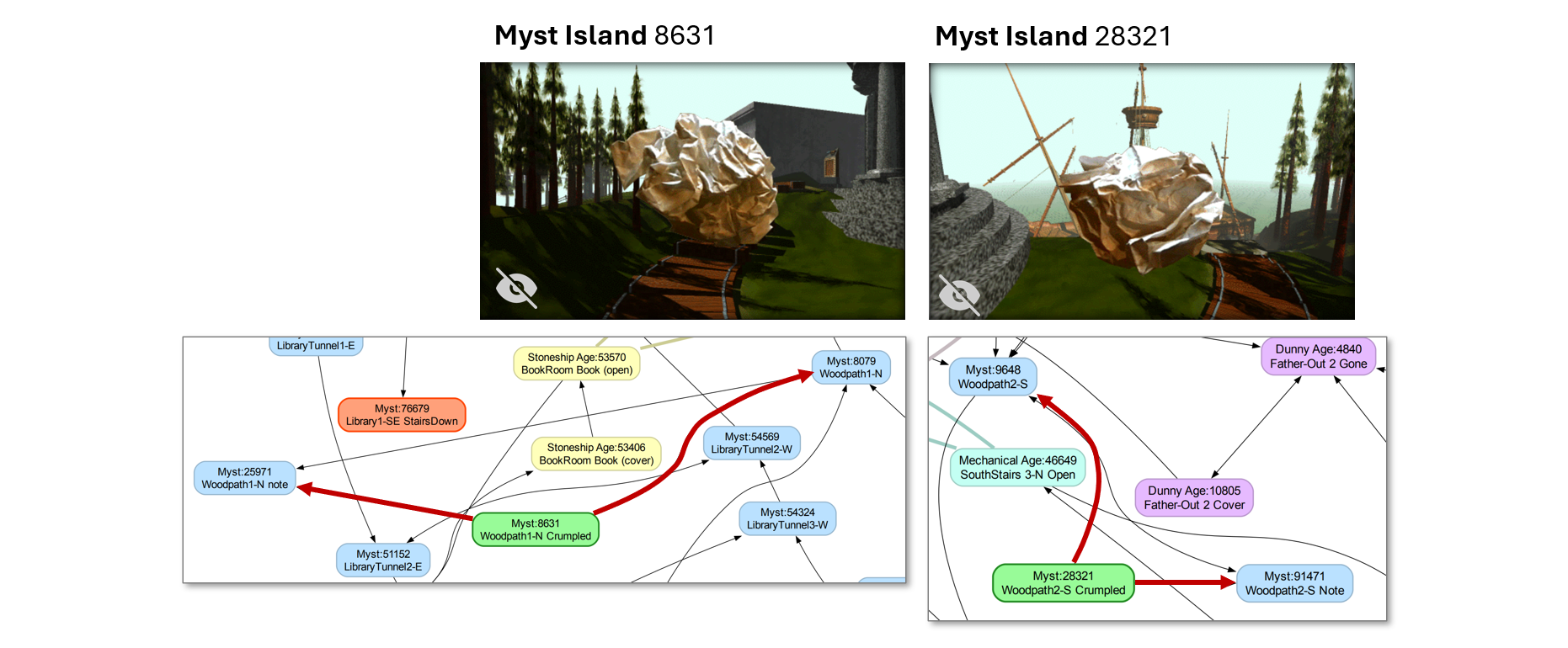
It is a well-known fact that Catherine’s note is not represented in the final game as a crumpled letter.
The graph reveals that the cards featuring the crumpled note assets are still in the game, like the assets themselves, but not reachable. Looking north, the bidirectional edges between 8631 (crumpled note) and its two neighbors, 25971 and 8079, have been transformed into directed edges from 8631, making it a source node. A bidirectional edge was created between 25971 and 8079, bypassing 8631. Looking south, the mechanism is identical: 28321 was transformed into an unreachable source node, while a bidirectional edge was added between 9648 and 91471.
While it does not reveal a new finding here, the graph shows that the assets do not appear in the game, not because they were not used but rather because the cards that feature them were disconnected, and the player cannot reach them.
Retrofitted Observation Platform Edges
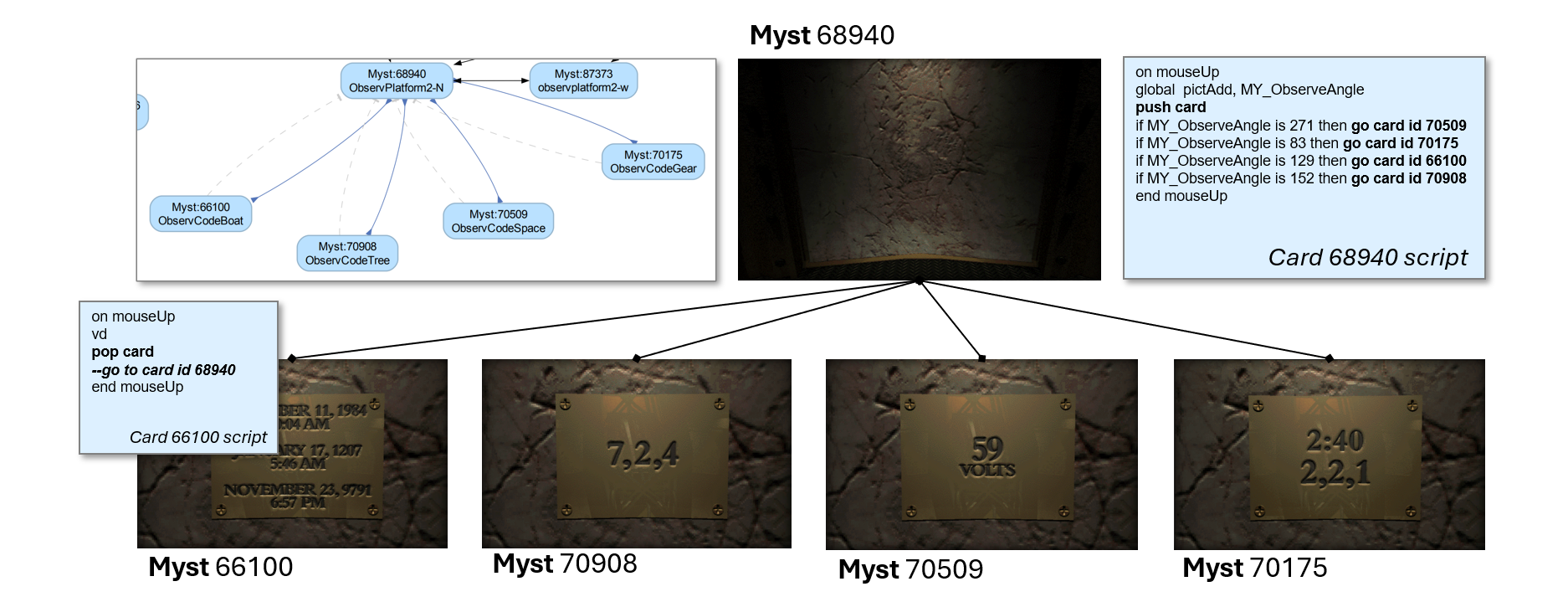
Initially, accessing the codes on the observation platform utilized the same navigational technique as most nodes. The player would reach card 68940, click to zoom in, navigate to the relevant card, and click again to return to the zoomed-out view. A bidirectional edge would be expected between 68940 and each of the cards representing codes.
However, this approach seems to have since been modified to use backtracking edges instead. First, the backtracking functionality was implemented by introducing a “push card” in the origin card and a “pop card” in the target card (this mechanism is explained in detail in the third article). Second, the directed edge from the code view (e.g., 66100) to the observation platform (68940) was disabled (prefixed with “–”) as it was no longer necessary.
In summary, bidirectional edges have been replaced with backtracking edges for the zoom in/zoom out effect.
The Planetarium Device and the True-False Source Node
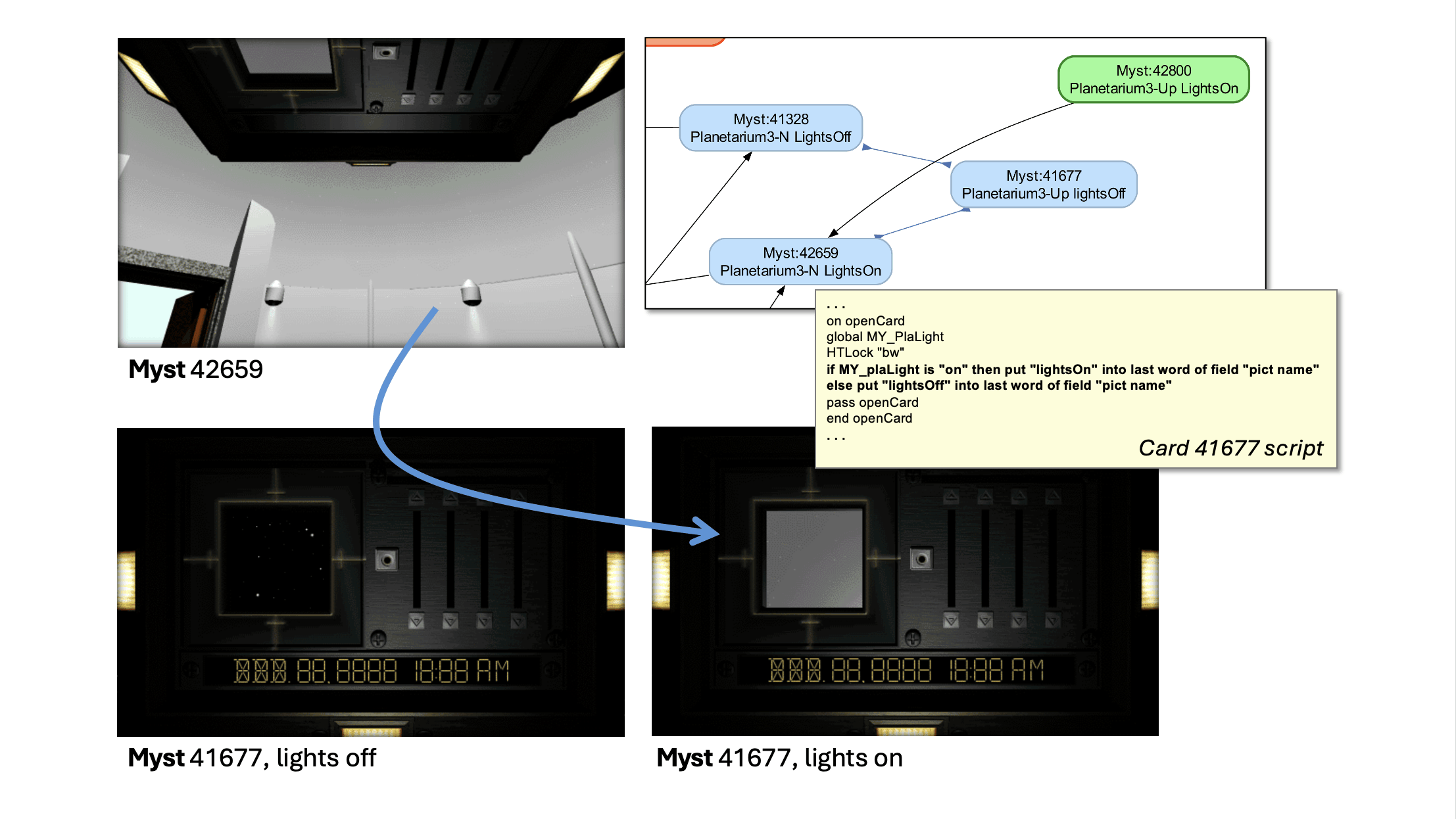
According to the graph, 42800 is a source node. But something seems off: researching the contents of the cards reveals that the asset, “Planetarium3-Up LightsOn”, representing the device on top of the dentist chair when the lights are on, does not appear to be duplicated in another node. Also, this asset is reachable from the game. Consequently, 42800 must somehow be reachable, too.
Additionally, there is an inconsistency in the vicinity of this node: 42659, which represents a partial view of the device when lights are on, supposedly has a backtracking edge with 41677, which shows the device when lights are off. This is not possible, as the player is expected to switch off the lights using the button next to the door; they cannot do it from the chair.
A review of the cards reveals that 42659 indeed points to 41677, and they have a backtracking dynamic (push/pop card) as the graph indicates. However, 41677 performs an immediate substitution of images to display “Planetarium3-Up LightsOn” when lights are on. So, ultimately, this image is directly used by a node other than 42800: it is, indeed, a source node, and most of its logic (it would be interesting to study to what extent) is present in 41677. [(Update November 2026) In the original Macintosh game, one click from the chair on 42659 opens the panel on 41677. Clicking down returns to the same chair view. The path search skips this edge in both directions. If I let it follow just the entry into each such close-up, it reaches 1,325 cards from the dock instead of 1,310. The two distances above still come out to 24 and 130 edges.]
Selenitic Age
Unreachable Nodes
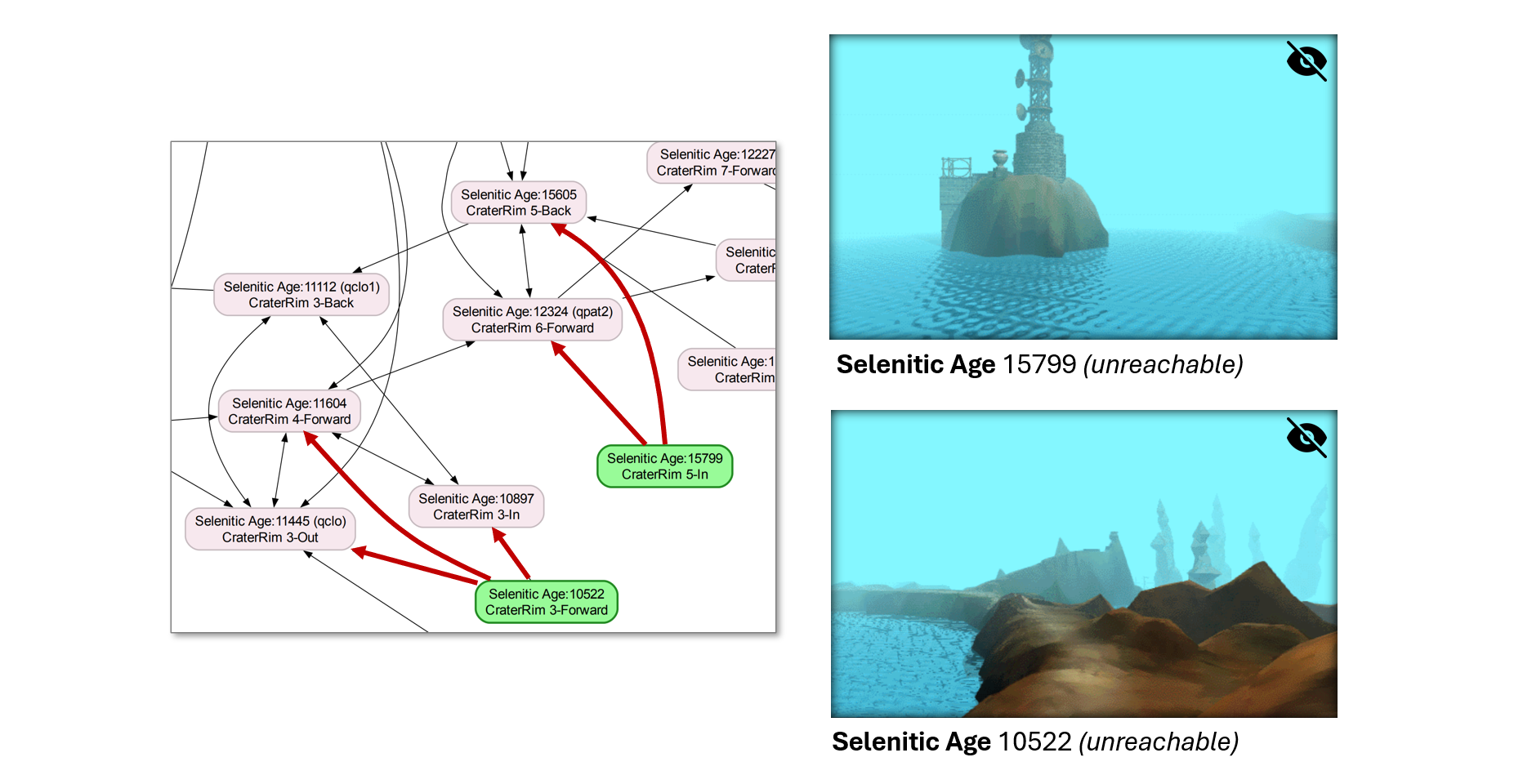
Several views cannot be seen in the Selenitic Age.
The graph reveals two alternative viewpoints on the crater rim, each representing a nuanced shift in perspective from the views selected for the release.
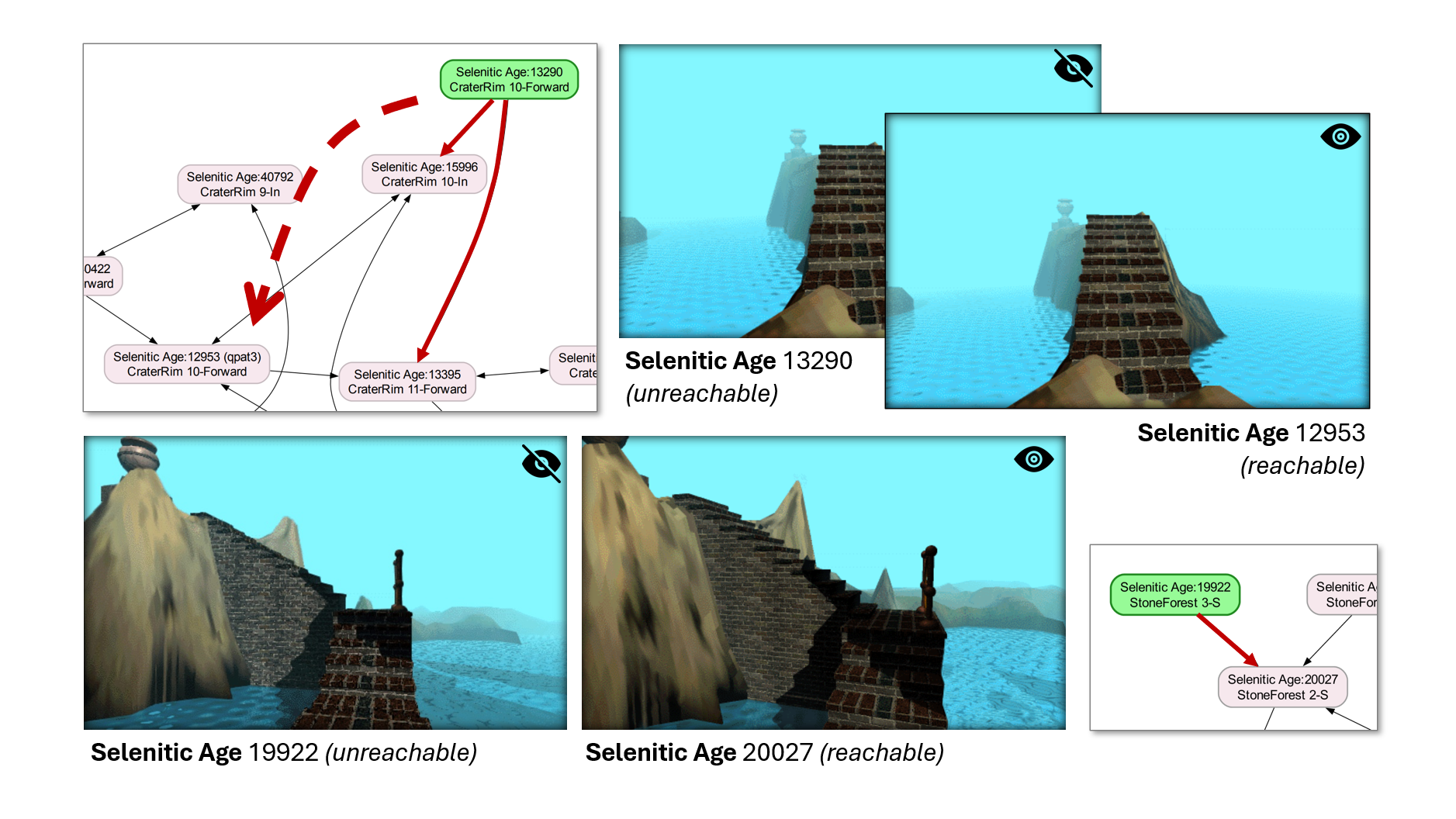
Also, regarding the crater rim, while 13290 is a source node, its asset is used by 12953 (qpat3) and, therefore, is viewable in the game. Another inaccessible alternate view relates to the stone forest, offering a slight change of perspective (compare 19922 and 20027).
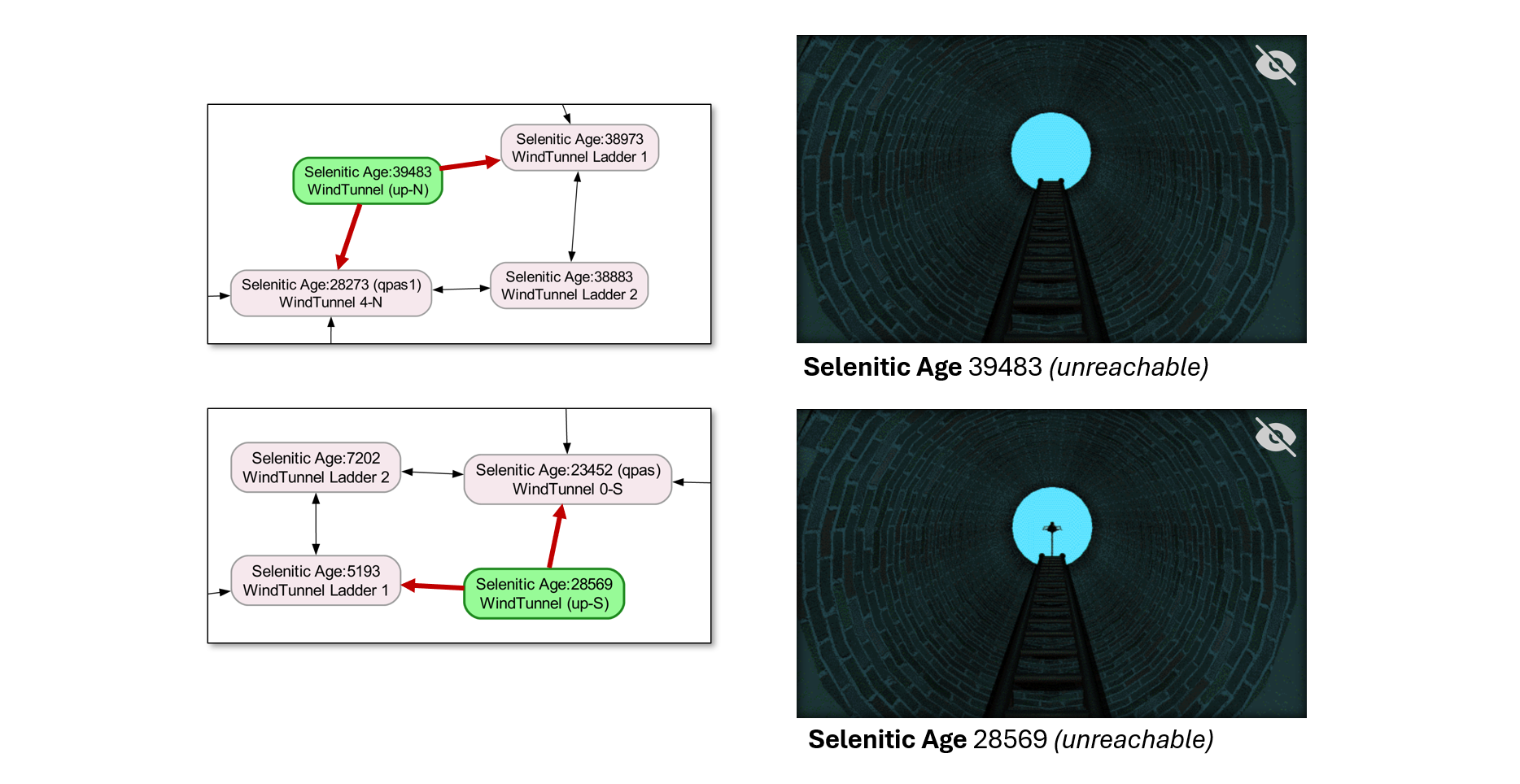
The last two show that it was initially envisaged that the player could look up to see the wind tunnel access from below.
Mechanical Age
Unreachable Nodes
Node 38824, featuring asset “East Is. 8-W (Down)”, is inaccessible from within the game, as it is a source node. Consequently, the corresponding asset is not used. If the image seems familiar, it is because it was replaced by a slightly different perspective, 16009, which is reachable. Also, 15738, representing the player looking down on the east island, facing south, is unreachable.
Channelwood Age
The Back of the Wooden Elevator, a False Sink Node
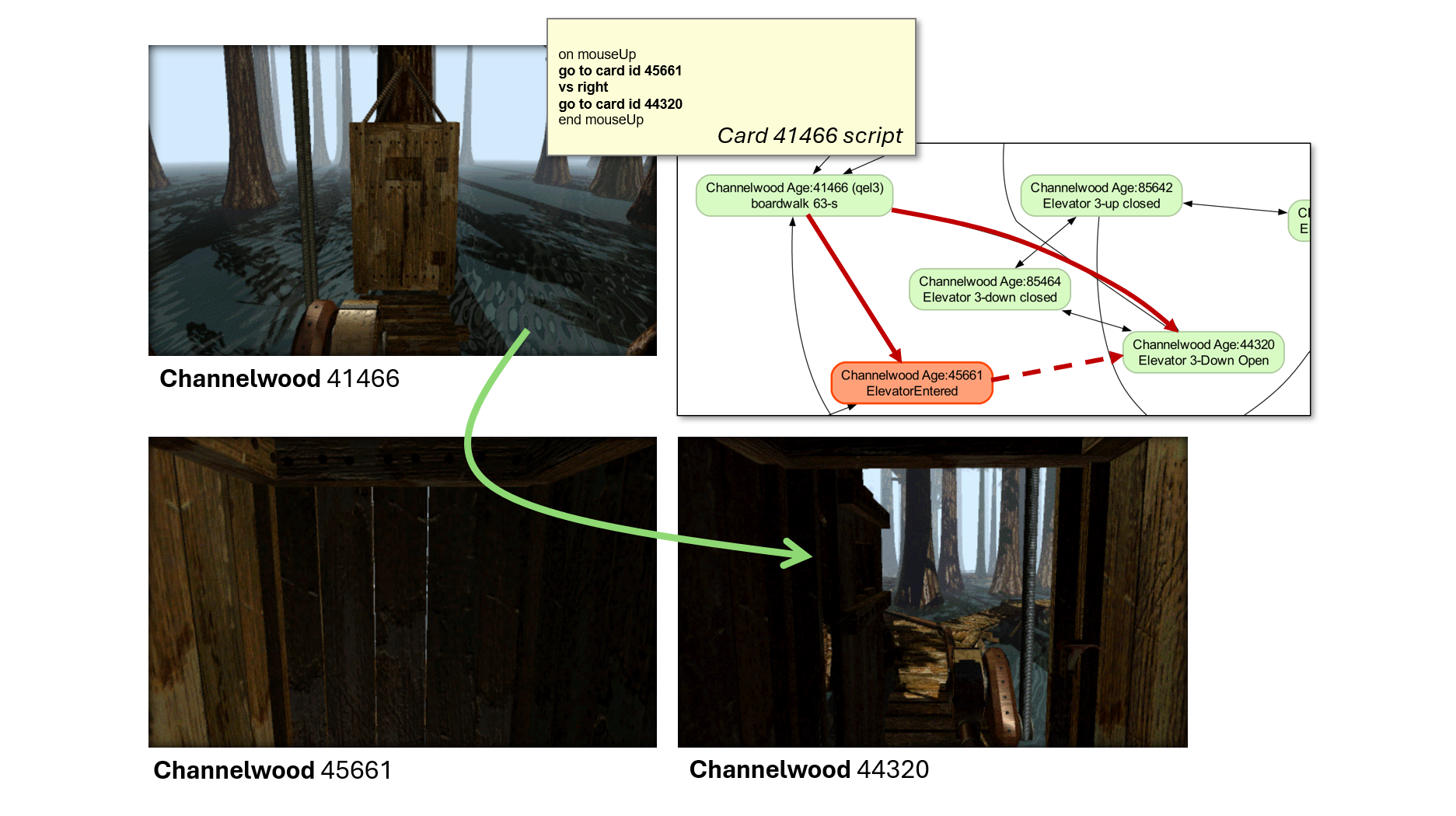
Nodes 45661, 96885, 97270, and 98476 use the same asset: “ElevatorEntered”. The original graph classified them as sink nodes because their own scripts contain no navigation: they display the back of the wooden elevator. The current graph records their automatic next steps and no longer classifies them as sinks.
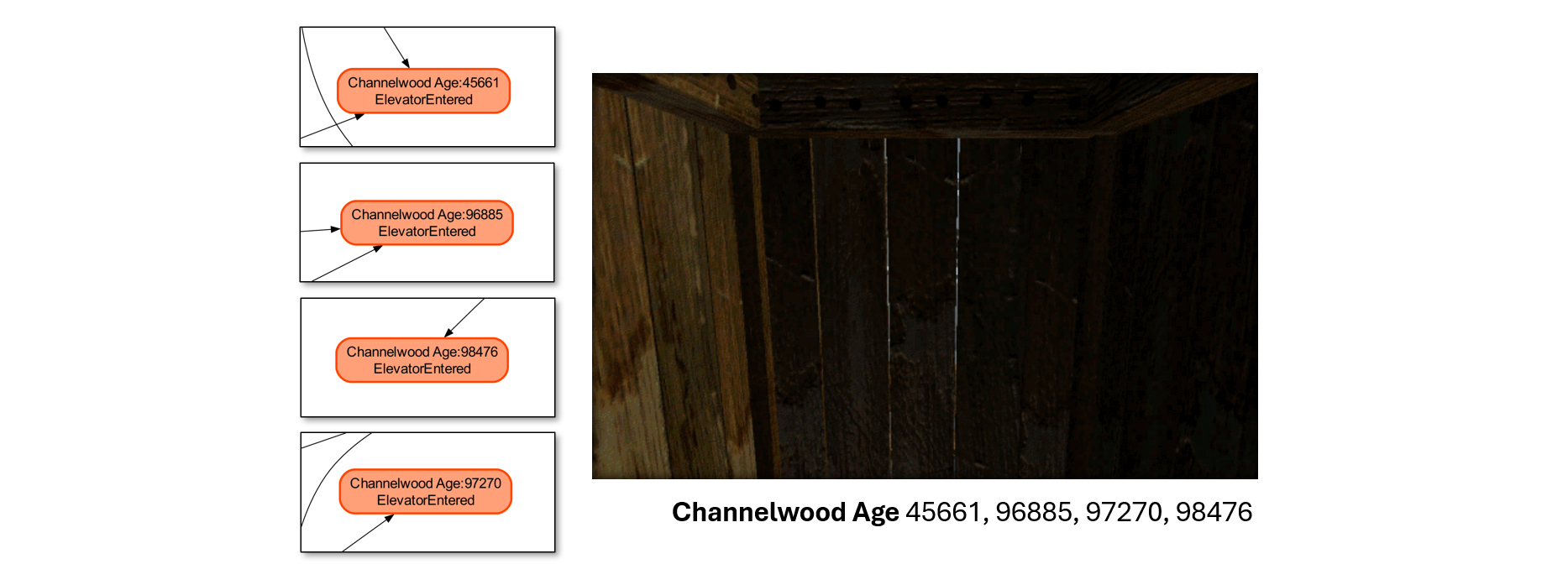
The original graph’s classification, before automatic next steps were recorded.
These apparent sinks prompted me to examine the nodes pointing to them. I identified the trick: they first reach the node representing the back of the elevator, then call “vs left” or “vs right”. This is not a HyperTalk command but a handler of Myst’s own, on vs how, defined in the launcher stack: it plays a scroll or a pan in the given direction, or nothing at all, according to the Transitions option chosen in the game’s menu. [(Update November 2026) I previously described “vs” as a HyperTalk command; it is a handler defined by Myst.] Finally, they reach the actual node. This behavior is similar to the electrified cage effect from the Mechanical Age, where the card just serves as a visual transition to the actual view.
Stoneship Age
Unreachable Nodes
In the Stoneship Age, the unreachability of the nodes is subtle. Node 17724, representing an open door in the tunnel, was replaced by 17526, whose script displays the door open.
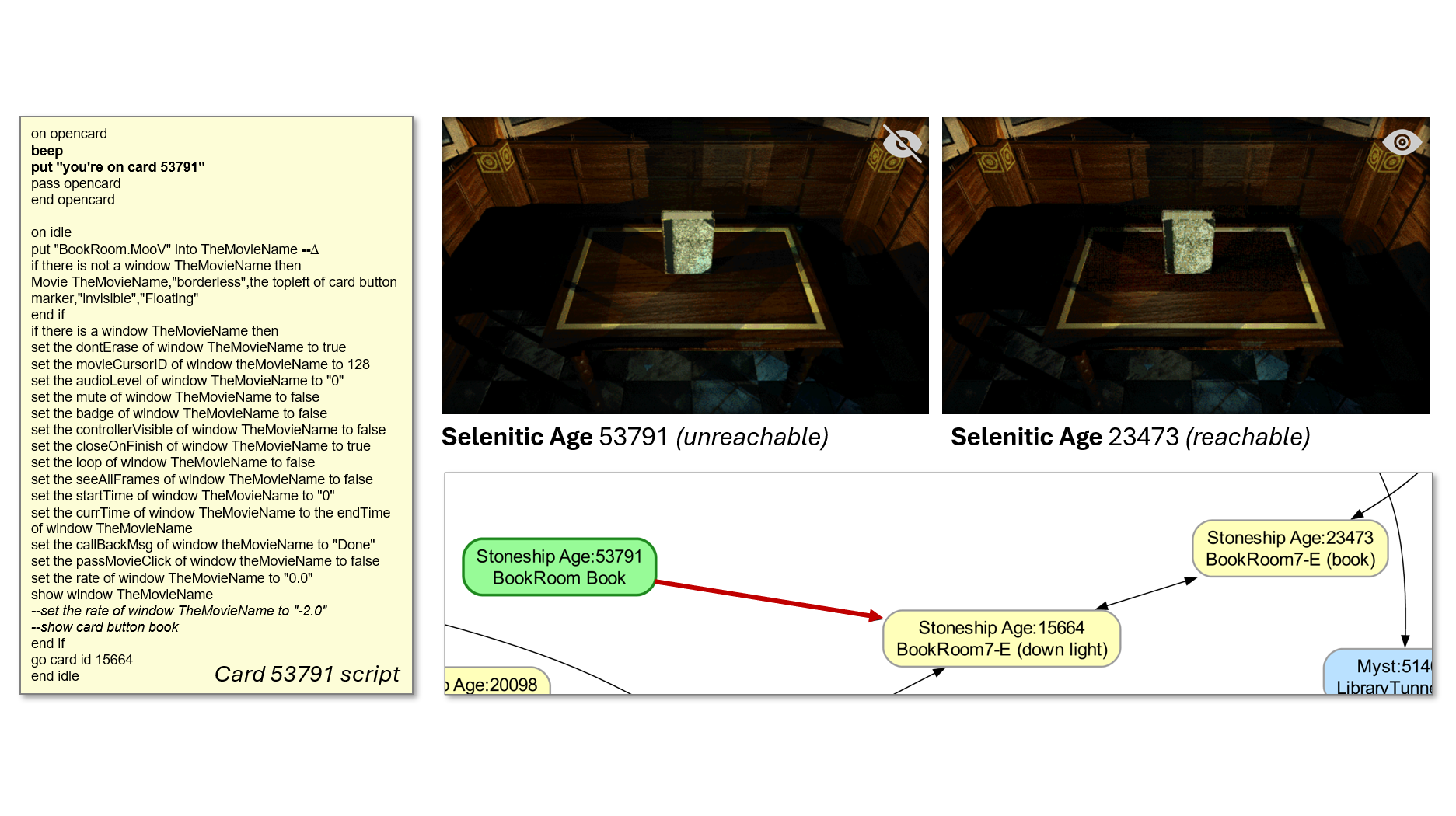
Node 53791, featuring the book linking to Myst Island, is interesting because it demonstrates a debugging device used by the Myst creators: the beep. The beep is noticeable on cards Mechanical Age:33554 (commented out), Mechanical Age:34613 (commented out), Myst:42800 (beep enabled, unreachable node), and Stoneship Age:53791 (beep enabled, unreachable node). The beep of Selenitic Age:54693 (the Mazerunner ship, a card so complex in comparison with the others that it would deserve an article of its own) is of another kind: it is part of the game, and sounds when the player presses the backtrack button where the maze offers no way back (if backTrack = "-" then beep). [(Update November 2026) I previously counted the Mazerunner beep among debugging remnants: in fact, it warns that backtracking is unavailable.] 53791 was replaced by 23473, which incorporates a very different script. Incidentally, they both represent the same image and use different image files.
Dunny (D’ni) Age
The Shared Card That Goes Nowhere
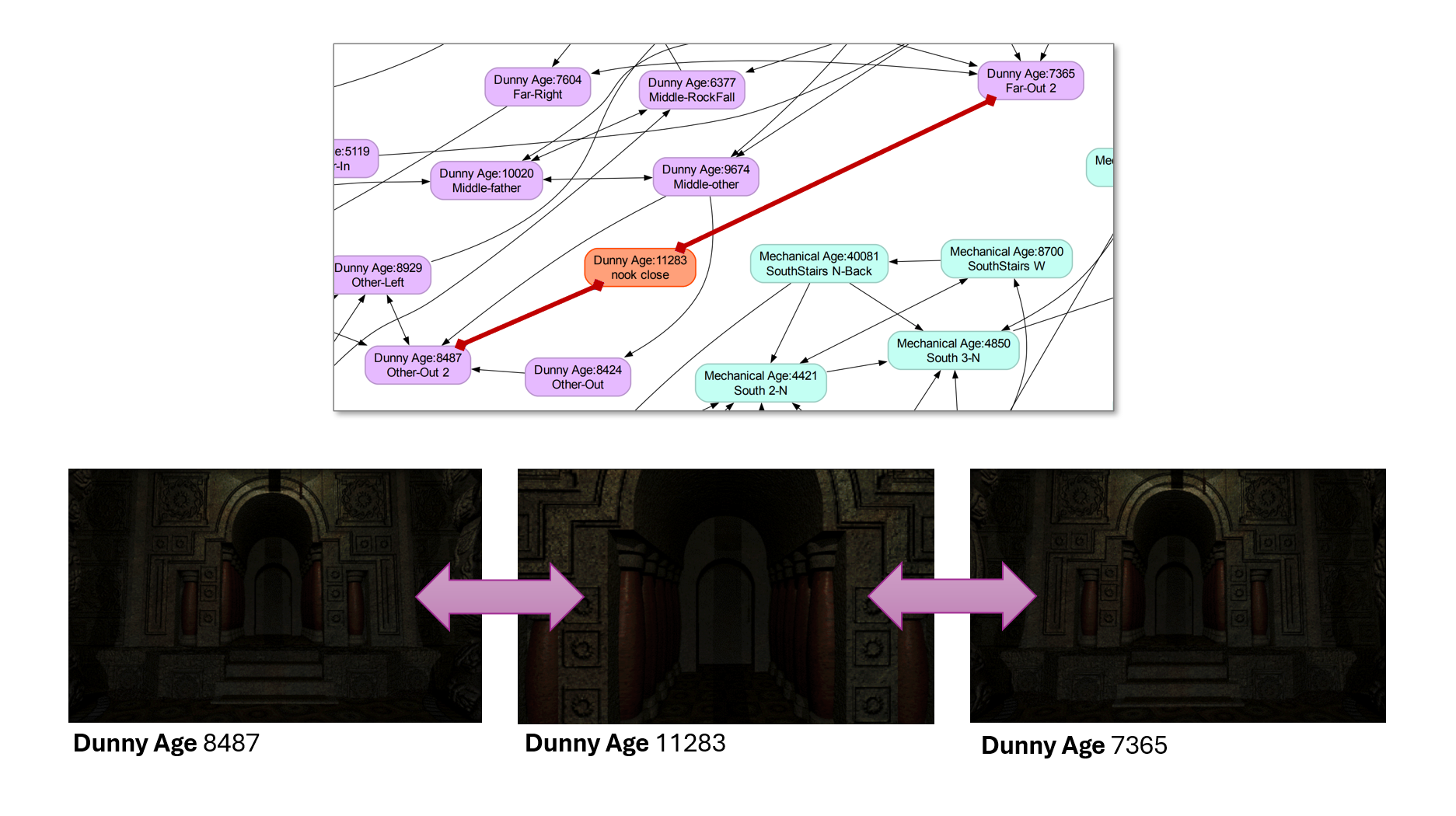
Last (at least for the scope of this article), two very similar locations, 7365 and 8487 (at first glance, the images may appear identical, but subtle differences suggest the rendering of different views), have backtracking edges to a common node, 11283. Because their architecture is the same, it makes sense for them to share the same zoomed-in perspective.
Conclusion
The findings presented here are low-hanging fruit revealed by the graph analysis, and probably more will emerge. Unreachable views, disabled links and false sinks are traces of how the game was built, and only a view of the whole makes them visible. In the third article, I go into great technical detail to explain how the Myst Graph generator, named DeMystify, works under the hood and open-source it.
Help shape DeMystify: send your ideas to .