The Revelation Graph, 2: Where the Nodes Stand
A single passage into the night, neighbors that are far apart, and eleven nodes that are named and not stored
Part 2 of 2 in The Revelation Graph


Introduction
The Revelation Graph, introduced in the previous article, draws the 618 nodes of Myst IV: Revelation and the references between them. [Version of the game: Myst IV: Revelation 1.0, the original English release on two DVDs, September 2004. The node names are those of this release.] As with Myst, Riven and Exile, I now look at what the graph shows that playing does not. To my knowledge, the findings presented here are new, except where I credit earlier work. Any node named below can be found in the explorable graph, where each link of this article opens the node it names.
Visual Indicators
I keep the two indicators of the Myst findings. A crossed-out eye on a view means that the game never displays it, as far as the stored references can tell: nothing leads to the node that holds it. An open eye means that the view is displayed in the game. Every view of this article has an open eye. [Node labels such as w5_z01_n020 have a thick underline, in the color of their Age, and open that node in the graph browser.]
A panorama is shown unrolled, twice as wide as it is high, with its front face at the center. Only the default picture of a node is shown: the movies, the water and the sky that the game adds are left out, and the sky is black. Edges under discussion are drawn in red, as in the earlier figures.
The maps are new. They draw the nodes as dots at the positions that the game stores, seen from above or from the side, with a line for each connection.
Disclaimer
The disclaimer of the first article applies. This article contains spoilers for the game, including its ending.
General
Shortest Theoretical Path
A new game begins in Tomahna by day, at w5_z01_n010. The three Ages are reached from Tomahna by night. From the first node to the arrival in Serenia (w4_z01_n010), the nearest of the three, the theoretical minimum distance is 32 edges:
w5_z01_n010 → w5_z01_n020 → w5_z02_n010 → w5_z02_n020 → w5_z02_n140 → w5_z02_n030 → w5_z02_n130 → w5_z01_n290 → w5_z01_n040 → w5_z01_n050 → w5_z04_n010 → w5_z04_n020 → w5_z04_n040 → w5_z04_n140 → w5_z04_n050 → w5_z04_n060 → w5_z04_n080 → w5_z01_n110 → w1_z01_n310 → w1_z01_n090 → w1_z04_n080 → w1_z04_n060 → w1_z04_n050 → w1_z04_n140 → w1_z04_n090 → w1_z04_n100 → w1_z04_n120 → w1_z03_n010 → w1_z03_n030 → w1_z03_n070 → w1_z03_n080 → w1_z03_n090 → w4_z01_n010.
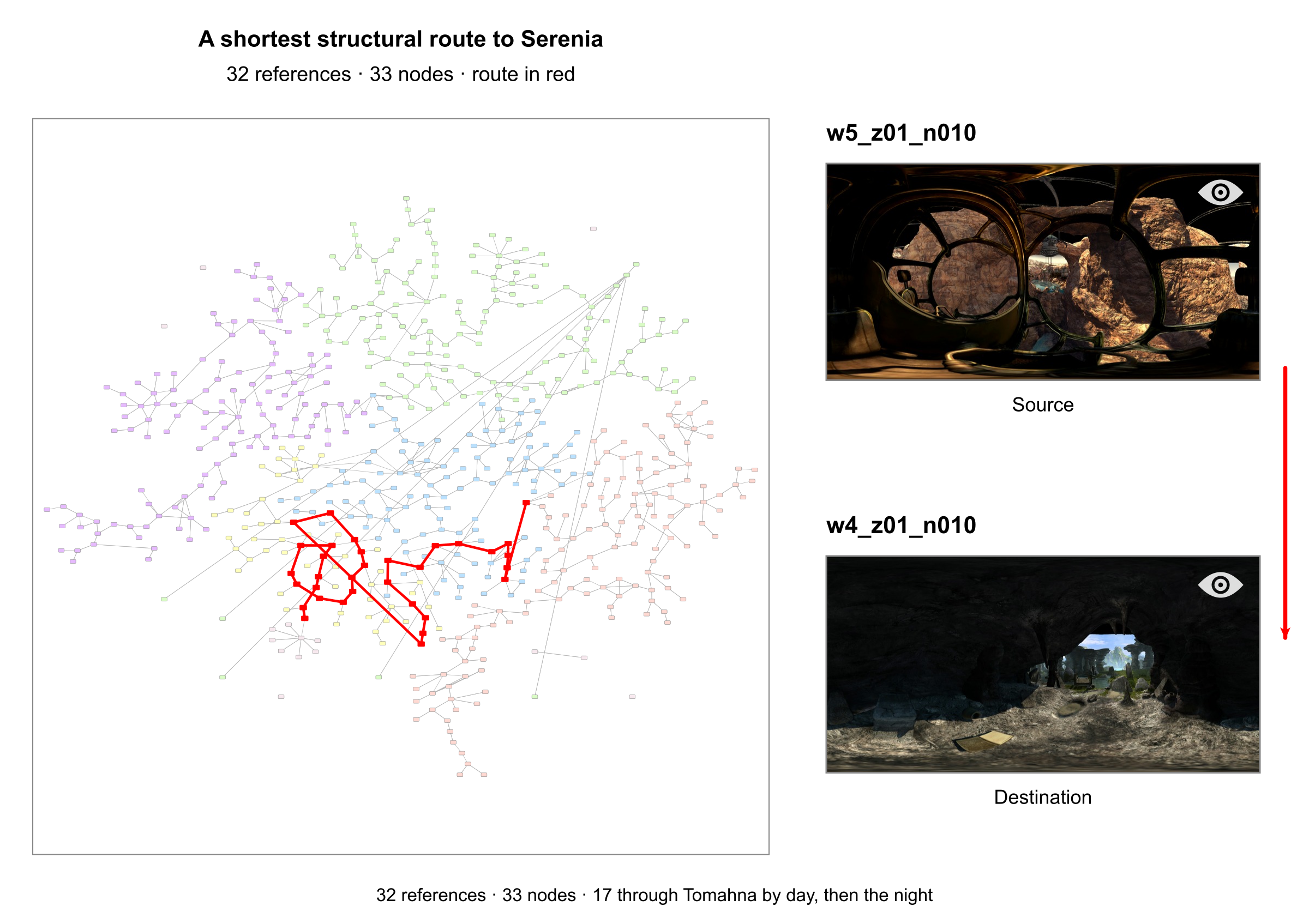
The route spends seventeen edges in the day, crosses into the night and walks back through the same building in the dark: the same zone and, for four nodes in a row, the same numbers in the other order. For comparison, reaching the final destination took 24 edges in Myst and 3 in Riven, while reaching Narayan in Exile took 23; here, 32 edges only reach the entrance of Serenia. As explained in the first article, a path in the graph is a distance between nodes, never a way to finish the game.
One Passage Into the Night
Tomahna is stored twice. By day it has 67 nodes, by night 126. Of the 67 nodes of the day, 63 have a node of the night with the same zone and the same number, and 59 of those stand at exactly the same position. The night is the larger world: four of its eight zones have no counterpart by day.
The two worlds are almost sealed from each other. Apart from five close-ups that the day borrows from the night, described below, exactly one connection takes the player from the day into the night, and no node stores it: it is compiled, in the class of w5_z01_n110:
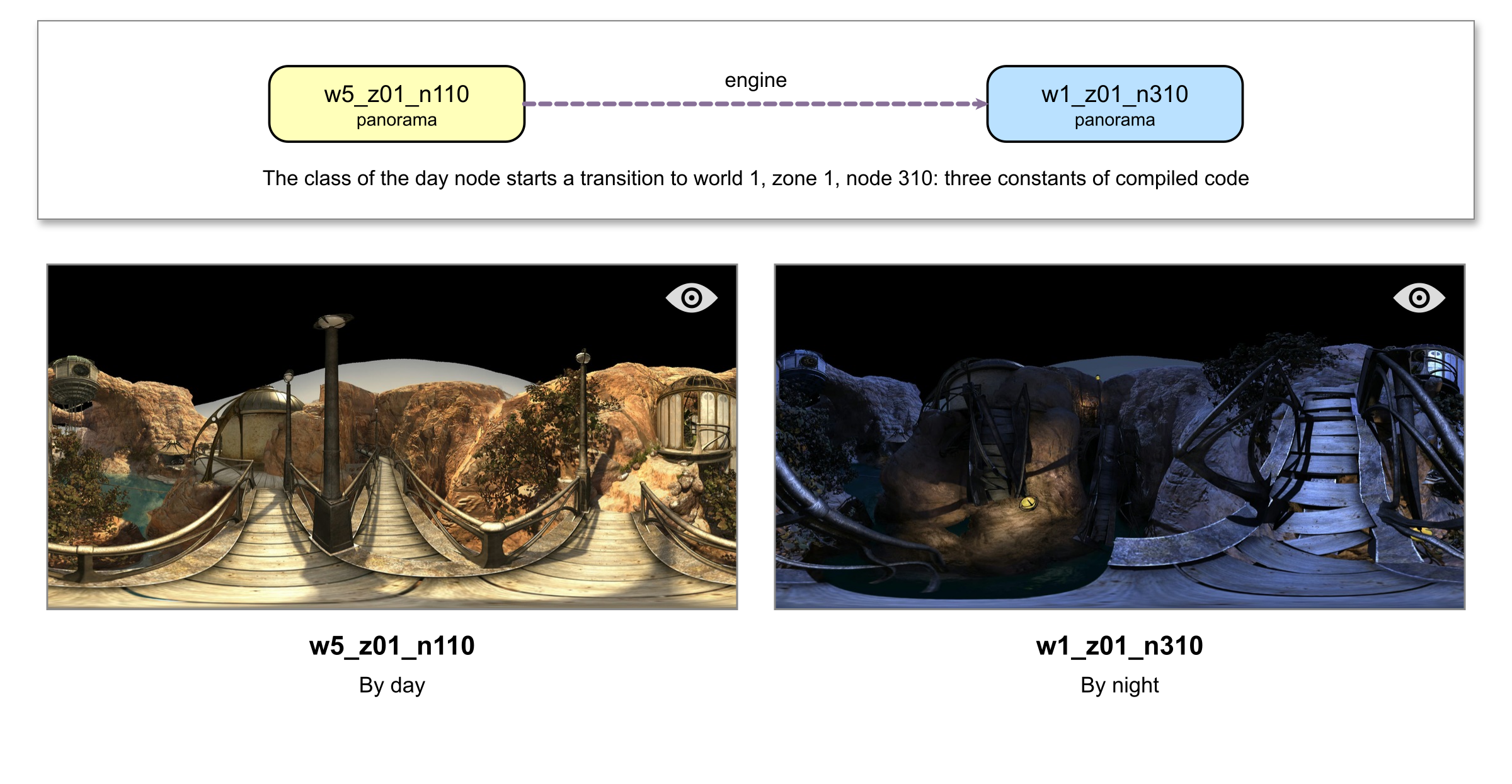
The passage from day to night. The class of w5_z01_n110 builds it in compiled code: a transition to world 1, zone 1, node 310, with the panel of the node called p_explosion. w1_z01_n310 stands 2.7 units from where the day ends.
Everything else hangs from it. Of the 609 nodes that the first node reaches, 557 lie behind w5_z01_n110: every route to them passes through that node. The route to the farthest node has 67 such unavoidable nodes, and the first seventeen are the way from the first node to that one.
The passage is not a click. When w5_z01_n110 becomes the current node, its class reads two variables of the power puzzle, clap1_open and clap2_open, and starts the transition only if both are false. A new game begins with both true, so the first walk through the node changes nothing. No command writes them: compiled classes do, and I did not read which act of the player sets them. The game’s own name for the movie of the passage is an explosion.
I tried it in the game. With both variables false, one step onto w5_z01_n110 plays the collapse of the walkway, and the player comes to at night in w1_z01_n310. With both true, the same step is an ordinary one.

The passage in the game: the walkway before the step, its collapse, and the first view of the night, w1_z01_n310.
The passage arrives at w1_z01_n310, a panorama of the path outside, by night, with one hotspot, which leads to w1_z01_n090, 4 units away. In the stored data, nothing leads to that node: no command, no parameter, no arrival record, and its neighbor has no hotspot toward it. Its entrance is three constants in the library of the day: 1, 1 and 310. The day has no node of that number, and the night has no node 110: w5_z01_n110 is one of four nodes of the day without a twin, with the first node of the game and the two nodes that lie beyond it.
What the data does name between the two worlds is a leftover. The day node w5_z02_n160 runs a class named for its twin of the night, and one of its parameters holds w5_z02_n160.tr_w1_z02_n170, a transition toward a node of the night. The day node stores no such transition; its twin, w1_z02_n160, stores one of that name, toward its neighbor. The value was renamed with the rest of the node when one Tomahna was made from the other, and it points at nothing. The graph does not draw it.
The day and the night do share something: five close-ups, stored once, in the night. A drawer of the day opens on w1_z02_n032, a node of the night, and so does the same drawer at night. These views store no way out. The engine goes back to the last node, whichever it was. The first article explains why the graph draws those returns and does not follow them: without that rule, the shortest path into the night would go through a drawer. That is a lot to ask of a drawer.
One name points the other way. Three nodes of the night use a class named for the day, w5_z04_incub, and each gives it the name of a close-up: w1_z04_n110 and w1_z04_n120 give w1_z04_n102, a close-up of the night, and w1_z04_n090 still gives w5_z04_n102, the same close-up by day. Two of the three names were changed when the day became the night, and the third was not. It changes nothing: the class does not open the close-up it names. It only compares the name with the last node the player visited, to know whether the player comes back from it. I tried it in the game: from these nodes, nothing on the incubator opens a close-up. The graph does not draw the name as a connection, and nothing leads from the night back to the day.
Longest Shortest Theoretical Path
The longest shortest path follows 87 edges, from w2_z05_n171, a fixed view at the end of Haven, to w4_z06_n330, in the Dream of Serenia. One pair of nodes reaches it:
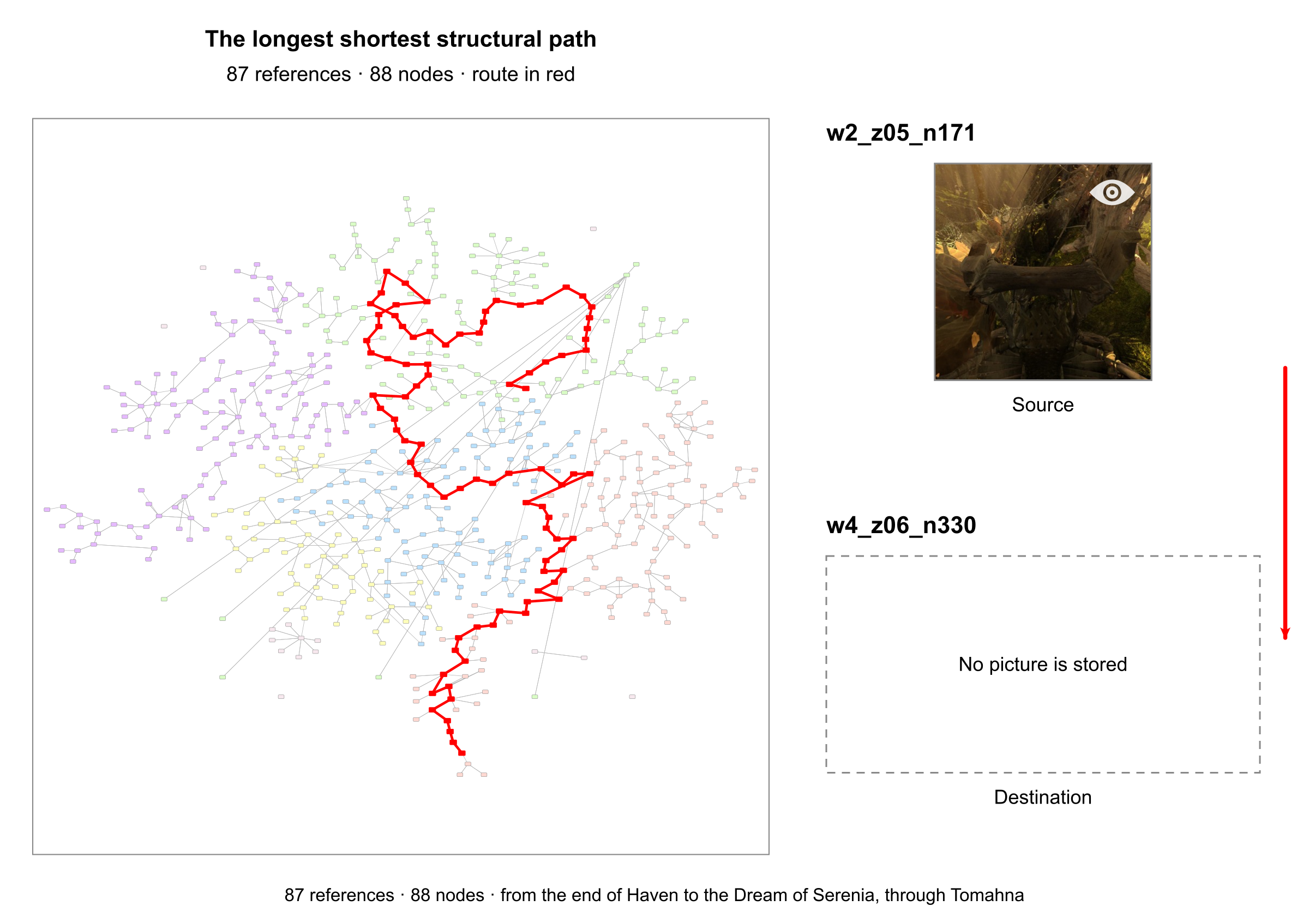
The path leaves Haven by its whole length, links back to the room of the books in Tomahna, crosses the night to the link to Serenia and walks Serenia to its end. In Exile, the same measure was 189 edges; in Riven, 125; in Myst, 130. Revelation is the smallest graph of the four and the most compact: the average distance between two of its nodes is 30.2 edges, against 58 in Exile.
What Zip Mode Buys
Zip mode is a ribbon of thumbnails: a click on one sends the player to a node already visited, in the same Age. The thumbnails are stored, two pictures per place, and they give the list: 28 Zip places, seven in Tomahna by night, six in Haven, six in Spire, five in Serenia and four in Tomahna by day.
Zip places are not drawn in the graph: each can be entered from every node of its Age, once visited. Adding them to the model gives what the mode buys. The longest shortest path falls from 87 to 24, the average distance from 30.2 to 7.9, and the farthest node from the first one is 22 edges away instead of 74.
Few Hubs
The busiest node is w1_z07_n030, a room of Tomahna by night: seven connections lead to it and ten leave it. No node has more than ten exits. Ninety percent of the connections join two nodes that stand less than 11 units apart: the graph is a set of corridors, as in Exile, and its hubs are rooms.
The Graph and the Map
Neighbors That Are Far Apart
With positions, a new question can be asked: which nodes stand close to each other and are far apart in the graph?
w1_z02_n010 and w1_z02_n150 are two panoramas of the same building, 3.5 units apart, which is the length of an ordinary step of this game. The shortest path between them has 11 edges.
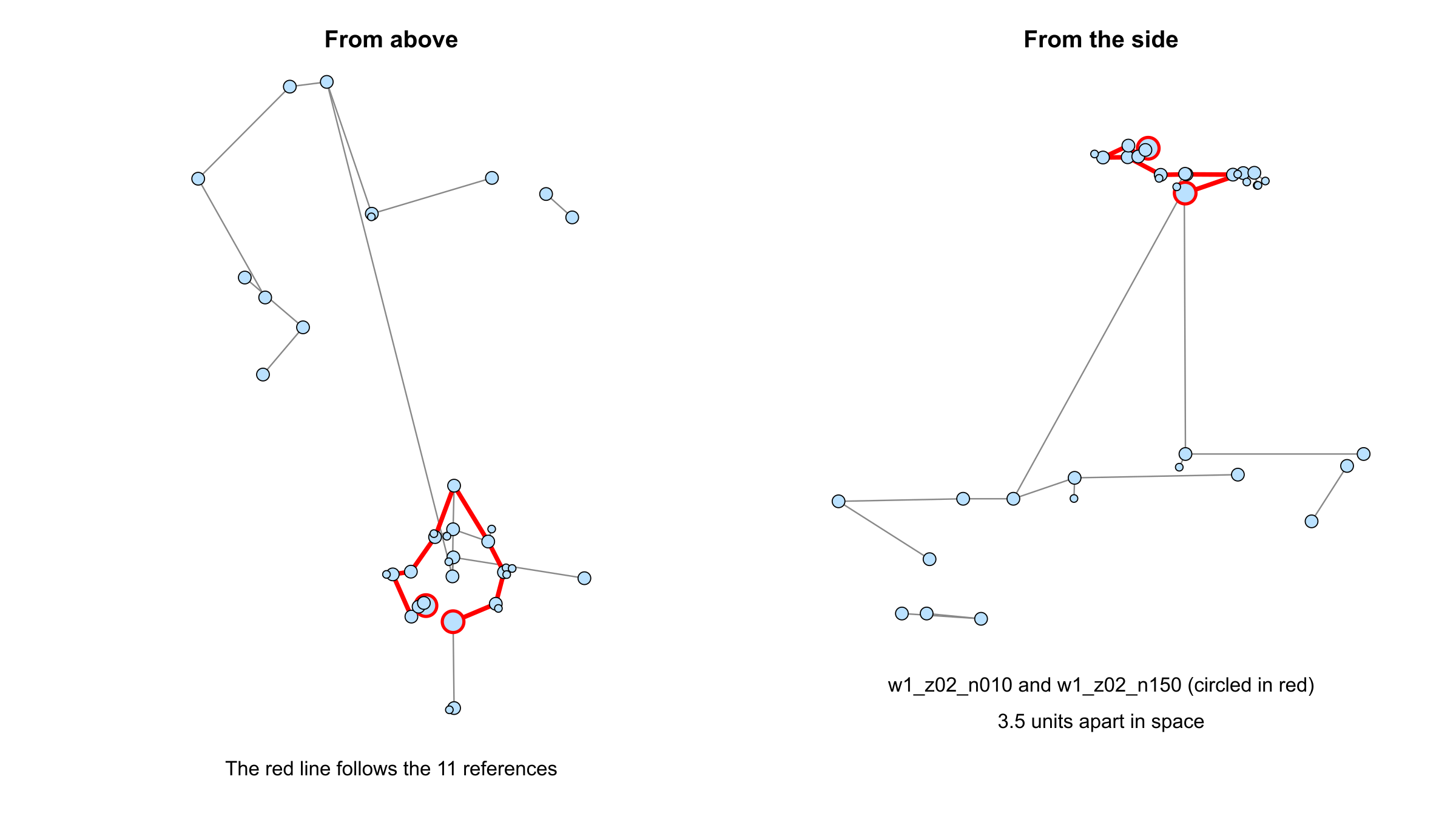
Two nodes a step apart in space and eleven edges apart in the graph. The red line is the shortest path between them.
The side view shows why: w1_z02_n150 stands 2.5 units higher, on the upper level. The path to it goes around the whole building. The graph measures the walk, the map measures the room, and their difference is the architecture.
The same comparison finds w4_z06_n170 and w4_z06_n230, in Serenia: 4 units and 10 edges.
Positions That Were Copied
The opposite case is a connection between two nodes that stand far apart. Half of the connections are shorter than 3.2 units, and nine in ten are shorter than 11. A few are much longer. Inside a zone, the longest ones all have one end in a node that stores no picture.
The reason is in the numbers themselves. w2_z01_n181 is a journal of Haven, a fixed view without a picture. It stands 189 units from the panorama it belongs to, at the position, to a tenth of a unit, of w1_z03_n091: a journal of Tomahna. w4_z02_n181, a journal of Serenia, stands exactly where w2_z06_n153, a journal of Haven, does. Five nodes of three Ages share one position to the last decimal: w1_z04_n115, w5_z04_n115, w1_z07_n034, w2_z06_n012 and w3_z03_n054. It is the position of w1_z04_n111, a fixed view of Tomahna. These five are not journals: they are the photographs of the game’s easter eggs, described below, and w1_z04_n111 is the close-up that opens one of them.
These matching positions suggest that nodes were copied and their coordinates left unchanged. A journal copied from another Age would bring its old position with it, even though the new view needs none. The maps of this study leave these 30 nodes out. Their coordinates offer clues to how the nodes were made, rather than reliable places on the map.
Between two zones, a few long connections join nodes that both have a picture. The longest is in Spire: w3_z02_n500 and w3_z04_n100 are 227 units apart and one click apart, in both directions. That one is a journey.
Nodes Without an Entrance
Five nodes outside the menu are not reached from the first node. Seven nodes are entered only by compiled code: five of them are reached that way, and two are not.
Entered by Compiled Code
w2_z05_n082 to w2_z05_n086, five fixed views of Haven, are the five branches of one compiled choice: the same call changes node with 82, 83, 84, 85 or 86 as its last number. The routine belongs to the class of w2_z05_n080, which picks the branch from an index, and a class that the five views share leads back to it. w4_z06_n310 and w4_z06_n320, in the Dream, are two more constants, side by side in the library of Serenia: the class of w4_z06_n260 reads a variable and goes to the first when it is 0, to the second when it is 1.
None of these routines names a node. Each is given to a node by its class: the method that calls the routine or hands it over, and the node that lists the class (the first article describes the reading). The five views of Haven are reached that way. The two nodes of the Dream are not, since their own origin is not.
Three Others
w3_z01_n032 is a vision of the amulet in Spire. A vision is normally named by the node it belongs to, and names it in return. This one names w3_z01_n031 as the node to go back to, and w3_z01_n031 does not name it. Changing one settings line lets the game open and play this unused vision directly.
w3_z04_n200 is a panorama of Spire without a picture. One of the two nodes that the interface treats as fixed whatever their kind, it stores limits for a pitch, a yaw and a zoom: it is a view through an instrument. w3_z04_n190 records the direction to face when arriving from it, and nothing stored goes the other way.
w4_z06_n260 belongs to the Dream, which a later section describes: it leads to w4_z06_n310 and w4_z06_n320, and both lead back to it, but nothing that path search follows enters the three.
What the Discs Name and Do Not Hold
Eleven Nodes That Are Not There
Eleven targets are named by the data and have no archive on the disc:
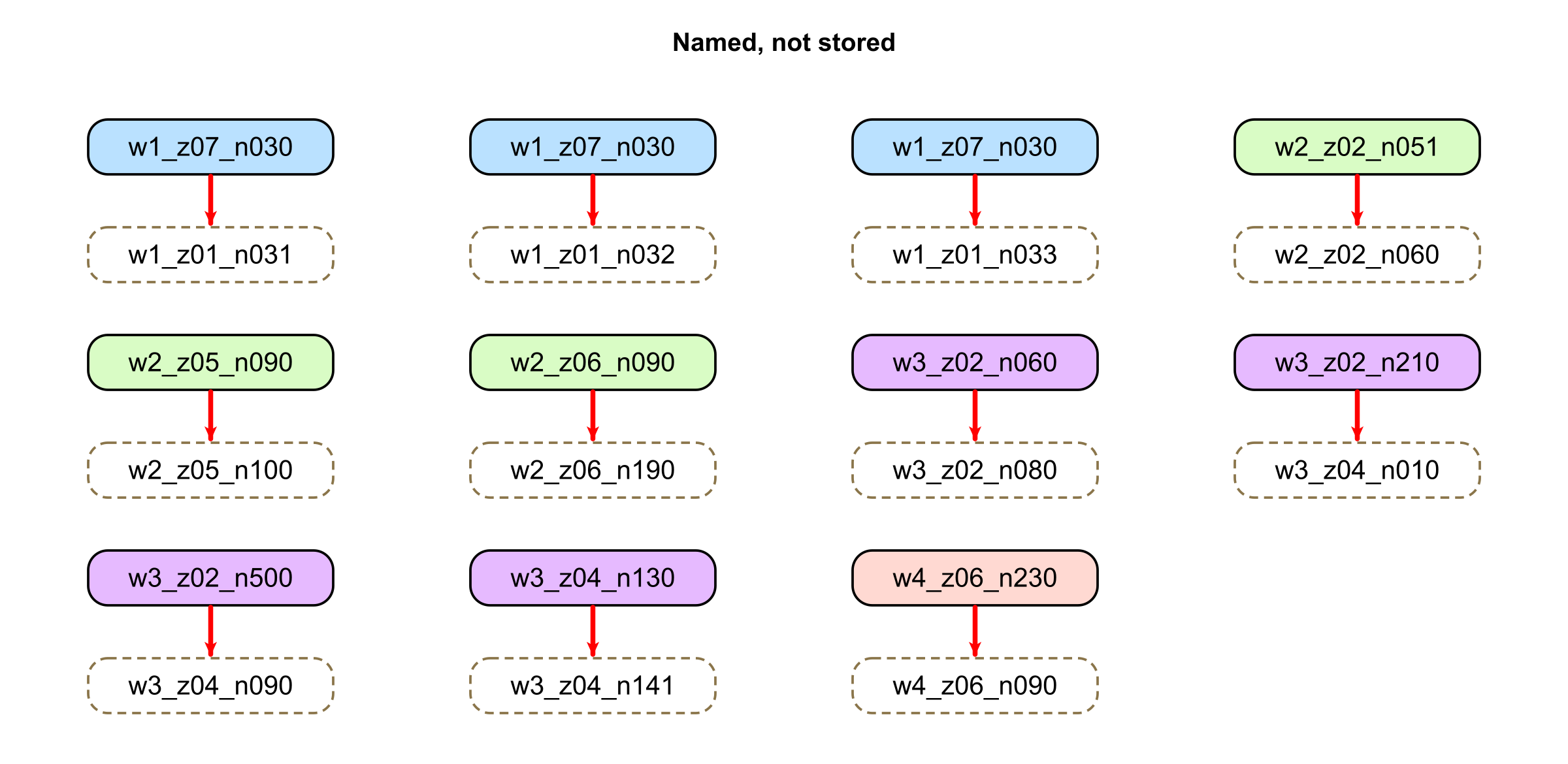
Two are named by commands. In Spire, a click in w3_z02_n060 runs ContextChange(3,02,080), and in Serenia a click in w4_z06_n230 runs ContextChange(4,06,090). Neither node exists. What would start these commands is stored as well, a click on a hotspot of that name, but not the hotspots themselves: neither node keeps a shape for them, so no click can reach them. Of the 1,017 clicks that the data ties to a move, these are two of the six without a hotspot.
The nine others are named by compiled code: hotspot names written as constants in the libraries, or parameters of compiled classes. The library of the night names three hotspots of w1_z07_n030, the busiest node of the graph: h_to_w1_z01_n031, h_to_w1_z01_n032 and h_to_w1_z01_n033. The node has none of them. Its own are called h_to_w1_z07_n031 to h_to_w1_z07_n033, and they lead to three close-ups that are stored. By the convention of the node numbers, the names of the code would be three fixed views of a panorama numbered 30 in zone 1, and that panorama is not stored either.
A name that leads nowhere is not necessarily a mistake. Compiled code can name a hotspot that it never uses, or use it for something other than a move. The graph records the name and draws the target as virtual.
A Table of Neighbors From an Earlier Version
Beside the node archives, the main archive holds a small file, nodedb.ndb: a table that gives, for each node, the nodes next to it. According to a study of the engine’s performance, the routine that would read it is an empty stub in the released program, so the game never uses it. The same study notes that the table is stale: some of its names are of nodes that no longer exist, and 249 nodes have no entry.
The table has 383 entries, and the graph shows the earlier state of the game that it describes:
- 14 of its entries are for nodes that no longer exist, such as
w1_z01_n004,w4_z02_n014orw4_z06_n188, and four more names of that kind appear only among the neighbors: 18 in all. Twelve of the 14 have a number that ends in 4. - 249 of the 618 stored nodes have no entry.
- Where it joins two stored nodes, the graph already joins them: the table adds no connection.
The table and the virtual targets overlap. w3_z02_n080 and w4_z06_n090, the two nodes that commands still ask for, are also listed in it as neighbors.
Names That Kept an Older Number
The parameters of the compiled classes have names, and seven names disagree with their values. In Spire, the class of w3_z05_n030 has a parameter called m_h_to_w3_z05_n040. Its value is the hotspot h_to_w3_z05_n050. There is no node 40 in that zone: the parameter was named when there was one, and the name is compiled into the library.
Two of the seven show how the night was made. The class of the day node w5_z01_n020 has a parameter named for a node of the night, and the class of the night node w1_z02_n130 has one named for a node of the day. The two Tomahnas share their classes, and each class was named in one world and reused in the other.
In all, the parameters mention 20 names of nodes that are not stored.
Commands That Were Switched Off
Much like Myst’s commented-out HyperTalk lines, a command that starts with a semicolon is ignored. The game stores 1,185 such lines among its 28,980. Most are settings that were tried and replaced. A few name things that the node no longer has: the first block of w1_z01_n020 still holds, switched off, a command that sets the state of a panel called p_levi_vehi and another that selects a state of the picture called state_w1_z01_vehicule_hidder. Neither the panel nor the state is stored in the node. Véhicule is French for vehicle: something that could be hidden once stood there. Between the French véhicule and the English hidder (with a spare d), the commented-out line also preserves a small bilingual souvenir of Montreal.
Thirty Nodes Without a Picture
Thirty nodes store no picture layer at all. Most are fixed views whose content is a movie or a book: the journals, which the game draws page by page on a panel, and several close-ups of mechanisms. Five have no class either, and one position for all five: they are the photographs of the game’s five easter eggs, long known to its players. Each stores an animation that carries a photograph of one of the teams that made the game, and a close-up opens it after eight taps in a given order, which a compiled class called easter_egg counts.
Seven are panoramas. One is the view through an instrument of Spire, w3_z04_n200, described above. The six others, w4_z04_n240, w4_z04_n250, w4_z06_n260, w4_z06_n310, w4_z06_n320 and w4_z06_n330 are panoramas of Serenia, and they are the Dream.
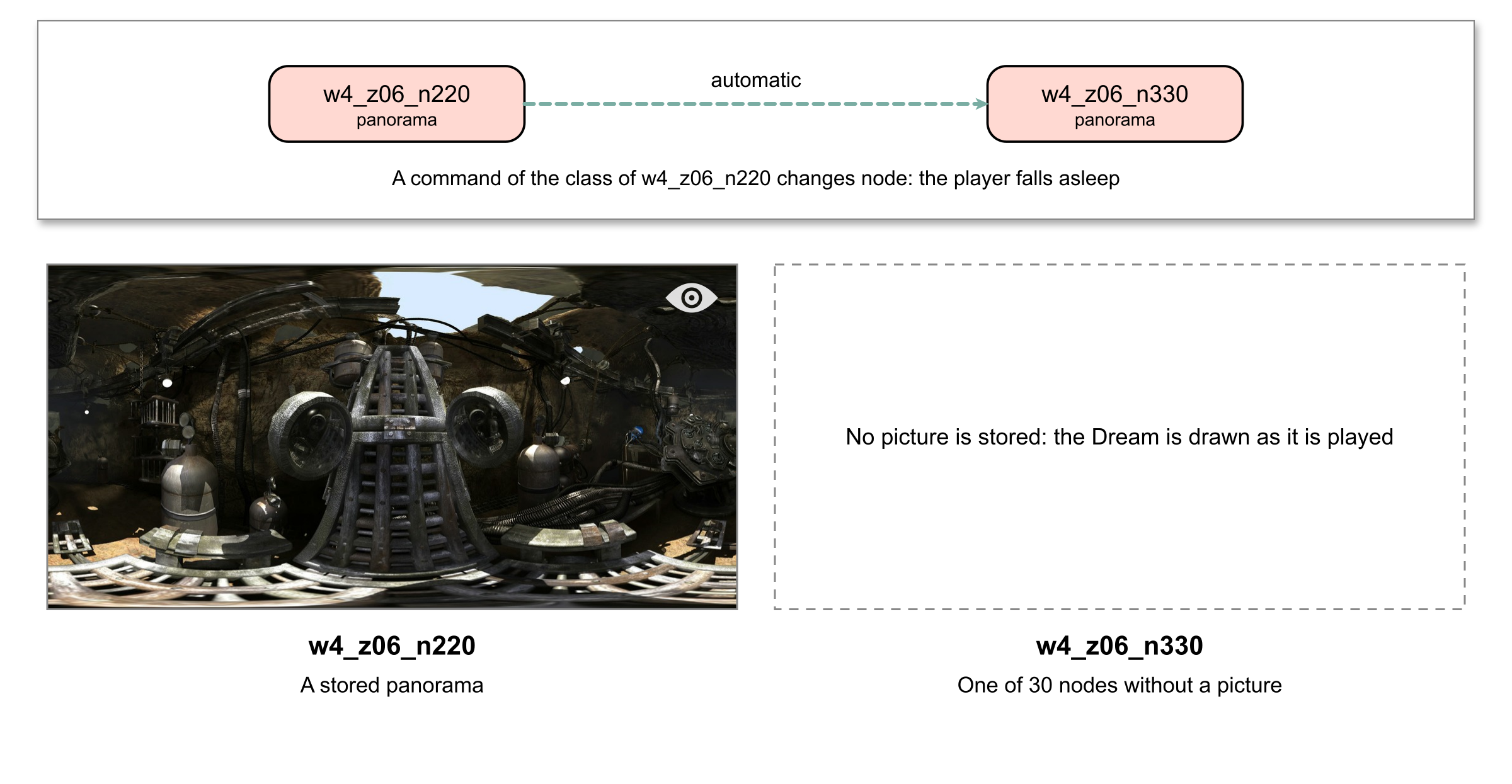
The entrance of the Dream. w4_z06_n220 has a panorama; w4_z06_n330, where its command sends the player, has none.
In the rest of the game, a node is a picture rendered in advance, with movies laid over it. In the Dream, the classes of the nodes take objects, halos, particles and positions as parameters, and no cube: the scene is drawn while it is played. The world of pictures that began with Myst ends here, inside its fourth game, in six nodes.
The Dream is also where the two automatic connections of the graph are. A command called cmd_dream_mask_effect, started by a class and by no click, changes node: the player does not walk into the Dream.
And it is where the graph stops. w4_z06_n260 is not reached from the first node: the one command that leads to it from a reached node is among the nine that nothing stored starts, and the two other nodes that lead to it are entered from it alone. The last steps of the game are compiled.
Conclusion
The graph of Revelation is the smallest of the series and the most regular. Outside the menu, its numbers follow a rule without exception, its commands can be read aloud, and nearly every step can be walked back.
What it adds is a second drawing. Because each node knows where it stands, the graph can be laid over the place it describes, and the differences between the two are findings of their own: a level that turns one step into eleven, a journal of Haven that stands in Tomahna, a whole world behind one node.
What is left over is thin and precise: a transition that the day names and only the night stores, eleven names without a node, a table of neighbors from an earlier version, a vehicle switched off. And the ending is where the method runs out, in six nodes that have no picture to show.