The Contradictions of the Fifth Age: Riven (1997)
An unclickable egg, grounded birds, and pictures Riven never picks
Part 2 of 5 in Behind the Ages
The Riven Graph maps the links between the game’s views. Looking inside the cards and scripts turns up a different set of development traces: a seventh easter egg buried under an ordinary step forward, bird flights whose counters reset just before they can trigger, and extra renders sitting unselected in Gehn’s laboratory. [Card labels such as Boiler:299 have a thick underline, in the color of their island, and open that place in the graph browser of the game.]
Riven keeps its easter eggs behind five clicks, made in a fixed order on five hidden hotspots, and its players know the six that they open.1 Two variables count the clicks, and seven cards wait for the result.2 [Version of the game: Riven 1.0, the original English five-CD release, September 1997. The card numbers are those of this release.]
The Seventh Egg Cannot Be Clicked
How to test the blocked hotspot.
- Make the five clicks of the egg hunt, in their order.
- On Book Assembly Island, walk the path around the crater to the view just past the pipe (Boiler:299).
- Click the spot at the foot of the rock, below the ladder.

The small square is the egg. The dashed outline is the hotspot of the ordinary step forward.
In the filmed test, I used ScummVM’s debugger to set the flag that enables the eggs. Clicking the spot took me forward to the ladder (Boiler:305).

After the click: the ladder, one step forward, and no press.
When the five clicks are done, the scripts switch on a hotspot named egg on that view: a square of 12 by 12 pixels at the foot of the rock, which leads to a card that nothing else leads to (Boiler:304), a press for binding books. The click never reaches it. The larger hotspot of the step forward contains it entirely, and when two hotspots lie under the pointer, Riven gives the click to the one stored last: the step forward is stored after the egg, and nothing ever switches it off. The eggs that do open are built the other way around: the egg in the drawer, the star and the bowl also lie inside larger hotspots, but are stored after them.
The press is there, complete.3 Reached with ScummVM’s debugger, its wheel screws the plate down, and a second click raises it.

The book press, on a card that no click leads to.
The hotspots are numbered, and on most cards of the game number 3 is the step forward. Here, number 3 is the egg, the only one of its number so small, and the step forward is a later hotspot laid over it. It reads as if the egg had been cut out of the card’s own way forward, with a new way forward laid on top in the wrong order. In the iOS edition, the click works.
One more click switches the eggs off.4 Enthusiasm, in Riven’s egg hunt, is penalized: one extra click on the drawer egg politely resets the whole expedition. The first of the five hotspots advances the count only when it is at zero, and resets the eggs every time it is clicked: after that click the eggs no longer open, and the hunt starts again from its first step. The hidden spot beside the ore cart of Boiler:491, which answered a moment before, then does nothing.
Two Flights That Never Play
How to reach them. Not in normal play. In ScummVM, open the debugger (Ctrl+Alt+D; Control+Option+D on a Mac) and type changeStack bspit 326; open it again, type var bbirds 6, then changeCard 326. The second flight cannot be shown at all.
The wooden balcony path, on the cliff of Book Assembly Island, has five views that share a counter named bbirds. Every arrival on one of them adds one to it, and at six it goes back to zero. Three of the views play a short flight of a bird when the counter has the right value, the flights that players see. A fourth view (Boiler:326) plays its own flight when the counter is at six. But the script that brings the counter to six puts it back to zero at once, so no arrival ever finds it there. With the counter set by hand, the bird flies.

The flight of Boiler:326, which waits for a count that never comes: a small white bird crosses the sky from the lower left to the upper right in less than a second.
A fifth flight of the same family is listed on Boiler:200, and no script plays it. Its frames, extracted from the game’s files, show the largest bird of the family.

The movie of Boiler:200, which nothing plays: six of its thirty-nine frames, enlarged twice.
The highest value that the scripts test is the one at which the counter goes back to zero, and it is the only value that never comes. Jungle Island has the same counter, under another name, with the same gap three times: its counter goes back to zero at nine, and three of its views wait for nine.5 Whether the gap is a slip or a way of parking a flight, the files do not say.
Two Extra Renders in Gehn’s Laboratory
Pull the lever on the round stove in Gehn’s lab and its door swings open. The official hintbook describes finding the partly burned linking book inside. On Boiler:163, the script draws picture 1 with the door closed and picture 2 with it open. The variable bstove records that door position.

Open eyes: the two stove views selected in play. Crossed-out eyes: the two unused book views, unreachable in normal play.
The same card lists those two book pictures as entries 3 and 4, named 163_bgehnlab_bkclsd.210 and 163_bgehnlab_bkopn.210. Its script never selects them, so these two book views are unreachable in normal play. Clicking the book sends the player to Boiler:279 for the close-up. The extra pictures show what an in-place view would look like, though the files give no reason for keeping them. Even Gehn kept a few drafts.
Two More Picture Layers
Boiler:230 also holds a small image of a fire-marble dome. Its load script selects the two main views and never selects this patch.
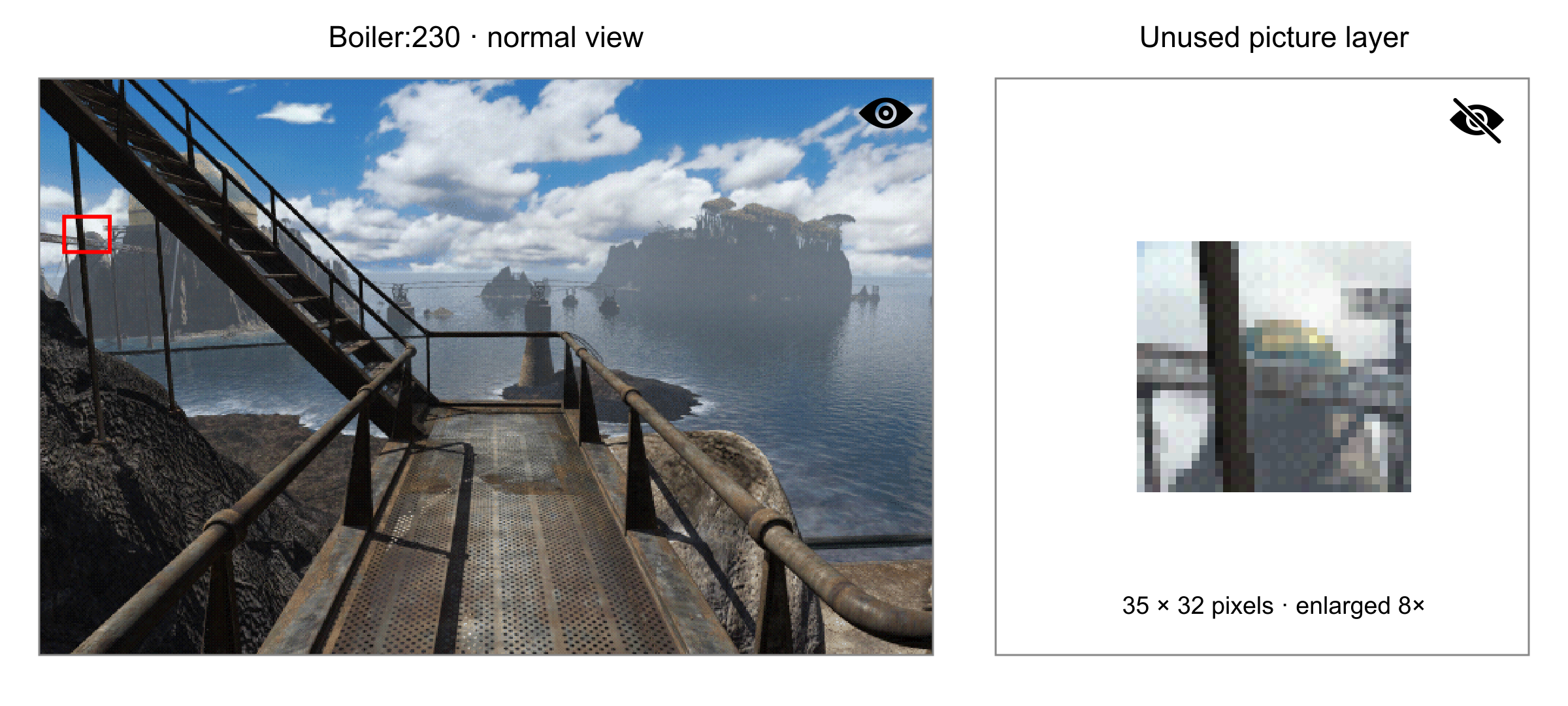
The red rectangle marks where the dome layer would go. On the right is the unused picture, enlarged 8×.
Another unused layer on Jungle:281 shows a raised submarine. That card’s load and update scripts select its other three pictures.
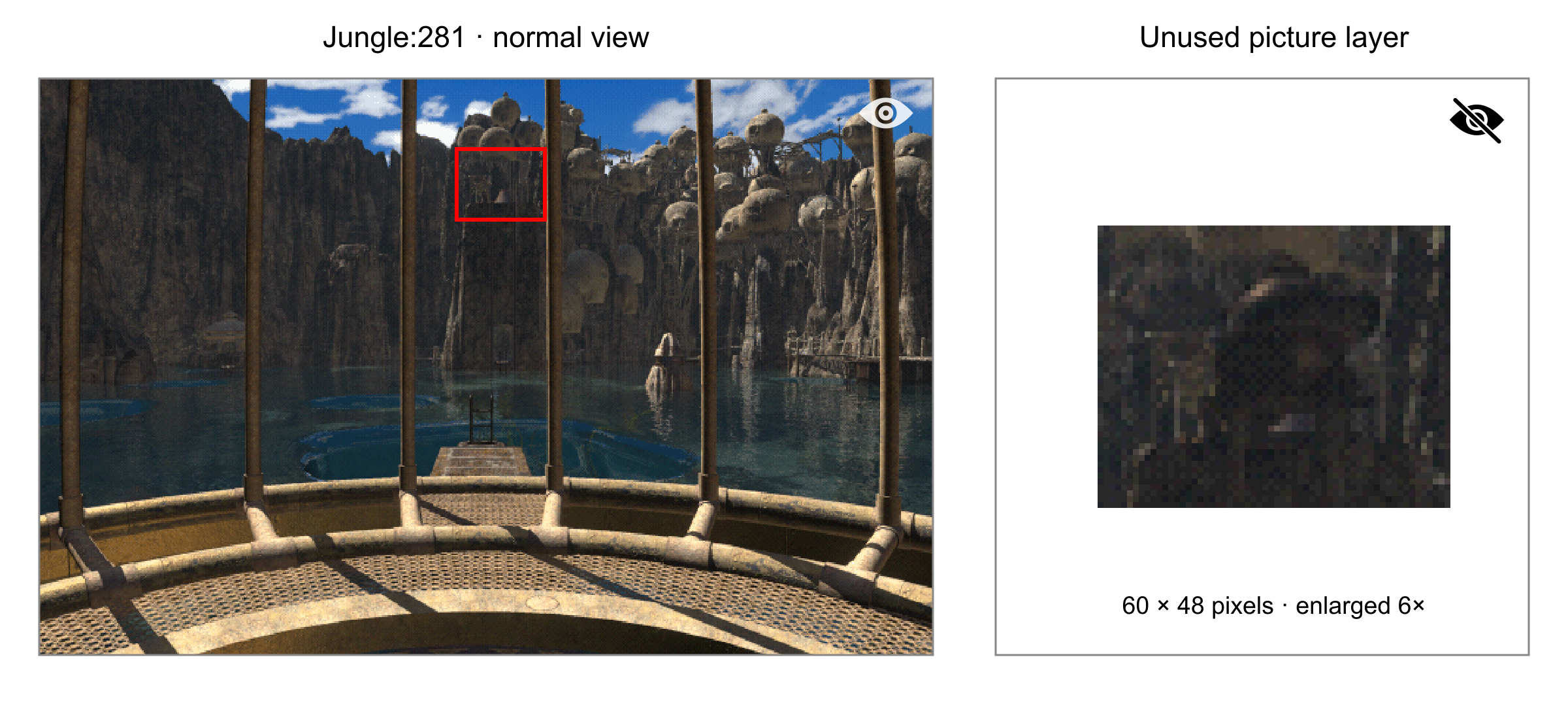
The red rectangle marks the submarine layer’s position. On the right is the unused picture, enlarged 6×.
Both layers are present on the original CDs, established here from the card scripts and stored picture lists rather than in-game tests.
Conclusion
Unlike Myst, where forgotten developer buttons still answer a stray click, Riven’s contradictions work the other way around: scripts enable an easter egg that a later hotspot swallows, wait for bird counts that reset one step too soon, and keep finished renders that no branch ever draws. Almost thirty years after release, the files still hold pieces of the Fifth Age that the game itself refuses to show, complementing the visual anomalies cataloged in The Riven Diffs.
Listed since 1998 by Riven Easter Eggs Revealed. That page counts six: the sixth, found by Gregg Collins, was confirmed by Richard A. Watson of Cyan, and the page wondered whether every island had one, since Prison Island had none. A later update of the page, sent by a reader, reports a seventh egg in the iPad edition, with its spot: the book press of Book Assembly Island, below. In the files of 1997, no card of Prison Island tests the flag that switches the eggs on. ↩︎
The second Riven Graph article follows these two variables. ↩︎
The press itself was known: Myst Journey gives its two movies and why Cyan took it out (testers took it for a lock), The Cutting Room Floor describes it as a removed object and shows the small hotspot of this view that leads to its card, and a working press was reported in October 2012 as a new egg of the iOS edition, and of that edition alone. ↩︎
Players advise clicking each of the five spots only once (MYST & RIVEN Illustrated): the scripts give the reason. ↩︎
That a variable decides when the birds of Jungle Island fly is noted in one line on the wiki of the Mohawk engine. ↩︎