What Quotation Marks, String Literals and DNA Have in Common
First-Order Expressions, Second-Order Expressions, and the Delimiters Between Them
There seems to be a pattern in languages (in the broadest sense in the context of this article: a series of symbols that are evaluated or interpreted): a duality between first-order expressions and second-order expressions that have different purposes but paradoxically use the same symbols.
This observation is probably self-evident (it echoes the use–mention distinction in philosophy of language, discussed by Gottlob Frege and Willard Van Orman Quine, and Alfred Tarski’s distinction between an object language and the metalanguage that talks about it), but I have not seen it explicitly formulated in these terms:
A language primarily uses first-order expressions, which are intended to be evaluated. A human reader evaluates a human language to produce a representation of the world. An example of a first-order expression in English is: It is raining outside.
A language also needs to represent information used in a capacity different from first-order expressions. This information is represented with second-order expressions. Example: “And what is the use of a book,” thought Alice, “without pictures or conversations?” In this context, this expression has a different purpose: it represents what someone other than the narrator is thinking or saying.
First- and second-order expressions use the same symbols (for instance, the English alphabet).
First- and second-order expressions are separated with delimiters. Only delimiters identify whether an expression is of the first-order kind or of the second-order one. In other words, they signal a transition between purposes.
A language evaluator (e.g., someone reading a sentence) needs the delimiters to switch between first-order and second-order purposes.
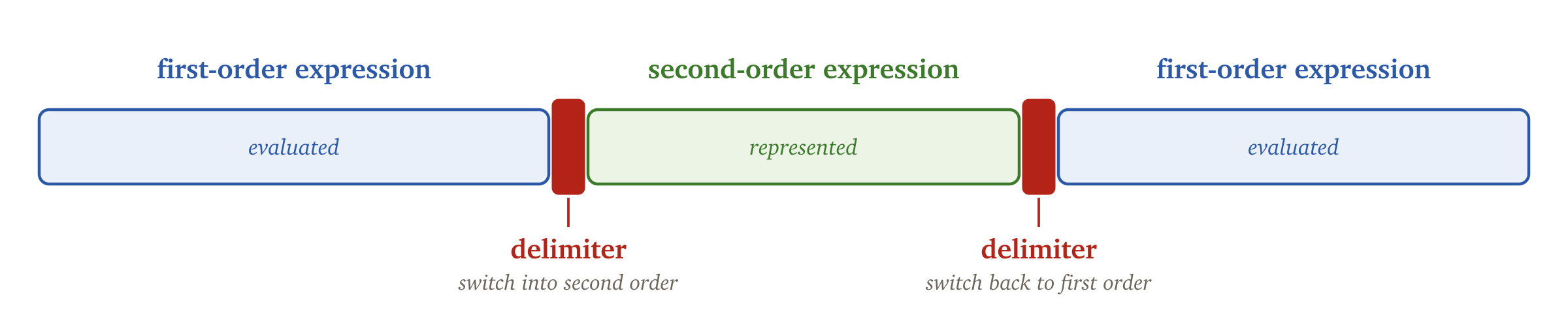
A delimiter switches into second order; the next one switches back.
Three Languages, One Mechanism
This observation can be applied to many forms of languages. I suggest three of them: natural language, artificial language, and genetic code.
Since antiquity (for example, ḏd-mdw in Ancient Egypt), human language has used this mechanism to report what someone other than the narrator says. In English, the delimiters are the quotation marks.


In reported speech, the quotation marks are the delimiters.
Many programming languages use this approach to distinguish between evaluated and represented statements. Examples in Python:
print(1 + 1) → 2vs.print('1 + 1') → 1 + 1.

In code, the quotes of a string literal do the same.
LISP uses an apostrophe (or
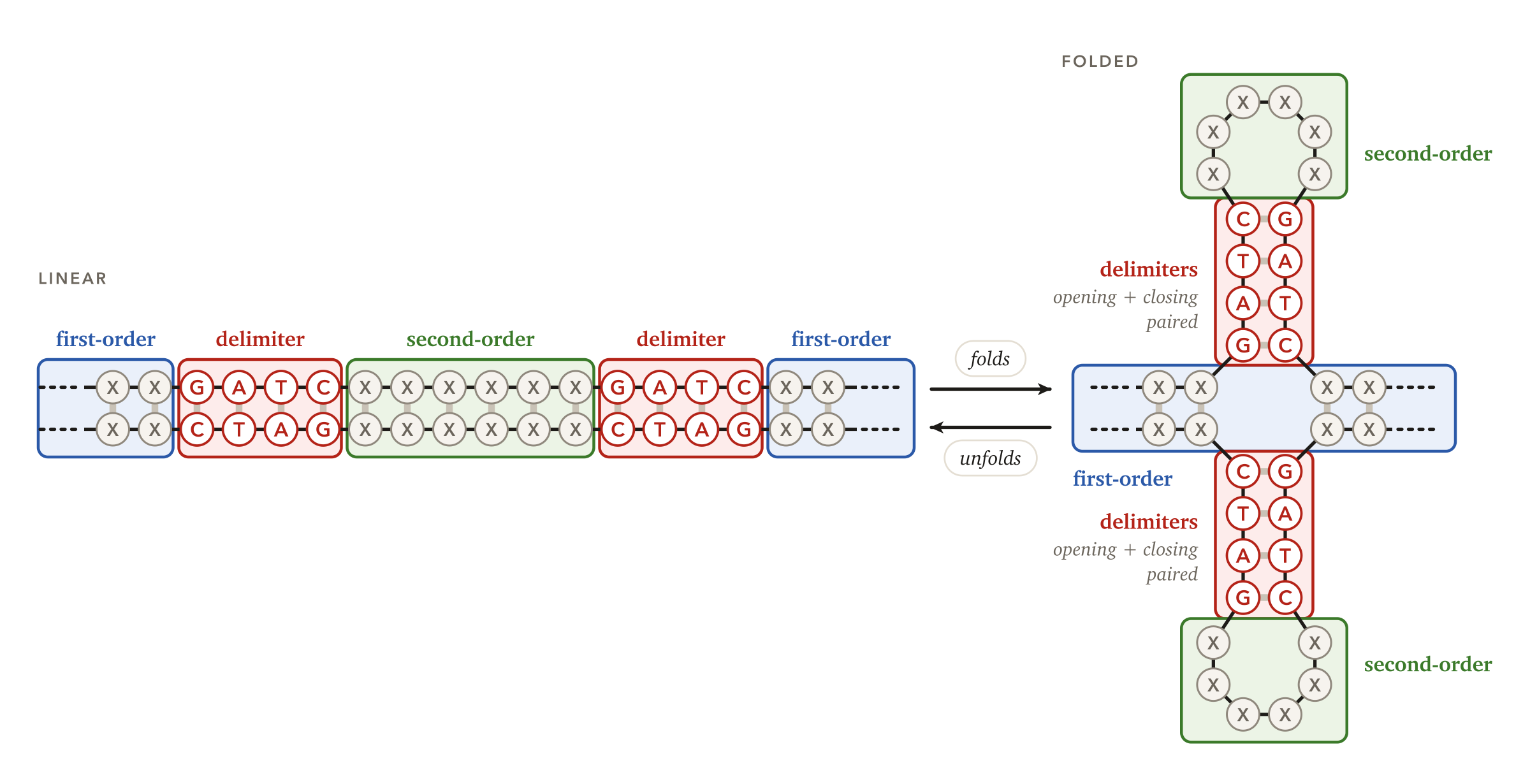
QUOTE). Quine programs are characteristic of this approach: they usually duplicate and combine first-order symbols (the code evaluated by the computer) and second-order symbols (the code represented by the computer) to blur the line between them as they output the exact representation of the evaluated code. The delimiters are usually quotation marks, too.When viewing DNA as a language, a similar mechanism appears to be in place. In a CRISPR locus, short repeated sequences act as delimiters: the same thirty-odd bases return again and again, and set apart segments with a different purpose than the rest of the DNA. For instance, when a bacterium is infected by a virus, it can store part of the virus’s DNA, in segments named “spacers” (second-order expression), into its own DNA (first-order expression). Precisely because they are second-order expressions, these spacers are not evaluated but ultimately (after their transcription) used as signatures by Cas proteins (Cas9 in the best-known systems) to detect known invading viruses. They act as a genetic memory (i.e., they represent information). More generally, CRISPR embodies this duality.
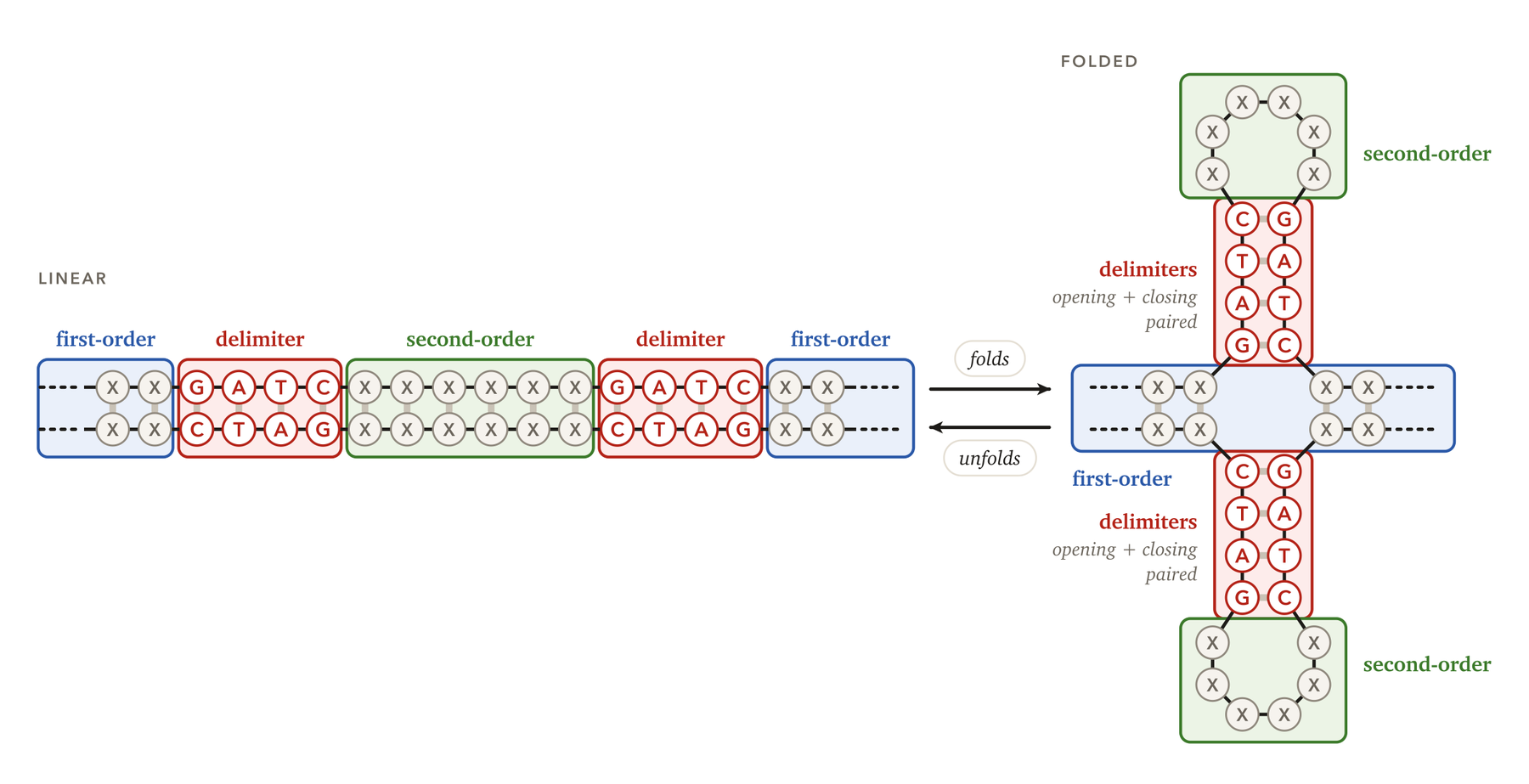
Fold the strands
In the scientific literature, analogies with human language focus mainly on palindromes (for example, this parallel with the Sator square, about the palindromic motifs that regulate genes). The “P” of CRISPR stands for palindromic because many of these repeats are partly palindromic, yet what delimits a spacer is the repetition: the same sequence before it and after it. I believe a more meaningful analogy would be to compare them with quotation marks. Because genetic code has a limited set of “symbols,” it cannot express the delimiters with a special base: a fixed sequence of ordinary bases constitutes the delimiter. It is as if the English language did not use special characters but a fixed sequence of letters instead:
She told him xyyx It is raining outside xyyx and therefore . . .. (In this example, the samexyyxopens and closes the second-order expression, as straight quotation marks do.)


When a Delimiter Appears Inside: Escaping
Because delimiters are written with ordinary symbols, one can turn up inside a second-order expression, where it must not act. Languages need a way to quote the quotation mark itself: English alternates “ ” and ‘ ’, Python writes 'It\'s raining', and a program that forgets to do it with the text it receives is open to SQL injection. Programmers know this family of problems as code versus data, quoting and evaluating, in-band signalling, escaping.
Summary
The following table summarizes this idea.
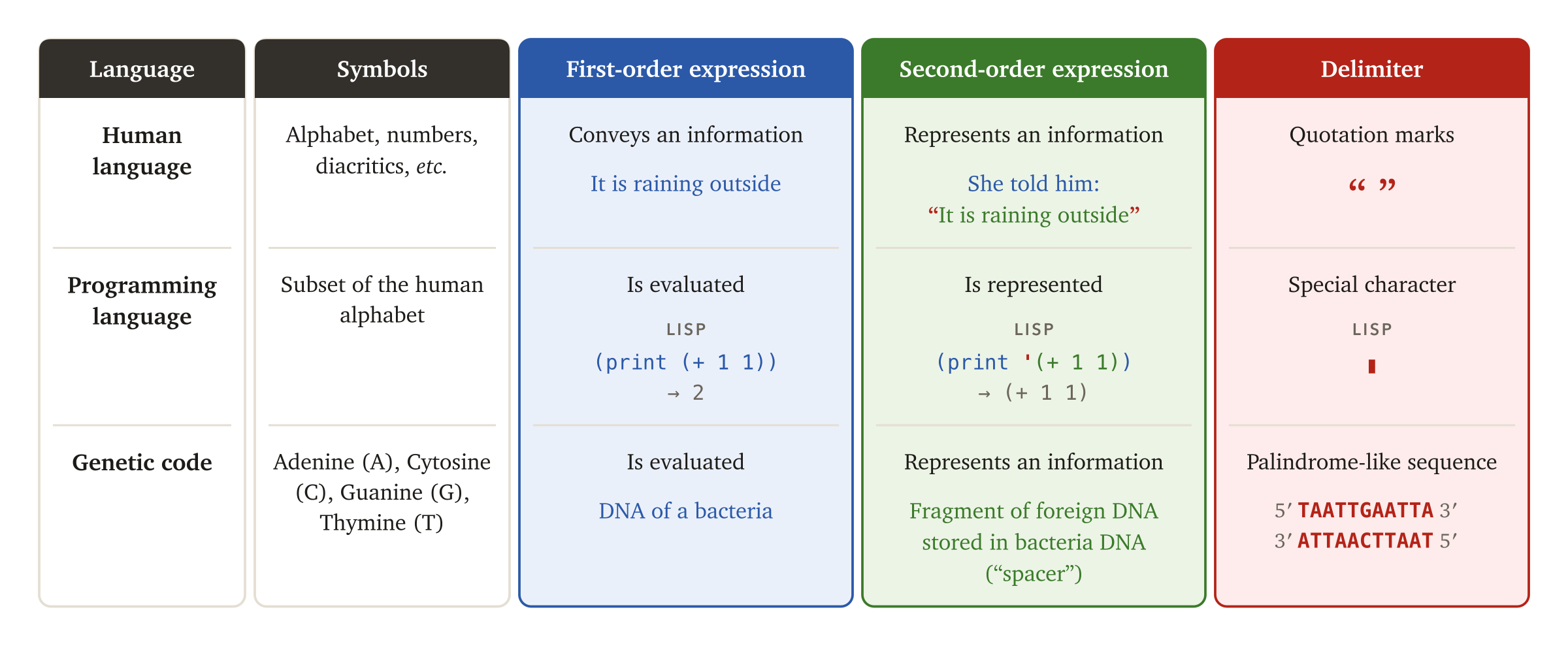
One duality, three languages.
Open Questions About AI
There are certainly more examples, and I wonder in particular whether there is a connection between artificial intelligence and this duality: [(Update November 2026) There does seem to be a connection. I explore it further in my later articles on special tokens in LLMs and XML tags in Claude.]
Can models infer by themselves the existence of first- and second-order expressions and the role of delimiters in switching between them?
Could this duality be leveraged to reinforce models’ security by making them inherently distinguish pure knowledge representation from information evaluation during the training stage?