Loading the graph…
Myst IV: Revelation (2004) is the fourth game of the Myst series, a point-and-click adventure game developed by Ubisoft Montreal. This page draws every node of its original English release and the references between them, as a graph and, since the game stores where each node stands, as a map.
Read the articles:
Want to see the Myst Graph, the Riven Graph or the Exile Graph instead?
Questions about this graph, or a find of your own?
Try: w5_z01_n010, where a new game begins; w3_z01_n010, the arrival in Spire; w1_z01_n021, a fixed view; w3_z02_n080, a virtual target named by a command. A zone matches all its nodes: w4_z06.
To see the shortest path between two nodes, fill the Path row above, or open one of these:
- w5_z01_n010 to w1_z01_n310, 18 edges: from the first node of the game to the first node of the night.
- w5_z01_n010 to w4_z01_n010, 32 edges: to the arrival in Serenia.
- w5_z01_n010 to w2_z02_n010, 40 edges: to the arrival in Haven.
- w5_z01_n010 to w3_z01_n010, 40 edges: to the arrival in Spire.
- w5_z01_n010 to w2_z05_n171, 74 edges: the node farthest from the first one, at the end of Haven.
- w2_z05_n171 to w4_z06_n330, 87 edges: the longest shortest path, from the end of Haven to the Dream of Serenia.
A path follows the drawn references only, with the model of the articles: no puzzle state and no Zip mode. It is a distance between nodes, never a walkthrough. A path shown in the graph stays red in the map.
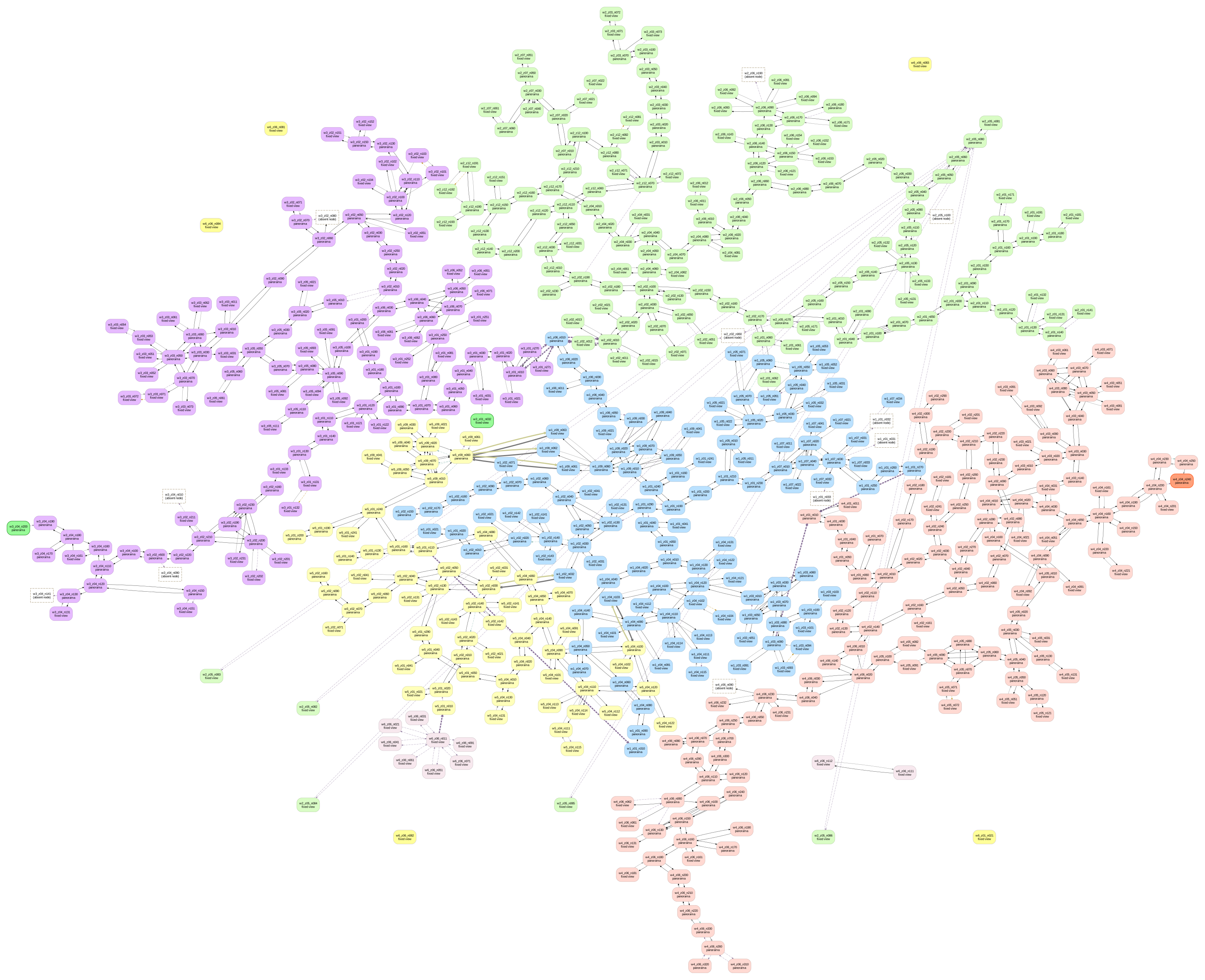
Each box is one node of the original English release of Myst IV: Revelation (version 1.0, 2004, two DVDs), or an explicitly marked virtual target. A label such as w5_z01_n020 is the name the game gives the node: world 5, zone 1, node 20. The second line says whether the node is a panorama or a fixed view. The drawing contains 618 stored nodes, 11 virtual targets and 1,355 typed connections: 1,031 moves, 209 returns from a fixed view, 95 references served by compiled code, 9 visions of the amulet, 2 automatic references and 9 commands that nothing stored starts.
A panorama is one box: turning inside it is not a connection. Dashed purple strokes are the references that compiled code serves; dashed green ones are conditional or automatic; gray ones are returns from a fixed view; a thick stroke in the border color of its source Age leaves that Age. Hollow arrowheads mark what path search leaves out: the 9 commands that nothing stored starts, and 10 returns from fixed views that several nodes enter, each of which belongs to the node the player came from. 63 connections are inferred, and their tooltips say so.
The map places each node where the game stores it. The game keeps the positions of each Age in that Age’s own axes and does not say where one Age lies from another. “All Ages” therefore joins them where the game links them, a choice of this page: each Age keeps its stored shape, scale and heights, turned about the vertical, and the node where the game enters it stands beside the node of Tomahna by night that leads to it, at the same height. Tomahna by day and by night is one place, stored twice with the same positions: by day stands above by night, joined where the game passes from one to the other. A line joins two nodes that a reference joins, in the color of the graph; a thicker line joins two Ages. The pages of the menu have no place and are left out of the map, and so are the 30 nodes that store no picture: their positions are copies of other nodes’ positions.
Path search retains 1,336 ordered pairs; the node farthest from the first one is 74 edges away and the finite diameter is 87. Source, sink and isolated markers describe the displayed references. Conditions are recorded, not executed, so these paths are not walkthroughs.
The SVG contains no picture or media file from the game. Open the complete vector drawing.